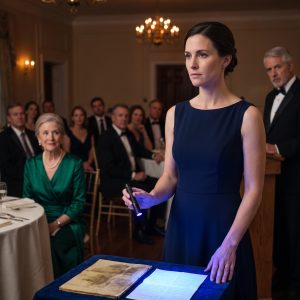
My uncle claimed the whole orchard and gave me the garage. One missing line on a seven exposed a forged will and changed everything.
“You get the garage, Wren. Grandpa was very clear about that.”
Uncle Desmond said it with a smile and slid the will across the dining table like he was serving dessert.
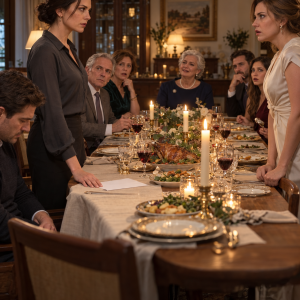
Twenty relatives sat in my grandfather’s farmhouse, in the room where I’d learned to crack walnuts at six years old. Every one of them looked at me. Not one looked surprised.
“The orchard, the house, the land, and every account go to me,” Desmond went on. “He said you’d understand. You always did like dusty little corners.”
His wife, Priscilla, laughed into her wine glass.
“It’s a shame, sweetheart. Twelve years squinting at old paper for a living, and you never checked the paper that mattered.”
I kept my hands folded on the table.
She was right about the twelve years. I’m a forensic document examiner. Courts hire me to say whether a signature is real or fake, and they hire me because I’m almost never wrong.
She was wrong about the paper.
“Signed three weeks ago,” Desmond said, tapping the last page. “October seventh. Witnessed, notarized, done.”
Mr. Abernathy, the family attorney, cleared his throat. He stared at the table instead of at me.
“It arrived at my office already executed,” he said quietly. “I filed it as instructed.”
“Instructed by whom?” I asked.
Desmond’s smile slipped for half a second.
Then it came back, wider.
“Don’t make this ugly, Wren. Take your garage and your little magnifying glass and go home.”
Somebody’s cousin snickered.
I’d love to say I stayed calm because I’m brave. The truth is I’d been studying that last page since it landed on the table, and I had stopped listening to my uncle a minute ago.
“May I see it?”
“Be my guest,” he said, laughing. “Go ahead. Find something.”
I pulled a loupe from my bag. Grandpa gave it to me when I was sixteen. “Look closer than everyone else, Wren,” he’d said. “That’s the whole trick.”
The room went quiet. One breath. Two.
Then I stood up.
“Grandpa signed his name the same way for eighty-eight years,” I said. “He lifted his pen twice inside the W. He pressed hard on the downstroke. And he crossed every seven he ever wrote. Every single one.”
Desmond stopped smiling.
“The date on this page says October seven. Look at the seven, Uncle Desmond. There’s no cross.”
Nobody breathed.
“And that signature wasn’t written. It was drawn, slowly, by someone who never learned to be him.”
His chair scraped back.
I set the loupe beside the page and looked him dead in the eye.
“You meant the garage as my punishment. It’s about to be the worst mistake you ever made.”
“A missing cross on a seven proves nothing,” Desmond said. “Old men get sloppy.”
“Old men do,” I said. “Forgers get sloppy faster.”
Priscilla set down her glass. “You can’t accuse family of a crime because you’re bitter about a garage.”
“I’m not accusing anyone yet. I’m reading a document.”
I turned to Mr. Abernathy. “Keep this original in your safe tonight. And I need the notary’s name.”
He glanced at Desmond. Desmond nodded, too quickly. “Give her whatever she wants. She’ll be embarrassed by morning.”
That’s when I knew he had never looked at that page under magnification. He thought the forgery was finished.
“Colette Voss,” Abernathy read. “Commission stamp, dated October seventh.”
“Thank you.”
Then I did the thing my uncle had mocked since I was twenty-two. I switched on my pocket lamp, tilted it low across the signature, and held the loupe steady.
Under the raking light, the ink wasn’t smooth. It wobbled in tiny beads at every curve, the way a hand moves when it’s afraid of leaving the line. Real signatures flow. This one crept.
And beneath the ink, so faint most people would swear it was a shadow, ran a thin gray line.
Pencil.
Someone had drawn Grandpa’s name first, then inked over it.
Desmond leaned across the table. “Shadows. Paper grain. You’re grasping.”
“Sit down,” I said gently.
To my surprise, he did.
“Here’s the thing about tracing,” I said. “You need something to trace from. A genuine signature, recent enough to be the same size, old enough that nobody would remember it.”
His jaw twitched.
“Grandpa kept every paper he ever signed. In his garage.”
For the first time all evening, my uncle looked at the door.
“Funny,” I said. “It’s the only room you ever offered me.”
I was at the garage by six the next morning, with a thermos of coffee and every lamp I owned. The padlock was untouched. Desmond had never imagined it was worth guarding.
Grandpa’s garage was less a garage than a library of everything he had ever touched. Forty years of invoices, loan papers, seed orders and receipts, filed by year in gray cabinets, every drawer labeled in his cramped handwriting with its crossed sevens.
Desmond had meant it as an insult.
He had accidentally handed me the evidence room.
It took two hours to find it: a 2022 equipment loan renewal, signed in blue ink. I scanned it at high resolution, printed it onto clear film, and laid the film over the signature on the will.
Every curve lined up. Every loop. Every tiny hesitation of the pen.
“Nobody signs their name the same way twice,” I told the empty garage. “Not even you, Grandpa. Only a tracing repeats.”
Then, behind a loose panel in his workbench drawer, where he used to hide butterscotch candies from the grandkids, I found a cream envelope with my name on it.
Inside was a will dated last April, signed by Grandpa and witnessed by two of his oldest pickers, along with a letter.
I didn’t open the letter. Not yet. I had somewhere to be.
At ten o’clock I walked into the dining room. Desmond and Priscilla sat at the head of the table with fresh coffee, looking comfortable. Mr. Abernathy sat near the window, gray-faced, with his phone in his hand.
“Wren asked me to make two calls last night,” he said. “I think the family should hear the answers.”
He put the phone on speaker.
“Colette Voss.”
“Ms. Voss, did you notarize a will for a Walter Hale on October seventh?”
“I’ve never heard of a Walter Hale,” she said. “On October seventh I was at my daughter’s wedding, three states away. My stamp was taken from my car in September. I filed a police report.”
Priscilla’s hand froze on her cup.
“The second answer,” Abernathy said, and slid a printout onto the table. “Mr. Hale was admitted to the hospital on October fifth. He was sedated the entire day of the seventh. He could not have signed anything.”
“This is absurd,” Desmond said, standing. “Anyone can claim anything.”
I placed the clear film over the will and pushed it toward him.
“Real signatures drift, Uncle Desmond. This one didn’t, because it was copied from this.”
I set the 2022 loan renewal beside it.
“And the seven,” I added softly. “Grandpa never forgot the cross. You did.”
Nobody in that room made a sound.
“You said it would be fine,” Priscilla whispered. Her face had gone the color of paper. “You promised me, Desmond. You said nobody would look.”
“Be quiet,” he hissed.
“You told me the stamp was easy!”
“Priscilla!”
The door opened. Mr. Abernathy had called the sheriff’s office at eight, and a deputy stood in the doorway holding a folder. She didn’t raise her voice. She didn’t need to.
Desmond looked around the table for anyone to defend him. The cousin who had snickered was studying the floor. Aunt Marian, who had called me “sweet but impractical” the night before, wouldn’t meet my eyes.
He turned to me last.
“Why the seven?” he asked, and his voice cracked. “Why did you have to look so closely?”
“Because he taught me to,” I said.
They left within the hour, one on each side of the deputy, still arguing. The forged will was voided before lunch. Grandpa’s real one took its place, and every relative who had laughed at the garage learned what was in it.
The orchard, the land and the farmhouse went to me, with a trust that guaranteed every picker who’d worked his rows a job for life. Everyone else received something modest and fair. Desmond received the price of his own trouble.
That afternoon I walked out to the oldest walnut tree, sat in the grass where Grandpa used to rest, and finally opened the letter.
Wren, everyone else in this family looks at what I own. You’ve always looked at what’s real. Take the orchard, but keep the habit. It’s worth more.
I read it three times. Then I cried, quietly, for the first time since the funeral.
Some people inherit land. I inherited the way he taught me to see, and this time I used it to save everything he loved.