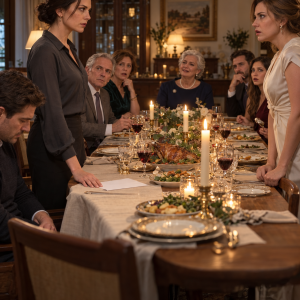
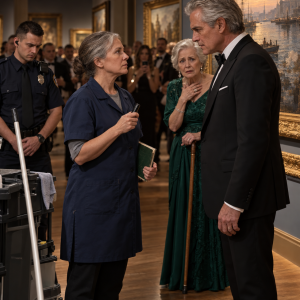
Her aunt-in-law called her the help at a charity auction. Then a UV lamp exposed a forged letter, a forged signature, and one very public lie.
I was the only person in the ballroom who knew the star lot was a fake, and I had known for an hour.
The letter sat on a velvet stand at the preview table. It claimed to be written by Captain Elias Thorne in 1853, and it was the crown jewel of the Whitlock Historical Society’s Founders’ Auction.
I bent over it with the loupe I always carry. I authenticate historical documents for the state archive. It’s the only job I’ve ever wanted.
Held up to the window, the paper showed a watermark from a mill that didn’t open until eighty years after Thorne died.
I found Daniel’s aunt in the hallway, adjusting her pearls.
“Lorraine, that letter can’t be from 1853. The paper is wrong.”
She didn’t even turn around.
“Tessa, dear, you file things for the county. I’ve been dealing with collectors for forty years.”
“I examine documents for the state. That’s not the same as filing.”
“Of course it isn’t,” she said, and patted my cheek like I was a child.
My husband stood two steps behind her. I looked at him.
Daniel studied his shoes.
“Not tonight, Tess,” he murmured. “Please.”
So I said nothing more. I went to my assigned seat, a folding chair at the staff table by the kitchen door, between two caterers who kept apologizing to me.
At seven, Lorraine tapped the microphone.
“Thank you all for coming. And thank you to our little helpers, like my niece-in-law Tessa, who keeps the county’s cabinets tidy.”
Laughter rolled across the room. A woman at the front table said, loudly enough for me to hear, “Oh, is that the one who dusts?”
I smiled. My face is good at that.
For two years, I had spent every Saturday in the society’s damp basement, cataloging their collection for free. Lorraine had never once said thank you. She had only said that I “kept busy.”
The auctioneer stepped up.
“Lot one, ladies and gentlemen. A letter in the hand of Captain Elias Thorne. We open at forty thousand dollars.”
A silver-haired collector in the second row raised his paddle at once.
Lorraine glowed. “Forty. Do I hear fifty?”
I stood up.
My chair scraped the floor. Sixty heads turned.
“Sit down, Tessa,” Lorraine said sweetly, into the microphone. “Not now.”
“I’m sorry, Lorraine. It has to be now.”
I walked to the front in my navy dress, my hair pinned back. From my bag I took two things: a page I had carried up from the basement that afternoon, an authentic Thorne logbook leaf from the society’s own collection, and a black lamp no bigger than a lipstick.
I laid the logbook leaf beside the letter on the velvet stand.
“Lights, please,” I said to the waiter by the switch.
He looked at Lorraine. Then, quietly, he turned them down.
Lorraine Whitlock had spent forty years being the cleverest person in every room, and she had about ten seconds left.
I clicked on the lamp.
The genuine logbook leaf glowed a dull, sleepy brown, the way old paper does. Captain Thorne’s letter lit up a chemical blue-white.
A gasp moved through the room like wind through wheat.
“Modern paper is treated with brighteners,” I said, steady in the quiet. “Nothing from 1853 glows like that. This letter was made in the last few decades.”
Lorraine laughed. It was a beautiful laugh, warm and practiced.
“A parlor trick, everyone. Tessa has had a long week. Gerald, darling, don’t let a flashlight frighten you.”
The silver-haired collector, Gerald Ashby, kept his paddle low but didn’t put it down. Beside him, a woman in a gray suit opened a leather notebook. I later learned she was his attorney.
“Mrs. Whitlock,” Gerald said carefully, “is there a certificate of authenticity?”
“Naturally.” Lorraine plucked a small card from the stand and held it high. “Authenticated by the State Archive Conservation Office. Signed, Tessa Brandt.”
She turned to me with a smile I will never forget.
“Your own signature, dear. You can hardly call your own work a fake.”
The room went quiet in a new way.
I took the card from her fingers. It was heavy cream stock, embossed with the archive’s seal. At the bottom, in blue ink, was my name.
It was a very good copy. But I have studied ten thousand signatures under magnification, and a signature isn’t a picture. It’s a movement. This one had been drawn slowly, by someone afraid of getting it wrong.
I turned the card over.
On the back, in pencil, was a short note in handwriting I had read on birthday cards for six years.
I read it once. Then I looked up.
“Lorraine,” I said, “you have one chance to tell them where this card came from before I read the back out loud.”
Lorraine’s smile held for exactly as long as it takes to choose a lie.
“I have no idea what that scribble is. Some clerk’s note. Tessa is embarrassed, that’s all.”
“All right,” I said, and read it aloud.
“‘Vale. Twenty-four hundred, cash. Copy on aged stock. Card by Friday. Practice T.B. signature, twenty times.'”
Nobody breathed.
“That’s your handwriting, Lorraine,” I said gently. “The looped L. The way you cross your sevens. I’ve catalogued forty of your letters for this society. I’d know it anywhere.”
“That proves nothing,” she snapped, but her voice had lost its warmth.
I held out my loupe to Harold Pruitt, the society’s treasurer, who had come up beside me without my noticing.
“Look at the downstroke in the T,” I said. “Genuine ink flows. Here, the pen stops and starts. That’s what hesitation looks like. That’s someone tracing my name.”
He looked for a long time. When he straightened, his face had gone gray.
“Lorraine,” he said, “you told the board the state archive certified three lots.”
“And I’m telling you they did.”
“Actually,” said Gerald’s attorney, calmly turning a page in her notebook, “my client wired deposits totaling eighty-five thousand dollars last week against this lot and two others. All three came with cards like this one.”
Nobody spoke.
Lorraine looked around the ballroom for a friendly face, and found none. Then she found her nephew.
“Daniel,” she said, her voice cracking for the first time. “Tell them. Tell them she’s confused.”
My husband stepped out of the crowd.
I had spent six years watching him look at his shoes. That night he looked at her.
“Two weeks ago, I watched you sit at the kitchen table and write Tessa’s name over and over,” he said. “You told me it was for a birthday card. I knew it wasn’t.” He swallowed. “I knew, and I said nothing. That’s on me. But it’s not on her.”
Harold Pruitt took the microphone from the auctioneer’s trembling hand.
“Lot one is withdrawn. Lots four and nine are withdrawn. Every deposit will be returned tomorrow morning. The board will meet Monday, and Mrs. Whitlock will not be chairing it.”
Lorraine stood alone at the front table, pearls trembling.
“After everything I’ve done for this family,” she whispered.
“You put my name on a lie,” I said. “That’s what you did.”
By Friday, she had resigned from every seat she held. The society refunded every deposit and sent written corrections to every buyer of every lot she had ever certified. The archive’s counsel opened a formal inquiry into the misuse of the state seal, and Lorraine, who had never once been made to explain herself, hired her first lawyer.
I found Daniel in the parking lot that night, leaning on the car.
“You watched her practice my name,” I said, “and you told yourself it was a birthday card.”
“Tell me what to do,” he said. “Anything.”
“Not tonight.” I was surprisingly calm. “I’m not doing the next part of this for you.”
I drove home alone.
The following Saturday, I went back to the basement. This time the new board had a contract waiting for me, with a salary and my title spelled correctly: Conservator.
Lorraine always said I kept busy filing things. She was right. I had filed the truth where only I knew how to find it, and on the one night it mattered, I opened the drawer.