The chairman called me “the help” and cut my fee. Then I opened my logbook and showed a hall full of donors where their money went.
I was tuning the hall’s new centerpiece when Gerald Fenwick told me to stop getting in the photographers’ way.
My name is Tamsin Hale. I tune pianos for a living, and I have perfect pitch, which is mostly a curse at parties.
I pressed the A above middle C. It rang thin, with a faint buzz underneath, like a bee trapped in a jar.
I pressed it again. My stomach dropped.
That was not the sound of a 1911 concert grand. That was a modern factory piano with cheap strings and a glued soundboard.
I knew, because I had tuned the real one for eleven years.
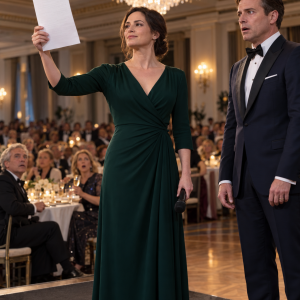
“Miss Hale.” Gerald’s voice carried across the stage. He chaired the Aldermere Hall board: silver hair, tuxedo, a smile always aimed at somebody’s checkbook. “Are you finished?”
“Almost. Mr. Fenwick, where did this piano come from?”
The donors nearby stopped talking.
“It’s the restored Whitcombe Grand,” he said, beaming at them. “Three hundred and eighty thousand pounds of your generosity, brought back to life.”
“It doesn’t sound like the Whitcombe.”
A few people laughed. Gerald didn’t.
“Tuners tune,” he said. “They don’t have opinions. Next time, use the service entrance. And don’t expect your full fee. Forty minutes, wasn’t it?”
“Three hours.”
“Then you’re slow.” He turned to the crowd. “The help always thinks it knows better.”
Somebody snickered. A woman in pearls glanced at my work boots and looked away.
My face burned. I did not cry. I closed the lid gently and picked up my canvas bag.
Then the guest pianist, Adrian Lowe, who was due to play at seven, stepped toward me. “Is something wrong with it?”
“Ask Mr. Fenwick to lift the lid,” I said, loud enough for the front row. “The maker’s plate is stamped inside the frame. Read the year on it.”
“That’s enough,” Gerald said.
Adrian was already looking. “Twenty nineteen,” he read.
Nobody laughed now.
“The Whitcombe was built in 1911,” I said. I unzipped my bag and took out a green cloth logbook, soft with age. “I tuned it every year for eleven years. And three weeks ago, I tuned it again.”
“Impossible,” Gerald said. “It’s right here.”
“No. It’s in a converted barn outside Harrogate, under a dust sheet. You hired me to tune it there, and you told me to keep it quiet.”
The hall went so silent I could hear the ventilation hum.
I opened the logbook to the last page and held it up. His signature sat right beside mine.
Gerald had told these people the restoration was finished, and within ten minutes every one of them would learn exactly what he’d done with their £380,000.
Gerald recovered faster than I expected.
He laughed, a warm, practiced boardroom laugh, and spread his hands to the donors. “Friends, this is a contractor with a grudge because I trimmed her invoice. Anyone can scribble in a notebook.”
He didn’t look away from me as he added, “Security.”
Two men in black jackets started up the aisle.
I didn’t move. “You’re right, Mr. Fenwick. A notebook can be faked. So let me play you something that can’t.”
I took out my phone. “Every time I tune, I record a reference tone for the maker’s file. It’s habit. It’s also a timestamp.”
I held it to the microphone and pressed play.
A single A filled the hall, deep and warm, with a slow shimmer in the upper strings. Nothing like the buzzing thing on that stage.
Then my own voice: “Whitcombe, Fenwick barn, Harrogate, third of September.”
Then a second voice, unmistakable. “Keep it quiet, Tamsin. The board doesn’t need the details.”
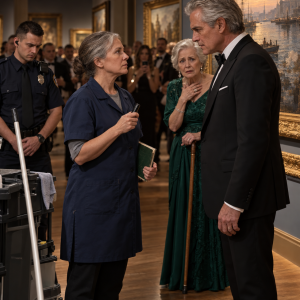
Someone in the second row gasped. An older woman in a navy coat rose slowly. “That’s Gerald,” she said.
The security men stopped walking.
For the first time, his smile slipped. Then it returned, wider than before. “Edited. Anyone can fake a voice these days. Do you know who I am? My solicitors will have you bankrupt by Monday.”
“Do they know about the second recording?” I asked.
He shrugged. He was so sure of himself he actually shrugged.
The second file had a bank account in it, and the hall’s treasurer was sitting six feet from him.
I pressed play again.
This one was a phone call. Gerald had taken it in the barn while I packed up my tuning lever, and I’d left my phone recording on the piano lid, half by habit and half by instinct.
“Four hundred and ten thousand, paid to Fenwick Heritage, as agreed,” his voice said, bright and easy. “The piano ships on the fourteenth. The hall thinks it’s still being restored. I’ve bought them a replacement for thirty. Nobody ever reads the plate.”
He gave the account number twice, slowly, the way you do for someone you think is writing it down.
The navy-coated woman in the second row was Margaret Doyle, the hall’s treasurer. She had gone white.
“Fenwick Heritage Limited,” she said. “Gerald, that’s the company I’ve been paying restoration invoices to since January.”
“Margaret, sit down.”
“No.” Her voice shook, but she didn’t. “You told me not to look at the piano because the dust would ruin it.”
Gerald tried the smile again. It didn’t take. He glanced at the side door, and I watched him measure the distance.
Adrian Lowe, still standing beside the false Whitcombe, spoke quietly into the silence. “You’re welcome to leave, Gerald. The police will still know where you live.”
That did it. Harold Whitfield, the deputy chair, a retired magistrate who hadn’t said a word all evening, walked up the aisle and held out his hand. “Your chairman’s medallion, please. And your phone.”
Gerald looked at the donors. At the woman in pearls. At the men who had written him cheques over dinners he’d hosted. Nobody looked back at him kindly.
He took off the medallion. His hand was not steady.
Margaret was already dialling the fraud line, on speaker, so everyone could hear that she meant it. By ten o’clock two officers had taken Gerald’s statement, and by midnight the account at Fenwick Heritage was frozen. Officers reached the barn in Harrogate the next morning. The real Whitcombe was there under its dust sheet, crated for shipping, two days before its flight.
Adrian refused to play the fake. The gala didn’t happen, not the way Gerald had planned it. Instead the donors gathered in the lobby, and Adrian played the old upright from the rehearsal room, the one I’d tuned that same morning, as an afterthought, between arguments. Every key was true. Nobody talked through a single note.
Afterward, the woman in pearls came over. She looked at my boots this time, then at my face. “I owe you an apology,” she said. “I’m sorry.”
“Thank you,” I said, and I meant it.
Six weeks later the Whitcombe came home. It took eight men and a lot of blankets to get it onto the stage. Margaret paid my full invoice, plus the fee Gerald had cut, and then she asked me if I’d consider becoming the hall’s resident piano technician, with a salary, a proper contract, and a key to the front door.
I took the job. On the first day, I used the front door.
The investigation is still going. Gerald has been charged with fraud, and the last I heard, his solicitors had stopped returning his calls. Most of the donors’ money has been traced and recovered.
On opening night I sat in the back row and listened to the real Whitcombe, deep and warm, the shimmer in its upper strings exactly where I remembered.
Gerald had told a room full of people that tuners don’t have opinions. He was right. We have ears, and mine had never once been wrong.