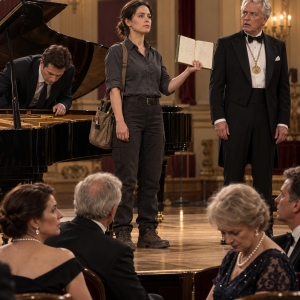
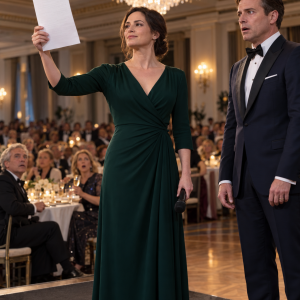
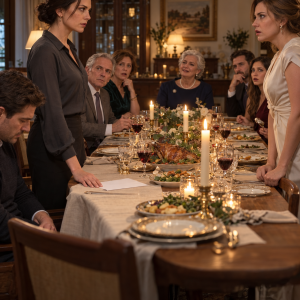
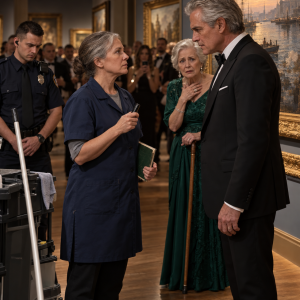
A gala waitress is accused of theft in front of 200 donors. She’s a former court reporter with a perfect record of what the director really said.
For twenty-six years I was a court reporter, which means I can’t un-hear a sentence.
Every word spoken near me still lands in my head in order, with the time attached. My hands never quit the habit either. Give me any pad and pen, and I’ll fill it with shorthand without meaning to.
When the county shut down my courtroom to cut costs, I took whatever work I could find. That night it was a gala for the Harbor Lights Children’s Foundation, carrying crab puffs through a ballroom of two hundred donors.
At 7:42, I passed the silent-auction table and heard the foundation’s director speak to his treasurer.
Grant Halloran had the kind of smile that always looked rehearsed. It wasn’t there now.
“Post the paddle-raise total as one eighty-six,” he told her. “The rest goes to discretionary. Nobody reads the fine print.”
I kept walking. In the service hallway, I wrote it all down. Time. Words. Both voices.
Then I went back to work, because that’s what you do when you’re the help.
At 9:15, the microphone squealed.
Halloran stood on the little stage, one hand pressed to his chest.
“I’m heartbroken to announce that the raffle cash box, nine thousand four hundred dollars meant for sick children, has vanished.”
Two hundred faces turned toward him. Then he pointed at me.
“She was the last person near that table.”
I set down my tray. “Mr. Halloran, I was only…”
“Empty your pockets.”
Two security guards flanked me. Halloran walked down from the stage and yanked the apron off over my head. My order pad and pen skittered across the marble.
Someone laughed. Phones lifted.
“Disgraceful,” a woman in pearls murmured. Her husband said, “Call the police.”
Halloran leaned close, his voice low enough that only the first few rows could hear.
“Nobody will believe you. You’re a waitress.”
My face burned. I did not cry. I had not cried in a courtroom in twenty-six years, and I wasn’t going to start in a ballroom.
I looked at the clock above the stage. 9:19.
Then I did what I’d done ten thousand times in court. I straightened my back and spoke for the record.
“Mr. Halloran, at 7:42 tonight, beside the silent-auction table, you told Ms. Prewitt, and I quote: ‘Post the paddle-raise total as one eighty-six. The rest goes to discretionary. Nobody reads the fine print.'”
The ballroom went silent.
Ms. Prewitt’s champagne glass slid from her fingers.
“At 8:31, at the coat check, you said: ‘Find someone from the catering staff. Someone nervous.'”
Halloran’s smile cracked.
“I have every word you spoke tonight, with the time beside it,” I said. “And I know what this room actually raised.”
Nobody moved.
* * *
Halloran recovered fast. I’ll give him that.
He laughed, loud and easy, and spread his hands to the room.
“Ladies and gentlemen, our staff is very creative tonight.”
A few donors chuckled. Nobody chuckled loudly.
“Anyone can invent quotes,” he said, glancing at my name tag. “Do you have a recording, Ms. Marsh?”
“I have twenty-six years as a certified court reporter,” I said. “I don’t need a recording. I am the recording.”
He stepped closer, smile stiffening, voice low again.
“You’re a waitress with a hobby. I’m the director of this foundation. Who do you think they believe?”
“Let’s find out.”
I picked my order pad up off the marble. In the front row, a silver-haired man had been staring at me for a full minute.
“Judge Pruitt,” I said. “You had me in your courtroom for six years.”
The retired judge rose slowly, leaning on his cane.
“Dolores Marsh,” he said. “In six years, she never once got a word wrong. If she reads it, I’ll stand behind it.”
Halloran actually smiled at that. It was his mistake.
“Fine,” he said. “Call the sheriff. Search whatever you like. There’s no box to find and no paper to read.”
He was too calm. He’d already done something he thought made him safe.
I opened the pad. Row after row of shorthand, every entry timed.
“The paddle raise closed at 8:58,” I said. “Forty-one paddles, and I have every number. The board behind you says $186,000.”
I looked up.
“The room raised $231,400.”
Gasps rolled across the ballroom. Ms. Prewitt sat down hard on the nearest chair.
“And at 8:44,” I said, “I watched you close the trunk of your car on a gray tote. It didn’t go to the kitchen.”
So I turned to the off-duty deputy at the doors, told him which parking row to check, and promised the room that by the time he came back, Grant Halloran would have nothing left to smile about.
* * *
Deputy Anita Cole didn’t move right away. She looked at Halloran.
“Sir, if there’s nothing in your trunk, this takes two minutes.”
“This is a circus,” he said. “I don’t consent to anything.”
“Then I’ll walk out with you,” said Judge Pruitt, “and we’ll ask again in the parking lot.”
Constance Whitcombe, the board chair, rose from her table. She hadn’t said a word all night.
“The foundation consents, Deputy. Ms. Marsh, where?”
“Row C. Silver sedan, third space,” I said. “I carried a crate out the dock door at 8:44 and saw him shut the trunk on a gray tote.”
They left. Halloran tried to follow. The two security guards, the same two who had flanked me, stepped in front of the doors and looked at Constance. She nodded once. They didn’t move.
While we waited, I did what I’d promised. I read the paddle numbers aloud, one by one, and the ballroom listened like a jury. By paddle nineteen, Ms. Prewitt was on her feet.
“Stop,” she said, her voice cracking. “He told me it was a bridge fund. He said the board knew. It’s been three years, every gala. I’m so sorry.”
Halloran didn’t look at her. He looked at the door.
Eleven minutes later, it opened.
Deputy Cole carried the gray tote in both hands. Inside was the raffle box, sealed, all $9,400 still in it. Beneath it lay a folder of bank statements for an account titled Halloran Advisory Group, with a deposit landing every Monday after every gala for three years.
Nobody spoke. Then Judge Pruitt said, “Well.”
Constance Whitcombe walked to the stage and took the microphone Halloran had left behind.
“Grant, you are suspended, effective immediately. The county prosecutor will hear from me in the morning.” She turned to the guards. “Please see Mr. Halloran out.”
They walked him across the same marble floor. Phones lifted. Nobody laughed.
He passed within a foot of me and said nothing. I didn’t need him to.
At 10:40, the true total went up on the board: $231,400, every dollar for the new children’s ward. The woman in pearls crossed the room and told me she owed me an apology. I said it was accepted, and I meant it. Then she wrote a check for the ward, and so did half the room.
The audit confirmed every figure to the penny. I certified my notes myself. By spring, Halloran had resigned, pleaded guilty to theft by deception, and agreed to repay every dollar. Constance’s board offered me a standing contract to keep the foundation’s meeting records. I said yes.
I hadn’t cried in that ballroom. I cried at my kitchen sink at midnight, quietly, with the water running. It was for twenty-six years of standing in the corner of every room, taking down what powerful people said and being trusted with nothing else.
Then I dried my hands, picked up a pen, and wrote the night’s last line in shorthand.
Grant Halloran told a ballroom that nobody reads the fine print. He never noticed the woman who had been writing it down her whole life.