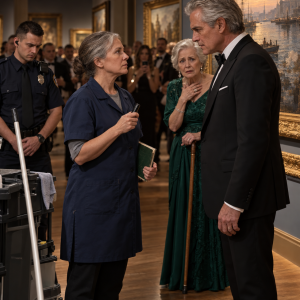
They accused me of stealing $212,000 at a family dinner. They forgot I’m the one person in the room who can prove whose handwriting it was.
Ingrid Brandt tapped her wine glass with a butter knife until the whole table went quiet.
“Before dessert,” she said, “we have a family matter.”
Nine of us sat around her long oak table, celebrating forty years of Brandt Marine Supply. Candles. Roast lamb. The good china.
I sat halfway down, beside my husband, Theo.
Here is what none of them knew. For fourteen years, I’ve been a certified forensic document examiner. I testify in court about forged wills, altered contracts, and handwriting that lies.
I can’t read a birthday card without noticing pen pressure. I can’t watch someone sign a receipt without seeing what their hands are hiding.
The Brandts believed I “pushed papers at the county building.”
I never corrected them. Being underestimated is quiet, and quiet had always been easier.
“Colette,” Ingrid said. “Go ahead.”
My sister-in-law stood. She ran the company’s front office and wore her importance like perfume.
“Two hundred and twelve thousand dollars left our account in March,” she said. “One transfer. One authorization.”
She slid a single page down the table. It stopped in front of me.
“Signed by Nora.”
Nobody breathed. Aunt Pilar set down her fork.
“For two years,” Colette went on, “Nora has reconciled our books on Sunday nights. Unpaid. Trusted. Alone.”
“You asked me to do that,” I said quietly.
“And you took advantage,” Ingrid snapped.
I looked at Theo. He was studying his napkin as if it held instructions.
“Here is what will happen,” Ingrid said. “You’ll sign over your share of the lake house, you’ll return whatever is left, and we will not call the police.”
“Mom,” Theo murmured.
That was it. That was his whole defense.
Colette smiled at me. Small. Sure of herself.
“Go on, Nora. Look at it. It’s your handwriting.”
So I looked.
It was my signature. The looped N, the flat tail on the a. Whoever made it had studied me carefully.
It was also the slowest signature I had ever seen.
Real signatures move fast. This one crawled. Ink pooled at the start of every stroke, and the pen had lifted four times inside a name I write without lifting once.
Someone had traced me.
I set the page down, stood, and looked straight at my sister-in-law.
“This is impressive work, Colette. Truly. Who taught you?”
Her smile flickered. “I don’t know what you mean.”
“Then I’ll say it plainly, so everyone can hear.” I turned to the table. “I’m a certified forensic document examiner. I have been for fourteen years.”
Mr. Osei, the family attorney, put down his glass.
“And that is not my signature.”
Ingrid laughed, but it came out thin. Colette’s hand found the back of her chair.
She had traced one signature. She had no idea I’d kept a copy of every page she ever handed me, and before the lamb went cold, this whole table would know whose handwriting was really on it.
“A hobby,” Ingrid said. “You picked up a hobby, and now you’re calling my daughter a criminal.”
“Mr. Osei, would you seal that page in an envelope? Nobody touches it again.”
He hesitated. Then he pulled an envelope from his briefcase, slid the page inside, and initialed the flap.
Colette recovered fast. Too fast.
“Let her call whoever she wants.” She reached for her wine. “I’ve run this company’s paperwork for ten years, Nora. Who do you think a bank believes?”
“Whoever is right.”
“That’s me,” she said, and smiled at the table like she’d already won.
I took out my tablet.
“Every Sunday for two years, I scanned each page before I filed it. Old habit. It’s a little over four thousand pages, and every one carries a date.”
Colette’s smile stayed put. It just stopped reaching her eyes.
“The transfer is dated March fourteenth,” I said. “That entire day, I was on a witness stand two counties away. There’s a court transcript with timestamps.”
“You could have signed it earlier,” Ingrid said.
“I didn’t sign it at all. It’s a tracing.” I looked at Colette. “Nobody traces from thin air. A forger needs a genuine sample of my hand. Someone in this house had one.”
Aunt Pilar’s fork rang against her plate.
“That’s absurd,” Colette said. “You can’t prove…”
“Last February, I wrote Ingrid a birthday card. Four lines and my signature.” I turned toward the head of the table. “Ingrid, where is that card?”
Ingrid opened her mouth.
Before she could answer, Colette’s chair scraped back, and I knew exactly where the card had gone.
“It’s in my study,” Ingrid said. Her voice had lost its edge. “Top drawer. I keep all my cards.”
“Would you get it, please?”
She left. Nobody spoke. One candle guttered. Colette finished her wine in a single swallow.
Ingrid came back empty-handed. “It isn’t there.”
“She probably threw it out,” Colette said, far too quickly. “She throws everything out.”
“It doesn’t matter,” I said. “I photograph everything I sign.”
I set the tablet in the middle of the table and turned it so they could all see. Two signatures, one laid over the other. Mine from the card, in blue. The one on the transfer, in red.
They didn’t resemble each other. They were each other.
“Here’s what a forger can’t fake,” I said. “Two genuine signatures are never identical. Hands vary, even mine. Only a tracing matches perfectly.”
Nobody said anything.
“And one more thing.” I zoomed in on the tail of the last letter. “In February, my pen was running dry. It skipped here. A hairline gap, pure accident. I have never signed that gap before or since.”
I looked at Colette.
“It’s in your forgery. Exactly the same. You copied my mistake.”
Mr. Osei, who had barely moved all evening, cleared his throat. “Where did the money go?”
“An account registered to Pelican Row Kitchen,” I said. “A restaurant that opened in April. The payment posted in March under a vendor name I didn’t recognize, so I asked about it by email. Colette wrote back that it was a supplier and told me to drop it. I still have that email.”
Brent turned in his chair. “Colette. You told me the loan was approved.”
Her composure cracked all at once.
“It was temporary!” she said. “The restaurant was failing. I was going to put every dollar back before the audit, and who would ever question Nora? She never says anything!”
Silence.
Then, for the first time all night, my father-in-law spoke.
“Sit down, Colette.”
Walter Brandt hadn’t raised his voice in years. He didn’t need to.
“You will resign in the morning. Mr. Osei will call the bank and the authorities. Every dollar comes back, and you will answer for the rest.”
Colette looked at her mother. Ingrid looked at the tablecloth.
“Nora,” Ingrid said at last. “I accused you in front of everyone.”
“Yes. You did.”
“I was misled.”
“You didn’t ask if it was true,” I said. “You asked for my share of the lake house.”
For once, she had nothing to say.
Theo stood. “Nora, I…”
“You said ‘Mom,'” I told him gently. “That was your entire defense.”
He sat back down, ashamed.
I picked up my bag. Mr. Osei held the door.
In the car, I finally let my hands shake. Not from fear. From fourteen years of swallowing what I knew. Then I drove to my sister’s house and slept better than I had in months.
The bank froze the account on Monday. Most of the money came back within the month. Colette lost her job, her office, and her mother’s blind faith, in that order. Ingrid hasn’t hosted a dinner since.
Theo has spent months learning to say more than one word at a time. I’m still deciding what those words are worth.
They spent fourteen years calling me the quiet one. Not one of them ever asked what I was reading.