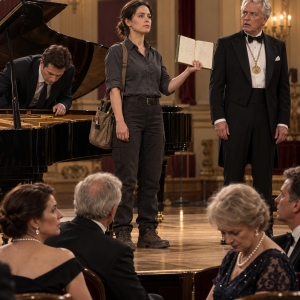
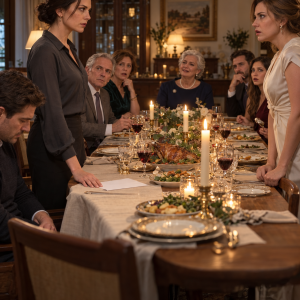
A night janitor was blamed for ruining a priceless painting. Her secret notebook and one small UV light exposed the museum director’s real crime.
I knew the painting was wrong before I ever touched a mop.
For twenty-six years I was the conservator at the Harlow Point Museum of Art. I could read varnish the way farmers read weather. Old resin smells faintly sweet, like a cedar chest. New varnish smells like a hardware store.
Then the museum “restructured” my department out of existence. Two years later I was cleaning its galleries at night, because I couldn’t stay away from the building.
On the evening of the donor gala, I rolled my cart past Harbor at First Light and stopped.
Hardware store.
I leaned closer. The brushwork was right. The signature was right. But the surface had a plastic shine that no painting from 1893 should have.
I told myself I was tired.
Then a voice boomed across the gallery.
“There she is.”
Dr. Graham Pruitt, the director, strode toward me in a tuxedo, with two hundred donors trailing behind him.
Mrs. Adelaide Fenwick walked at his side, gripping her cane. Her grandfather had given the museum that painting.
“Ms. Tully,” Graham said, loud enough for the whole room. “Would you like to explain this?”
He pointed to the lower right corner. A faint cloudy smear, the size of a thumbprint, marked the varnish.
“I don’t know what that is,” I said.
“I do.” He smiled at the crowd. “Someone wiped a priceless painting with a chemical cloth. This morning, while the gallery was empty.”
People gasped.
“I have never touched that painting,” I said.
“The security log says you were alone in this room at six a.m.”
“I was mopping the floor.”
Someone laughed. Someone else raised a phone.
Graham turned to Mrs. Fenwick. “Adelaide, I’m so sorry. The insurance deductible alone is two hundred thousand dollars. Ms. Tully will be held responsible.”
Mrs. Fenwick looked at me with real pain. “Marian, is it true?”
“No, ma’am.”
Graham stepped close and lowered his voice so only the front row could hear.
“Who do you think they’ll believe? The director, or the cleaning lady?”
Two guards moved toward me. The younger one, Teodor, wouldn’t meet my eyes.
My hands stayed steady. They had been steady for twenty-six years.
I leaned my mop against the cart and reached into my apron pocket for the two things I had carried every night since the day they fired me: a green field notebook, its cover soft with age, and a pen-sized ultraviolet light.
Graham’s smile slipped for half a second.
“Dr. Pruitt,” I said, “that smear isn’t mine. And that painting isn’t Elias Wren’s.”
“Turn off the lights.”
My thumb found the switch.
* * *
“The lights,” I said again. “Please.”
Nobody moved. Then Mrs. Fenwick lifted her cane and pointed it at the switch panel.
“Do as she says, Teodor.”
The gallery went dim. In the dark, Graham laughed.
“Ladies and gentlemen, indulge her. It isn’t every night the cleaning staff performs science.”
He sounded certain. That was his first mistake. He had never once wondered why I kept the notebook.
I pressed the little light to the frame and swept it across the canvas.
Old varnish glows a soft, greenish haze under ultraviolet. Modern synthetic varnish glows a hard, chalky blue-white.
The entire painting glowed blue-white.
A murmur rolled through the crowd.
Graham didn’t even blink. “Of course it glows. She soaked it in her solvents.”
“Then look at this.”
I opened the notebook to a page marked with a ribbon and held it beside the canvas. A printed photograph, dated three weeks ago. Same painting. Same light. The surface glowed a soft, even green.
“I photographed her every month,” I said. “On my own time. Long after you took my office.”
“Anyone can glue a picture into a book,” Graham said. He spread his arms to the room. “Shall we call the police about the vandal, or the fantasist?”
“One more thing,” I said.
I moved the light to the lower left corner.
“In 2009, this painting had a two-inch tear right here. I mended it from behind with linen thread and a hand-cut patch. Under ultraviolet, that repair glows like a scar.”
I let the beam rest there.
Smooth. Blank. Nothing.
Graham’s arms slowly lowered.
“The real Elias Wren has a mend in this corner,” I said. “This one doesn’t.”
Then I asked Mrs. Fenwick to have it taken off the wall, because a forger can copy anything except what I wrote where nobody looks.
* * *
Teodor and the other guard lifted the painting off its hooks. The whole gallery leaned in.
“This is theatre,” Graham said. “Put it back.”
“Turn it around,” said Mrs. Fenwick, in a voice I had never heard her use.
They turned it around.
The stretcher bars were pale and raw, joined by bright staples from a machine. No dust. No tags. No pencil.
“In 2009, I signed my mend on the back of this painting,” I said. “My initials, the date, and the words mended by hand. The wood I wrote on was more than a century old. This wood is less than two weeks old.”
Nobody breathed.
“She could have written that anywhere,” Graham said. His voice had gone thin.
“Could she?” said a calm voice from the back tables.
A woman in a gray suit stood. “Priya Nair, the museum’s insurer. Dr. Pruitt, three days ago you booked an emergency restoration transfer for this painting. A transport crew is waiting at your loading dock at nine tonight.”
She let that sit.
“You reported the damage this morning. You booked the truck three days before the damage existed.”
Graham opened his mouth. Nothing came out.
Teodor set down his end of the frame with great care. For the first time all night, he looked at me.
“Ms. Tully, I’m sorry,” he said. “On the fourteenth, Dr. Pruitt sent me home early. I forgot my badge and came back for it. There was a van at the dock. Two men carrying a flat crate.” His voice shook. “He told me it was a rotation, and that I’d be looking for work if I mentioned it. My wife is expecting.”
“Teodor, you’re finished here,” Graham said hoarsely.
“No, he isn’t,” said Mrs. Fenwick.
She crossed the floor, a small woman with a cane, and looked up at Graham for a long moment.
“My grandfather gave that painting to this town so ordinary people could stand in front of it,” she said. “You sold it to someone who would never let them look.”
“Adelaide, this is a misunderstanding—”
“You made that smear yourself,” I said quietly. “Wet varnish, dabbed on with a cloth. You needed a reason to pull the painting tonight, and someone to blame who could tell the difference. I was the only one left.”
He had no answer. The man who called me the cleaning lady simply stood there in his tuxedo while two state troopers came through the far doors, the truck driver behind them, already talking.
Graham tried once to walk toward the exit. Two hundred donors stepped aside to open a lane for him. Nobody said a word.
He walked it alone.
The original turned up nine days later in a climate-controlled vault two states away. The collector who bought it had been told the sale was legal, and he returned it with an apology. When it came back, I laid it face-down on the conservation table and found my own pencil on the old wood: M.T., 2009, mended by hand.
The board voted unanimously to reopen the conservation lab. They asked me to lead it. I took my old keys back and set one condition: an apprentice.
Teodor started his conservation classes that fall, with my letter of recommendation in his pocket.
I kept the green notebook. People think the truth is loud. Mine was a pen-sized light, a worn notebook, and one minute in the dark.