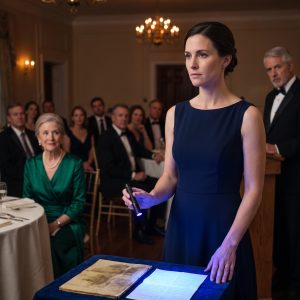
At the biggest dinner of the year, my boss sent me to the kitchen table. He never knew I understood every word the investors said.
Six years at Voss Harbor Supply, and my title was still “office coordinator.”
What nobody there knew was that I grew up in Lisbon. My grandmother raised me in Portuguese until I was twelve, and I never lost a single word of it.
I never mentioned it. Nobody ever asked me anything except where the stapler was.
But whenever a Portuguese supplier called and my boss, Desmond Voss, put them on speaker, I understood everything. Including what they said when they thought he couldn’t follow.
For fourteen months, I had built the relationship with the Cardoso family, importers from Porto. Every email. Every spreadsheet. Every 6 a.m. call.
Tonight, they were signing a five-year exclusive deal in a private dining room downtown.
Desmond met me at the door.
“You’re not on the guest list, Ines.”
“I made the guest list.”
“Then you know it doesn’t include you.” He smiled for the guests behind him. “There’s a small table by the kitchen. Keep an eye on the water pitchers.”
His CFO, Brenda, laughed into her wine glass.
I said nothing. In my one good navy dress and my grandmother’s silver earrings, I carried my folder to the little table by the swinging kitchen door and sat down.
Desmond had hired an interpreter for the evening. Kyle, from an agency, in a very shiny tie. Desmond introduced him as “certified” the way people say “organic.”
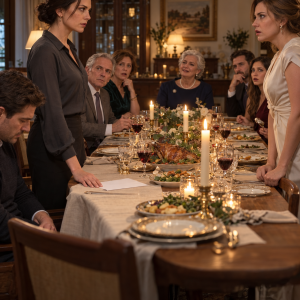
Dinner went smoothly. Helena Cardoso, the family’s chairwoman, watched everything and said almost nothing. Her lawyer, Mr. Almeida, sat beside her with a thick contract. Margaret Hale, Desmond’s co-owner, sat at the far end and hadn’t looked up from her plate all night.
Then the signing began.
Mr. Almeida read the payment clause aloud in Portuguese. Slowly. Then he frowned.
Helena leaned toward him and murmured, “Ele prometeu que o depósito ficaria em conta de garantia. Aqui diz que é pago diretamente à empresa e não é reembolsável.”
He promised the deposit would sit in escrow. This says it’s paid straight to the company, and it’s non-refundable.
Kyle cleared his throat. “She says everything looks fine, and they’re happy to proceed.”
Desmond beamed. He lifted his pen.
Three million dollars. Straight into his company’s account. No way back.
My hands went cold. Then very still.
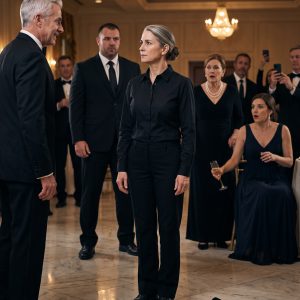
I stood. My chair scraped the floor.
“Ines,” Desmond hissed. “Sit down. Water.”
I walked to the head of the table, folder against my chest, and looked at Helena Cardoso.
“Senhora Cardoso,” I said, in the Portuguese of my grandmother’s kitchen. “Com todo o respeito, não foi isso que a senhora disse.”
With respect, that is not what you said.
Silence.
Kyle’s face went the color of paper.
Helena’s eyes narrowed. Not with anger. With interest.
“Continue,” she said.
Desmond had told me to keep the water glasses full. In ten minutes, he would be begging me to keep talking.
“Repeat that,” Desmond said, in the voice he used on delivery drivers.
“Ms. Cardoso said the contract makes the deposit non-refundable and payable straight to the company,” I said. “She says you promised escrow.”
Desmond laughed, loudly, for the room. “Ines files my invoices. Kyle is a certified interpreter.”
“Certified,” Kyle repeated weakly.
Desmond turned to Helena and slowed his English down, as if volume could work as translation. “Please forgive her. She’s very emotional. Kyle, tell them I’ll have her removed.”
Kyle opened his mouth. Nothing came out.
Helena watched him for a long moment. Then she spoke to him in Portuguese, gently, almost kindly. “Diga ao senhor Voss o que eu disse. Palavra por palavra.”
Tell Mr. Voss what I said. Word for word.
Kyle stared at the tablecloth.
Behind me, the kitchen door swung and clicked shut.
“He doesn’t understand her,” I said quietly. “He never did.”
Desmond’s smile stayed on his face like something glued there. “Even if that were true, it changes nothing. You’re an office coordinator, Ines. You have no authority here.”
“No,” I agreed. “But I have the version I sent you.”
I opened my folder.
“On March third, I emailed you the contract with the escrow language. Section nine. I wrote it myself, because you said you didn’t have time for fine print.”
Brenda had stopped laughing.
“The copy on this table was changed the night before it was printed,” I said. “And before dinner, someone told Kyle to skip anything about the deposit.”
Kyle made a small, broken sound.
“You can’t prove any of that,” Desmond said. But he had set the pen down.
At the far end of the table, Margaret Hale finally looked up from her plate. She had co-founded the company with him twenty years earlier, and she hadn’t spoken all evening.
“Desmond,” she said. “Why does she have a printout of your email?”
“Because she’s a snoop,” he said, too fast. “She prints everything.”
“Yes,” I said. “I do.”
I slid the first page across the linen to Helena Cardoso. Her eyes moved down it, and I watched doubt turn into certainty.
Then I pulled out the last page in my folder, the one that explained exactly where Desmond planned to spend that deposit.
It was a default notice.
It had arrived at the office three weeks earlier, addressed to Desmond, stamped URGENT in red. Company mail was my job. I opened everything, the way I had for six years, and I read that letter standing at the copier with my heart pounding.
Desmond had borrowed against the Harbor Street warehouse without telling anyone. The payment was due Monday. He owed almost exactly three million dollars.
I laid it in front of Margaret.
She read it once. Her face went from pale to something much harder.
“You mortgaged my warehouse,” she said.
“It’s a temporary arrangement,” Desmond said. “Margaret, I was going to explain…”
“To pay it with the Cardoso deposit.”
He didn’t answer. Across the table, Brenda had developed a sudden interest in her napkin.
Then Helena Cardoso spoke, in English so clear it could have cut glass.
“Mr. Voss, I have understood every word you said tonight.”
Desmond turned toward her slowly.
“I wished to learn who in this room would tell me the truth,” she said. “It took most of the dinner. It was not you.”
She closed the contract and slid it back across the table.
“We do not sign with a man who lets a stranger translate my words into lies.”
“Ms. Cardoso, please, this is a misunderstanding—”
“A misunderstanding needs two people who do not understand,” she said. “You understood perfectly.”
She stood. Her lawyer stood. Kyle stood too, and left the room without his jacket.
Margaret was the last to move. She folded the default notice, put it in her bag, and looked at Desmond the way you’d look at a stranger who had wandered into your house.
“My lawyer will call you at eight,” she said.
On Monday morning, Desmond’s badge didn’t open the front door. The operating agreement he and Margaret had signed twenty years earlier had a clause for exactly this: pledging company property without the other owner’s consent. She invoked it before her first coffee.
Brenda resigned by lunch. Kyle’s agency dropped him, and according to Margaret’s lawyer, he had already written down everything Desmond told him to skip.
Desmond waited in the lobby. When I walked in beside Helena Cardoso and Mr. Almeida, he stepped in front of me.
“Ines. Please. After everything I’ve done for you…”
“You gave me a seat by the kitchen, Desmond,” I said. “I built the rest of the room.”
He had nothing left to say.
The Cardoso agreement was signed that afternoon, this time with escrow, the correct version, in both languages. Margaret asked me to read the Portuguese aloud before anyone lifted a pen. I did, every line, without hurrying.
Desmond’s shares were bought out within the month to settle what he owed. He left with far less than he had planned to take.
Margaret offered me a new title: Director of International Partnerships. I asked for a seat at the table. She laughed and told me that was included.
That night, I called my grandmother in Lisbon.
“Avó, they finally heard me.”
She was quiet for a moment. “Quem tem voz não precisa de gritar,” she said.
Someone with a voice doesn’t need to shout.
I hadn’t. Not once.
For six years, they had told me where to sit. In the end, all I had to do was stand up.