The afternoon felt like it belonged to them.
Four friends had claimed a quiet stretch of beach — the kind most people drive past because the parking is bad and the sand is coarser than the tourist spots. They had blankets, a cooler full of sweet tea and fruit, and nowhere to be until Monday. For the first time in months, nobody’s phone was face-up.
Diane was mid-story about her neighbor’s tomato garden when the dog appeared.
It came fast — a scruffy, rust-colored mutt with wild eyes and a matted coat. Not aggressive, but not calm either. It ran a tight circle around their blankets, barking sharp and hard, tail wagging in that frantic way that’s less happy and more desperate.
“Aw, she’s starving,” said Priya, already reaching for a sandwich. She tore off a corner and held it out.
The dog ignored it completely.
That was the first wrong thing.
It kept circling. Barking. Looking at each of them in turn like it was trying to pick a volunteer. Marisol stood up, half-laughing, half-unsettled. “Okay, weird dog. What do you want?”
Then Carol went pale.
She had been watching the dog closest. She was the one who noticed the way the afternoon light hit the animal’s left side. Something matted the fur there — darker than the rust, wet-looking.
“You guys.” Her voice dropped. “Look at her side.”
They all leaned in. A smear of blood, dark and still damp, streaked across the dog’s ribs. Not old. Not a scratch.
Priya stepped back. “Is she hurt?”
But the dog wasn’t limping. Wasn’t whimpering. Wasn’t protecting the spot when Carol slowly reached toward her. She was too focused — on them, on whatever she needed them to understand — to worry about herself.
Then she bolted.
She ran north, toward the rocky outcrop where the beach narrowed and the families never went. She stopped after twenty yards, looked back, and barked once.
The four of them stood there for exactly three seconds.
Then they followed.
The rocks came up faster than expected. The dog wove between them easily; the women picked their way more carefully, sandals slipping on the wet stone. The tide was starting to push in. Carol called out: “Hello? Is someone there?”
Nothing.
Then Marisol rounded a boulder and stopped so fast that Priya walked into her back.
A man lay on the flat shelf of rock just above the waterline. He was on his side, one arm stretched out, his face turned toward the sea. A gash above his temple had bled down the side of his face and onto the stone. He must have lost his footing on the slick rock — there was a fishing rod a few feet away, still rigged.
The dog was already beside him, pressing her nose to his cheek.
“Call 911,” Diane said, and she was already moving toward him, pulling off her cover-up to press against the wound. Her voice was steady in a way her hands weren’t. “Tell them the north end, past the jetty. Tell them he’s breathing.”
He was. Barely.
They kept him talking — or tried to. He surfaced in and out. At one point he said a woman’s name, quietly, like he was asking. None of them answered it. It didn’t feel like their place.
The paramedics reached them fourteen minutes later. The women stood back as the stretcher was maneuvered over the rocks. One of the EMTs stopped and looked at them — sunburned, shaken, still holding the bloody cover-up.
“You found him?”
“The dog found him,” Diane said.
They looked around. The dog was gone. Just — gone. Back to wherever she’d come from, or wherever she was going next. No collar. No owner. No explanation.
Later, driving home in silence, Carol said what they were all thinking.
“She knew. She absolutely knew.”
Nobody argued. Nobody had a better answer.
Some things don’t need one.
Related Posts

The Signal at Gate 14
Officer Renata Ford had worked airport security for six years, long enough to develop an instinct for the wrongness that doesn’t show up on any scanner. It…

She Stopped Wearing Makeup. Hollywood Started Paying Attention Again
She Stopped Wearing Makeup. Hollywood Started Paying Attention Again. Pamela Anderson walked into Paris Fashion Week in September 2023 wearing nothing on her face. No foundation, no…
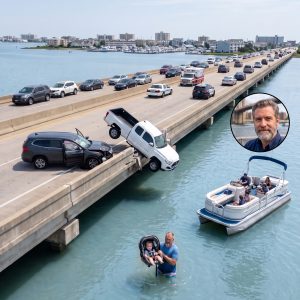
A toddler was thrown off a bridge into the bay during a 5-car crash.
A toddler was thrown off a bridge into the bay during a 5-car crash. A stranger jumped 30 feet after her. It happened May 2, 2021 on…
When My Widowed Father Kept Taking Women to the Same Restaurant, I Thought I Understood Grief. I Didn’t.
My mother died two years ago. My father, Daniel, was sixty-one, and for the first year he barely left the house except for groceries and the occasional…
After four long years of home visits, interviews, and endless waiting, our son finally arrived. Ethan was seven, small for his age, with serious brown eyes.
After four long years of home visits, interviews, and endless waiting, our son finally arrived. Ethan was seven, small for his age, with serious brown eyes. It…