Told she was too fragile for the family lumber business, Wren read the page her brother hid, and Dad’s secret clause changed everything.
Nineteen years. That’s how long I’d kept the books at Hallowell Timber & Supply.
I could glance at a supplier invoice and tell you it was off by forty dollars before my coffee cooled. Dad called it my party trick.
My brother Garrett called it “clerical.”
When Dad died in March, Garrett became president overnight. By June, he was telling everyone I was fragile.
“Wren’s been through a lot,” he’d say at the yard, squeezing my shoulder. “We’re keeping the heavy stuff off her plate.”
The heavy stuff was my entire job.
Within a month, my desk was in a supply closet with a label maker and a space heater.
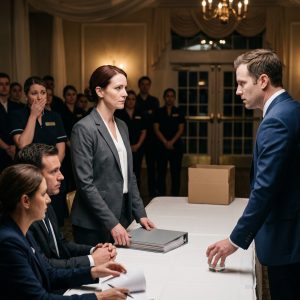
Then, on a Thursday in September, Garrett called me into the conference room above the lumberyard.
Our lawyer, Mr. Pruitt, was already seated. A thick stack of paper sat in front of my chair, bristling with yellow sign-here flags.
Garrett pulled the chair out for me like I was a guest.
“Just a formality,” he said. “Insurance renewal. Pruitt flagged where you sign.”
“Insurance renewal for what?”
“Sis.” He smiled the way you smile at a toddler near a staircase. “You don’t have to read it. It’ll only stress you out.”
Mr. Pruitt became very interested in the ceiling.
I picked up the first page anyway.
“Wren.”
“I’ll be quick.”
Page one said INSURANCE. Page three said INSURANCE.
Page six said ASSET PURCHASE AGREEMENT.
The buyer was a company called Brandt-Keene Group. The price was $11.2 million.
I turned to page nine and kept reading.
Garrett’s smile started to wobble. “You won’t follow the legal parts.”
“No,” I said. “But I follow numbers.”
I set the page down.
“Section nine buys out my forty percent for four hundred thousand dollars.”
Nobody spoke.
“Forty percent of eleven point two million is four million, four hundred eighty thousand.”
“That’s a complicated calculation,” Garrett said. “There are adjustments.”
“There’s one adjustment. Me.”
He stood behind his chair, pen in hand, the way he does when he thinks a meeting is over.
“Wren, I’m trying to protect you. Dad would have wanted you out of the stress.”
“Dad wanted a lot of things.”
I reached for the old green ledger I’d carried in my bag every day for six months. Nobody had ever asked why.
I slid a folded page out from behind its back cover.
Cream paper. Dad’s handwriting. A blue notary stamp.
“Any sale of this company,” I read, “requires the written consent of the Class B shareholder.”
Garrett’s pen stopped moving.
“Dad never filed that.”
“He did. I carried it to the county courthouse myself, two weeks before he died.”
I looked at Mr. Pruitt. He had stopped studying the ceiling.
“Class B is me, Garrett. It was never the quiet seat. It was the vote.”
The color left my brother’s face in one slow slide.
“Put the pen down,” I said. “By Monday, you’re going to lose the company you just tried to sell.”
Garrett recovered faster than I expected.
He laughed. Actually laughed, and set the pen down like a man conceding a minor point.
“A technicality,” he said. “Pruitt will have it set aside by Monday. Right, Pruitt?”
Mr. Pruitt gathered his papers into a neat stack. “I’d need to read it first.”
“Then read it.”
“I’d also need to know why I wasn’t told it existed.” He stood. “I may not be the right lawyer for this conversation, Garrett.”
Garrett waved him out like a waiter.
Then he turned back to me, relaxed, almost kind.
“Wren, you’ve had a rough year. Take the weekend. Ask yourself whether you really want to fight your own family over a piece of paper.”
“I’d like to keep the page, please.”
“Keep it. Frame it.”
He pulled out his phone and walked to the window.
“Ms. Okafor? Garrett Hallowell. Small family flare-up, nothing to worry about. My sister’s had a hard time since Dad. We’ll be back on schedule.”
He put her on speaker, the way people do when they want a witness.
There was a pause on the line.
“Mr. Hallowell,” a woman said, “I’m glad you called. We received a packet from your sister at seven-forty this morning.”
Garrett’s smile stayed on his face. The rest of him didn’t.
“A packet.”
“Inventory reconciliations. The Delmar Road deed. Eighteen months of supplier statements. Our diligence team has been reading since breakfast.”
He looked at me.
I closed the green ledger and folded my hands.
“You’ve been in a closet for six months, Wren,” he said, very quietly. “What were you doing in there?”
“Counting. On Monday, you’ll see what I counted.”
By Monday morning, the whole yard knew something was happening.
Forklifts idled longer than they needed to. Two of the drivers found reasons to walk past the conference room windows.
I arrived at seven. I wore the navy cardigan I’d worn to Dad’s funeral and carried exactly one thing: the green ledger.
Garrett showed up at eight with a new lawyer, a tall man with an expensive watch and a tired face. Ms. Okafor from Brandt-Keene arrived at eight-fifteen with two colleagues and a banker’s box.
Mr. Pruitt came last. He sat at the far end of the table, as far from Garrett as the room allowed. That told me what I needed to know.
“Let’s keep this simple,” Garrett’s new lawyer began. “This so-called amendment is a family document of doubtful—”
“It’s a recorded corporate amendment,” Mr. Pruitt said. “I read it Saturday. Twice. It’s valid.”
Garrett turned on him as if he’d been slapped. “You work for me.”
“I worked for your father first.”
Nobody said anything for a moment.
“Wren,” Ms. Okafor said gently. “Would you like to tell us what you found?”
I opened the ledger.
“Thursday, I only read the first sentence. There’s more.”
I read the rest slowly, so no one could say they’d missed it.
“If any officer negotiates the sale of this company without full written disclosure to the Class B shareholder, that officer’s voting shares convert to non-voting shares, and he shall step down as president.”
Garrett laughed, but it came out thin. “He couldn’t have meant that.”
“He wrote it by hand,” I said. “He meant it.”
Ms. Okafor slid a page across the table.
“Mr. Hallowell, in our first meeting you told us your sister had agreed in principle. In writing, you said all shareholders were aligned. You also told us the Delmar Road property was leased.”
“I may have misspoken.”
“Ms. Hallowell’s deed says otherwise. So do eighteen months of tax receipts, every one of which she paid.” She paused. “Our attorneys consider that a material misrepresentation. Brandt-Keene is withdrawing its offer, effective now.”
“You can’t.” Garrett stood. “We had a deal.”
“We had a deal with a company that didn’t exist the way you described it.”
She closed her box.
“And we’ll be reserving our right to recover our diligence costs from the person who made the statements.”
Garrett opened his mouth. Nothing came out.
His lawyer leaned over and whispered. I caught only two words: personal exposure.
Mr. Pruitt cleared his throat. “As of this morning, Garrett, your shares carry no vote. The company will need a new president.”
Garrett looked around the table, from face to face, searching for one that would take his side.
He found mine last.
“Wren,” he said. “Come on. I was trying to protect you.”
I thought about the supply closet. The label maker. The space heater that smelled like burnt dust.
“You weren’t protecting me,” I said. “You were protecting the sale from me.”
He sat down slowly. For the first time in six months, my brother had nothing to say.
When the room emptied, he stayed behind.
“Dad would’ve been ashamed of me,” he said finally. I couldn’t tell whether he was talking to me or to the table.
“I think Dad would have asked why you never just asked me.”
He had no answer for that. He left his pen on the table and walked out.
Ms. Okafor lingered at the door.
“For what it’s worth, if this company ever comes to market at a fair price, under the right owner, we’d like a call.”
“It’s not for sale,” I said. “But I’ll send you our year-end numbers. They’ll be accurate.”
She smiled. “I read your reconciliations. I believe it.”
That afternoon, two of the yard crew carried my desk out of the supply closet and back into the accounting office. Old Dale, our longest-serving forklift driver, left the space heater in the closet.
“Figured that belongs where it was,” he said.
I sat down in my chair. A stack of unopened supplier invoices was waiting.
I picked up the first one.
It was off by forty dollars.
I found the mistake before my coffee cooled, and I got back to work.
Dad used to say numbers never lie.
He just never mentioned they were patient.