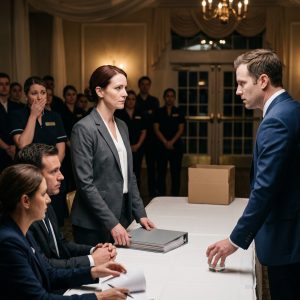
At a dinner meant to seal an investment, her partner called her a line item to trim. He forgot she could read lips, and exactly who owned the code.
I lost most of my hearing when I was nine.
By twelve, I could read a whispered sentence across a cafeteria.
I never advertised it. Hearing aids for the sound, lips for the truth. That was simply how I moved through the world.
At thirty-four, I was the co-founder of Tallyvane, a freight-routing company that moved cargo for two hundred trucking firms. I had written the routing engine myself, at my kitchen table, two years before I ever met my partner.
Callum Ridley had been the face of the company ever since.
That night, he had booked a table on the thirty-first floor of a restaurant with a jazz trio and a view of the whole city. Marguerite Boyle, our potential investor, sat beside him with silver hair and sharp eyes.
“Wear something simple,” Callum had told me earlier. “Let me do the talking. Loud rooms are hard for you anyway.”
He was right about the noise. I turned my hearing aids down to save my head from the music.
He knew that.
“This is Odessa,” he told Marguerite, waving a hand in my direction. “She keeps our office running.”
Marguerite’s eyebrows rose.
“Odessa is a co-founder, Callum.”
“Of course. Figure of speech.”
He laughed. Marguerite didn’t.
I smiled and opened the menu.
When the entrées were ordered, the trio launched into something loud. Callum leaned toward Marguerite, angled his chin away from me, and lowered his voice.
He never covered his mouth.
Men like Callum never think they need to.
The candle lit his face perfectly. Every word crossed the table to me as clearly as print.
“She’ll sign whatever we put in front of her by Friday,” he said. “After that, she’s a line item we can trim.”
Marguerite went very still.
Her eyes flicked to me.
I kept my face soft and turned a page of the menu, slowly.
Callum sat back, pleased with himself, and reached for his wine.
I closed the menu. I folded my hands on the table and looked straight at him.
“Line item,” I repeated, in a voice so even it surprised me. “Say it to my face, Callum.”
His smile stopped.
“What?”
“I didn’t hear you,” I said. “I read you. Every word.”
The wineglass froze an inch from his mouth. Marguerite set down her fork.
“You said I’d sign by Friday,” I told him. “You’re right. I will.”
His color began to drain.
He had until Friday to enjoy being the smartest man at the table. After that, the only thing getting trimmed would be him.
Callum caught me at the coat check, hands raised like I was a spooked horse.
“Dess, come on. Loud room, hearing aids on low. You misheard me.”
“Maybe I did,” I said.
Relief rolled across his face. He believed it instantly, because it was the version where he stayed safe.
By morning, the term sheet sat in my inbox with a yellow flag on the signature line and a note: Big week! Sign Friday and we celebrate.
I didn’t answer.
I opened the bottom drawer of my desk and took out a one-page agreement I’d typed myself three years earlier, before Tallyvane had an office, an investor, or a logo.
The license for my routing engine.
The company paid me one dollar a year to use it. Callum had skimmed the first paragraph and said, “You handle the paperwork. You’re so good at it.”
I had handled it.
At nine, I called Tobias Lund, the attorney who’d helped me with every contract since college. He read the term sheet while I waited, and the line went quiet.
“Odessa. Page six. They want you to assign the engine to the company outright.”
“I know.”
“Page seven says the company already owns it. Free and clear. Callum certified that to the investor.”
“He’s never owned a line of it,” I said.
“No. And the license you wrote has a clause about exactly that.”
“Section nine,” I said.
Tobias exhaled. “You wrote it on purpose.”
“I write everything on purpose.”
At noon, Callum posted in the team channel, never checking who could see it: Closing Friday, 4 p.m. Order champagne. Odessa’s coming around.
I screenshotted it.
Then I sent Marguerite Boyle one email with one attachment and no explanation.
On Friday at four, I would sign exactly one document, and it wouldn’t be his.
Friday at 3:58 p.m., the conference room on the fortieth floor smelled of fresh coffee and new carpet.
Callum stood at the head of the table in a new silk tie. A bottle of champagne sweated in a silver bucket beside the two attorneys he’d hired for the occasion.
Marguerite sat at the far end with a leather folio and a calm, gray-haired man at her elbow named Mr. Hale.
I walked in with Tobias.
“There she is,” Callum said, arms wide. “My team player.”
I sat. Tobias set a single sheet of paper in front of me and laid a pen beside it.
“Just initial the flagged pages,” Callum said, sliding the term sheet toward me with two fingers.
“I’m not signing that.”
He laughed. Then he noticed nobody had joined him.
“We talked about this, Dess.”
“You talked,” I said. “I read.”
Marguerite opened her folio.
“Mr. Ridley, page seven. You certify that Tallyvane owns the routing engine outright.”
“Correct.”
“Ms. Marlowe sent me a license this week. It says the engine belongs to her. The company merely borrows it.”
Callum turned to his lawyer. “That’s a technicality.”
His lawyer was already reading the copy Mr. Hale had slid across the table. His face changed.
“Callum,” he said quietly. “Section nine.”
“Read it out loud,” I said.
The lawyer cleared his throat. “If the company misstates ownership of the engine to any third party, the license ends on written notice.”
“She wouldn’t,” Callum said.
I signed the sheet in front of me, dated it, and slid it across the table.
“That’s the notice,” I said. “Witnessed by Mr. Hale, as of 4:01 p.m.”
“You can’t.” His voice cracked. “Two hundred customers run on that system.”
“Two hundred customers run on my code,” I said. “The code you told an investor was yours.”
Marguerite closed her folio.
“I fund companies, Mr. Ridley. Not borrowed engines. And not men who plan to trim their partners.”
“That was a joke.”
“That night, she asked you to say it to her face,” Marguerite said. “You couldn’t then, either.”
Callum turned to me, and the polish finally cracked.
“Dess. Please. We built this together.”
“I built the engine,” I said. “You built the pitch. A pitch needs something real to point at.”
Mr. Hale stood. “Our offer is withdrawn.”
Marguerite rose after him, leaving the champagne unopened.
Callum’s phone began to buzz on the table. Once. Twice. Then it wouldn’t stop. The two angel investors he had promised everyone were calling to ask what exactly he’d certified.
He didn’t answer any of them.
The license ended thirty days later.
Most customers followed the engine to my new company, Northcast Systems, which Marguerite’s firm funded in a single meeting.
Tallyvane kept a lease, a logo, and a conference room with nothing to sell. Callum kept his title for another month, until the board stopped returning his emails.
That evening, I rode the elevator to the roof alone.
For the first time in months, I turned my hearing aids all the way up.
Traffic. A distant siren. Someone laughing three buildings away.
I’d spent years turning the world down so nobody would think I was fragile.
I had never been fragile. I had only been quiet.
He spent three years assuming I couldn’t hear him.
It never crossed his mind to ask what I was reading.