I met Daniel outside a nearly empty train station, holding a cardboard sign that made me stop walking.
MARRY ME. I HAVE 30 DAYS LEFT.
I stared at him.
“You’re serious?”
He nodded. “Unfortunately.”
I should have kept walking.
Instead, I sat beside him.
Daniel had been sleeping near the station for months. He knew which coffee kiosk opened first, which security guard quietly left sandwiches after midnight, and exactly when the last train emptied the platform.
What surprised me most was what he didn’t do.
He never asked me for money.
When I offered him food, he thanked me. When I offered cash, he shook his head.
“I don’t need money today,” he said. “I need someone who won’t disappear when the paperwork gets complicated.”
I laughed nervously.
Then he showed me the hospital papers.
Advanced heart failure. Doctors had warned him that he probably had only weeks.
“Why marriage?” I asked.
“Because I don’t have anyone.”
The answer was so simple that it bothered me.
“You could ask for help without marrying someone.”
“I could,” he said. “But people hear ‘dying stranger’ and suddenly they’re busy.”
I worked in municipal administration. Forms, deadlines, confusing government offices—those things didn’t scare me.
People did.
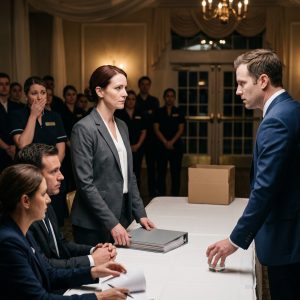
Two days later, we stood in a courthouse ceremony room.
The clerk asked whether we both understood what we were doing.
Daniel looked at me.
“I do.”
My voice came out quieter.
“I do.”
He squeezed my hand.
His fingers were trembling.
I assumed it was fear.
Three weeks later, I sat beside him in hospice while rain tapped against the window.
Daniel died just before sunrise.
Six days later, an envelope arrived at my apartment.
My name was written across it in his handwriting.
Inside was one sheet of paper.
The first sentence made me read it twice.
“Mara, I need to apologize before I thank you.”
I kept reading.
Then I reached the last paragraph.
Daniel had left me one instruction.
Go back to the courthouse. Ask for Eleanor. Tell her my name.
I had no idea why.
But the next morning, I went.
And when the clerk heard Daniel’s name, she stopped smiling.
“Wait,” she whispered. “You were his wife?”
“Yes.”
She looked at me for several seconds.
Then she locked the office door.
“What is this?” I asked.
Eleanor pulled an old ledger from a locked cabinet.
It was thick, dusty, and filled with handwritten entries.
She opened it.
Marriage records.
Hundreds of them.
Then she pointed to the witness section.
There was Daniel’s handwriting.
Again.
And again.
And again.
I looked at her.
“He worked here?”
“For twenty-six years,” Eleanor said. “Long before you met him.”
I turned another page.
There he was.
Another couple.
Another signature.
Another.
Daniel had spent years helping people who came to the courthouse alone.
Couples without parents.
People estranged from their families.
Older couples whose friends couldn’t travel.
He had volunteered as a witness whenever someone needed one.
“He never married?” I asked.
Eleanor shook her head.
“Not once.”
My chest tightened.
Then she reached for another folder.
“This one is different.”
She placed our marriage certificate on the desk.
I already knew what it said.
Daniel’s name.
My name.
Our signatures.
But Eleanor pointed to the witness line.
“Look at the date.”
I did.
Then she opened the clerk’s appointment book.
There was an entry from the afternoon before our ceremony.
Daniel had come to the courthouse alone.
He had sat in the ceremony room for nearly an hour.
“He asked me something strange,” Eleanor said.
“What?”
“He asked what it felt like to stand on the other side of the desk.”
I remembered his trembling hands.
I remembered how carefully he folded our certificate.
I remembered thinking he was afraid of dying.
Maybe I had been wrong.
Eleanor looked at me.
“He told me he’d spent his entire career watching people choose each other.”
I couldn’t speak.
Then she handed me the rest of his letter.
Daniel had written that he owed me the truth.
His illness had been real.
His loneliness had been real.
But the story about needing a wife to handle everything after his death wasn’t the whole truth.
Hospice already had procedures in place.
The county already had arrangements for people without relatives.
He hadn’t actually needed me for that.
He had known exactly what kind of person I was.
I solved problems.
So he had turned his loneliness into a problem I could solve.
And he admitted it had been unfair.
Then came the sentence that broke me.
“I was afraid if I asked you whether loneliness was enough reason to marry me, you would think too long.”
I closed my eyes.
For weeks, I had believed I was the one saving him.
But Daniel had known something about me that I hadn’t understood.
I was always trying to rescue people from situations they had never asked me to fix.
At the bottom of the letter, he gave me one final instruction.
Go back to the station.
So I did.
I sat on the bench where I had first found him.
I expected grief.
Instead, I found myself remembering every small thing I had missed.
The black coffee.
The terrible jokes.
The way he smiled whenever someone else got good news.
Then I noticed someone sitting nearby with a worn backpack.
He looked exhausted.
My first instinct was immediate.
Offer money.
Find a shelter.
Call someone.
Fix it.
Then I remembered Daniel’s final words.
Ask what people want before deciding what they need.
So I turned toward the stranger.
“Are you waiting for someone?” I asked.
He looked at me.
“No.”
“Do you want company?”
He hesitated.
Then he nodded.
We sat there without trying to fix anything.
For several minutes, neither of us spoke.
Then I laughed softly.
“What?”
“I just remembered something.”
“What?”
“My husband hated black coffee.”
The stranger smiled.
“You said he drank it.”
“He did. He just hated admitting he wanted sugar.”
For the first time since Daniel’s death, I laughed without feeling guilty.
When I returned home that evening, another envelope was waiting.
It had been forwarded from the courthouse.
The envelope was smaller than the first.
Inside was a photograph.
Daniel stood in the old courthouse ceremony room, years before I knew him.
He was younger.
Cleaner.
Smiling.
In front of him stood an elderly couple who had clearly traveled a long way to get married.
On the back, Daniel had written:
“I thought I was giving them a witness.”
Underneath it was another sentence.
“They were giving me a reason to keep showing up.”
I sat at my kitchen table for a long time.
Then I understood why he had wanted our marriage.
Not because he needed someone to manage his death.
Not because he wanted an inheritance.
Not because he expected me to rescue him.
He wanted, once in his life, to stop standing beside the people being chosen and become the person someone chose.
I wished he had trusted me enough to ask.
I wished he had given me the chance to say yes without wrapping the question inside an emergency.
But I couldn’t change that.
What I could change was what happened next.
The following morning, I went back to the courthouse.
Eleanor was at her desk.
“I want to volunteer,” I said.
She stared at me.
“For what?”
“For people who show up alone.”
Her expression softened.
“You sure?”
I thought about Daniel.
“I am.”
Months later, I sat in the same ceremony room while another nervous couple stood beneath the wooden arch.
The bride kept looking at the floor.
The groom kept rubbing his palms together.
The clerk asked whether they were ready.
They both said yes.
Then the groom looked around the room.
“Do we have a witness?”
I smiled.
“You do.”
For the first time, I understood what Daniel had spent decades doing.
Sometimes being there isn’t about saving someone.
Sometimes it’s about making sure they don’t have to stand alone.
And sometimes the person who thinks they’re rescuing you is the person you quietly teach how to stay.