The fluorescent lights hummed above me as I lay on the hospital bed, clutching my side where the pain radiated with every shallow breath. I had called my son hoping for comfort. What I got instead was a glance at his watch and words that cut deeper than any fall ever could.
“I have to go,” Michael said, already backing toward the door. “It’s my promotion celebration. You’ll be fine.”
I wanted to believe he didn’t mean it the way it sounded. That somewhere beneath the tailored suit and the restless impatience was still the little boy who once cried when I scraped my knee in the garden.
But he left. And the room felt colder than before.
When the doctor finally discharged me, I didn’t go home. Something pulled me toward Michael’s house instead—not anger, not resentment, just a quiet hope that maybe I could still reach him. That if I showed up and simply said I’m proud of you, something would soften.
The rain had started by then, heavy and relentless. I could hear the party from the sidewalk—laughter spilling through the windows, music thumping against the walls. His life, moving forward. Full and bright.
I knocked.
When he opened the door and saw me standing there—soaked, still wearing the hospital bracelet—his expression didn’t soften. It hardened.
He pulled me outside before I could speak, his grip tight on my arm.
“What are you doing here?” he whispered sharply, glancing back at the guests inside. “You look like a mess. My colleagues are in there.”
“I just wanted to congratulate you—”
“Not like this.” His voice was ice. “Go home.”
The door closed before I could respond.
I stood in the rain for a long moment, letting it wash over me. My hands trembled—not from the cold, but from something breaking loose inside. A realization I had been avoiding for years.
The son I raised was gone. And in his place stood someone I barely recognized.
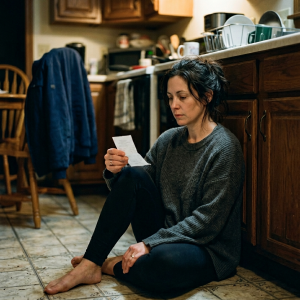
That night, I didn’t sleep. I sat at the kitchen table, watching the rain streak down the window, turning memories over in my mind like worn photographs.
Michael had always been ambitious. I admired that about him once. But somewhere along the way, ambition had turned into something else—something sharper. He had started talking about work differently. Bragging about “adjusting” reports to make his numbers shine. Laughing about how easy it was to pressure younger employees into doing what he wanted.
I had listened in silence, convincing myself it was just talk. Just stress. Just the corporate world being what it was.
But that night, sitting alone in the quiet, I finally admitted the truth:
I had been making excuses for cruelty.
By morning, the decision had made itself.
I picked up the phone and dialed Mr. Anderson—the regional director of Michael’s company. A man I had met once at a holiday function, kind-eyed and thoughtful. The kind of person who still believed integrity mattered.
“Mrs. Taylor,” he said warmly. “This is unexpected.”
“I have something to tell you,” I said. “Not as Michael’s mother. As someone who knows what’s been happening.”
I told him everything. The falsified reports. The coerced staff. The corners cut and the people stepped on. I gave him dates. Names. Even screenshots Michael had carelessly sent me, thinking a mother would never speak.
When I finished, the line was quiet for a moment.
“Thank you,” Mr. Anderson said finally. “This took courage.”
After I hung up, I sat very still. My hands shook, but my heart felt strangely calm. Like setting down a weight I had been carrying for too long.
The investigation moved quickly. By that evening, Michael had been suspended. By the end of the week, he would be terminated.
He showed up at my door that night, rain-soaked and furious.
“You did this,” he said, his voice shaking. “You destroyed everything I worked for.”
I met his eyes without flinching. “You destroyed it yourself. I just stopped pretending otherwise.”
“This is betrayal.”
“No,” I said quietly. “This is consequence.”
He stared at me, searching for something—remorse, maybe. An apology. But I had none to give. Not for protecting the people he had hurt. Not for finally telling the truth.
“You’ll regret this,” he said.
“Maybe,” I replied. “But I would have regretted staying silent more.”
He left without another word.
I closed the door gently and returned to the kitchen table—the same place where I had made that single phone call. The apartment was quiet, but for the first time in years, the silence didn’t feel heavy.
It felt like honesty.
Reflection
Sometimes loving someone means watching them face the consequences of who they’ve become. It’s not cruelty. It’s not revenge. It’s the hardest kind of truth—the kind that costs you something precious but saves something even more important: your integrity, and perhaps, in time, theirs too.
Disclaimer: This article shares a personal story inspired by real-life experiences. Names and details have been changed to protect privacy.