A Story of a Mother’s Courage and a Daughter’s Freedom
The moment I saw my daughter standing frozen in that dining room doorway, I knew something inside me had finally broken—not in a way that would destroy me, but in a way that would set us both free.
Lily was eight years old. She had spent the entire car ride to my parents’ house talking about the turkey, the mashed potatoes, the chance to see her cousins. She wore a dress she had picked out herself, navy blue with tiny white flowers, because she wanted to “look nice for everyone.”
What happened next would change everything.
When we arrived, the house smelled like rosemary and roasting meat. Laughter echoed from the kitchen. My mother greeted us at the door with her usual smile—the one that never quite reached her eyes when she looked at me, but sparkled when my brother Jason walked in behind us.
I should have noticed the whispers. I should have caught the knowing glances exchanged between my sister-in-law and my mother as they set the table. But I was too busy helping Lily take off her coat, too focused on making sure she felt comfortable in a house where I had never quite felt comfortable myself.
Dinner was announced. Everyone took their seats. Plates were passed, wine was poured, and for a brief moment, I let myself believe that maybe this year would be different.
Then my mother walked toward Lily carrying something that made my heart stop.
It was a dog bowl.
Metal. Scratched. With the name “Buddy” still faintly visible on the side—our old family dog, gone for over a decade.
She placed it in front of my daughter and said, loud enough for the entire table to hear, “Here you go, sweetie. You’re the family dog this year.”
The table erupted in laughter.
I watched Lily’s face crumble. Her lower lip trembled. Her eyes filled with tears she was desperately trying to hold back because she didn’t want to make a scene. She was eight years old, and she was already learning to shrink herself to make others comfortable.
The laughter continued.
My brother slapped the table. “Classic,” he said, wiping his eyes.
My father chuckled and shook his head, as if this were simply good-natured fun.
And my mother—my own mother—stood there beaming, proud of her joke.
I didn’t scream. I didn’t throw anything. I didn’t give them the satisfaction of seeing me fall apart.
I simply stood up, walked over to my daughter, took her hand, and said, “We’re leaving.”
Lily looked up at me, tears streaming down her cheeks, and whispered, “Mommy, did I do something wrong?”
My heart shattered into a thousand pieces.
“No, baby,” I said, my voice steady even as everything inside me burned. “You didn’t do anything wrong. They did.”
We walked out the door without looking back.
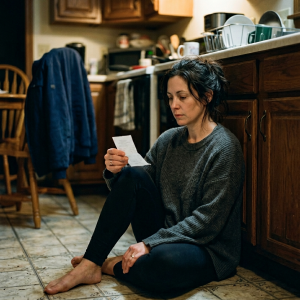
That night, after Lily finally fell asleep, I sat at the kitchen table in the dark.
For years, I had tolerated the comments, the comparisons, the subtle cruelties disguised as jokes. I had swallowed my feelings to keep the peace. I had made excuses for people who never made excuses for the way they treated me—or my daughter.
But watching an eight-year-old girl be humiliated for entertainment? Watching her question whether she had done something to deserve it?
No.
This ended now.
Over the next forty-eight hours, I did something I had never done before: I stopped protecting them.
I gathered everything—messages where my sister-in-law laughed about “putting her in her place,” old texts from Jason complaining about how children “ruined holidays.” Screenshots of dismissive comments, records of moments I had forgiven but never forgotten.
And then I wrote a letter. Not emotional. Not dramatic. Just honest.
I explained what had happened. I detailed the pattern of behavior that had led to this moment. And I made one thing absolutely clear:
“Lily and I will have no further contact with any of you. I will not allow my daughter to be harmed, mocked, or diminished by anyone—including family.”
I sent it to everyone. Aunts, uncles, cousins, grandparents. Every person who had ever praised my parents for their hospitality, who had admired my brother’s charm, who had looked at our family and seen something worth envying.
They all received the truth.
By the following morning, my phone was exploding.
My father left twelve voicemails. My mother sent twenty-two texts, each one more desperate than the last. My brother sent only one message:
“You ruined my life.”
I read it, set my phone down, and walked into Lily’s room.
She was sitting on the floor, surrounded by puzzle pieces, carefully fitting them together. When she heard me come in, she looked up.
“Mommy,” she said quietly, “can we not go there anymore?”
I knelt beside her and pulled her into my arms.
“We’re done, sweetheart,” I said. “We’re never going back.”
In the weeks that followed, the messages kept coming. Anger. Guilt. Blame. Apologies that weren’t really apologies.
“You overreacted.”
“You’re tearing this family apart.”
“But we’re family.”
Eventually, my mother sent a long email explaining how embarrassed they all were, how the extended relatives had “turned against them,” how my father couldn’t sleep.
It ended with: “You’ve punished us enough. It’s time to stop.”
I read those words carefully. And I realized something that finally set me free:
They weren’t sorry for what they had done.
They were sorry that people found out.
I archived the email and never responded.
Months passed. Lily’s teacher sent me a note saying she had been participating more in class—raising her hand, reading aloud, helping other students. The shy, anxious little girl who had learned to make herself small was finally beginning to unfold.
One evening, we baked a pie together. Pumpkin, her favorite. As she carefully scooped the filling into the crust, she said something that made everything worth it.
“I like when it’s just you and me.”
I smiled. “I do too, sweetheart. It’s peaceful.”
She nodded slowly. “And safe.”
That one word—safe—told me I had made the right choice.
I changed my phone number. I moved to a new neighborhood. I found a therapist who helped me understand that the guilt I felt wasn’t mine to carry.
And slowly, carefully, Lily and I built a life that wasn’t about surviving family gatherings. It was about thriving without them.
The truth is, walking away from family isn’t cruelty.
It’s protection.
Sometimes the bravest thing a mother can do is burn the bridge behind her, so her child never has to cross it again.
My family eventually stopped reaching out. Not because they understood. But because they finally realized I wasn’t the daughter who tolerated their behavior anymore.
I was a mother now.
And I chose my daughter—every single time.
Final Reflection
Some bonds are not strengthened by blood, but by how we treat one another. Protecting those we love sometimes means letting go of those who harm them. A peaceful home isn’t one without conflict—it’s one where safety and dignity are never compromised, no matter who is asking you to stay silent.
Disclaimer: This article shares a personal story inspired by real-life experiences. Names, details, and circumstances have been modified to protect privacy.