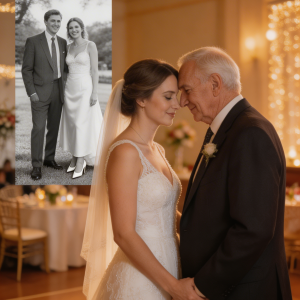
The dress had been folded in lavender tissue paper for forty-three years.
My grandmother, Nora, had worn it the morning she married the man everyone in our small town called the quiet one — a carpenter with calloused hands and eyes the color of late autumn. She passed away two springs ago, and left the dress to me in a handwritten note tucked inside a Bible no one had opened in decades.
“Give it to the girl who reminds me most of myself,” it read.
My mother said that was me.
I took it to a seamstress three weeks before my wedding. The fabric was ivory silk, heavy and real, the kind they don’t make anymore. The seamstress — an older woman named Agnes who wore reading glasses on a pearl chain — slid her fingers along the inner lining to measure the seam allowance.
Then she stopped.
“There’s something in here,” she said quietly.
She reached into a hidden pocket sewn so carefully into the bodice that you’d only find it if you were looking — or if you knew it was there.
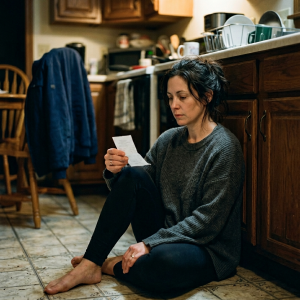
She pulled out a folded square of paper, yellowed at the edges. The ink had faded to the color of old tea.
I almost didn’t read it.
But Agnes placed it in my hands and said, “I think this was meant for you.”
The letter was dated June 14th, 1981 — three days before my grandmother’s wedding.
It was written to Nora. Not from her husband-to-be. From a woman named Celeste, whose name I had never once heard spoken aloud in our family.
“Nora,” it began, “if you’re reading this on your wedding day, it means you chose him. And I understand. I do. But before you walk down that aisle, I need you to know something about the people who raised you — something I promised myself I would tell you before it was too late…”
The letter went on for three pages, each word more careful than the last — the kind of careful that comes from a person who has rehearsed a confession for years.
Celeste was Nora’s biological mother.
She had given Nora up as a baby, not out of abandon, but out of desperation — a single woman in a town that had no mercy for women like her. She had watched Nora grow up from a distance. She had been there, silent and invisible, at every school play, every graduation, every heartbreak. She had never stopped loving her.
And she had sewn this letter into the dress herself — slipping it inside the lining the night before the wedding while helping Nora press the fabric.
“I didn’t want to take anything from you,” she wrote near the end. “I only wanted to leave you something to find when the time was right. A piece of the truth. A piece of me.”
At the bottom, in handwriting shakier than the rest — as if written last, or written through tears — were seven words:
“You were always, always worth keeping.”
I sat in Agnes’s small shop for a long time after that. The dress hung on the mannequin behind me, its ivory silk glowing faintly in the afternoon light.
I thought about my grandmother — the way she used to hum while she cooked, the way she kept dried flowers pressed between the pages of her books, the way she always said “love is not the loud thing people think it is.”
I wondered if she had ever found the letter. If she had sewn it back in herself, as a gift to whoever came after her.
Or if Celeste’s message had waited, patient and quiet for forty-three years, for exactly the right hands to find it.
I wore the dress on my wedding day.
And just before I walked out the door, I pressed my hand gently against the bodice — against the hidden seam — and whispered a thank-you to a woman I would never meet.
She heard me. I’m sure of it.