The turquoise waters of Pernambuco, Brazil, were once a dream destination for sun-seekers. Today, that reputation is being overshadowed by a chilling reality: a series of brutal shark attacks that have left two young people with life-altering injuries in less than 24 hours.
For locals and tourists alike, the stretch of coastline near Recife has become a high-stakes zone where a simple dip in the ocean can turn into a desperate fight for survival.
A Weekend of Terror
The tragedy began on May 31, when 11-year-old João Lucas Castor Nemezio Sales was swimming in shallow water at Piedade Beach. Witnesses reported the water suddenly turned red as a bull shark—estimated at 2.5 meters—struck. The boy’s family and bystanders managed to pull him from the surf, but the attack caused severe damage to his hand and thigh, ultimately forcing surgeons to amputate his leg at the Hospital da Restauração.
Less than 24 hours later, the nightmare struck again. Just six miles away at Boa Viagem Beach, 19-year-old Marcela Vitória de Lima Santos was attacked by a much larger predator—a roughly 10-foot tiger shark. Her cousin, who was nearby, heard her final desperate screams before he and local lifeguards rushed to pull her to safety. A vacationing doctor reportedly used the drawstring from her shorts as a makeshift tourniquet, a move that likely saved her life before she underwent an emergency amputation.
The “Hidden” Dangers Lurking Offshore
While these back-to-back attacks have grabbed global headlines, they are part of a grim and long-standing pattern. According to the State Committee for Monitoring Shark Incidents (CEMIT), there have been 84 recorded shark incidents in the region since 1992.
The question remains: why here? Experts point to a “perfect storm” of environmental and human factors. Increased coastal development, nearby river discharge, and significant port projects have altered the local ecosystem. These changes appear to be funneling sharks—particularly bull and tiger species—closer to the shoreline, especially during high tides or after heavy rains when the water becomes murky and visibility is low.
What We Know
The Victims: An 11-year-old boy and a 19-year-old woman were both victims of shark-related amputations on May 31 and June 1, 2026.
The Species: Officials identified a bull shark in the first attack and a large tiger shark in the second.
The History: This follows the January 2026 death of 13-year-old Deivson Rocha Dantas at Chifre Beach, marking an exceptionally deadly start to the year for the region.
The Mitigation: Authorities have installed 150 warning signs across 33km of the coastline, but officials admit that despite increased monitoring and scientific study, the risk remains persistently high.
Why This Matters
For those living near or visiting the Brazilian coast, these incidents serve as a sobering reminder of the thinning barrier between urban life and wild nature. The attacks aren’t just isolated tragedies; they are a lightning rod for an ongoing debate about how human construction and ecosystem disruption might be inadvertently inviting apex predators into our playgrounds.
Whether you are a local resident or an international traveler, the message from authorities is becoming impossible to ignore: even in shallow waters, the ocean remains an unpredictable environment where warnings are not just suggestions—they are a matter of survival.
As the local government scrambles to revive shark-tracking programs and increase safety patrols, one thing is clear: the relationship between these beaches and the creatures patrolling them has reached a dangerous turning point.
Related Posts
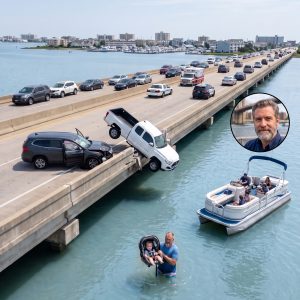
A toddler was thrown off a bridge into the bay during a 5-car crash.
A toddler was thrown off a bridge into the bay during a 5-car crash. A stranger jumped 30 feet after her. It happened May 2, 2021 on…

When My Widowed Father Kept Taking Women to the Same Restaurant, I Thought I Understood Grief. I Didn’t.
My mother died two years ago. My father, Daniel, was sixty-one, and for the first year he barely left the house except for groceries and the occasional…

After four long years of home visits, interviews, and endless waiting, our son finally arrived. Ethan was seven, small for his age, with serious brown eyes.
After four long years of home visits, interviews, and endless waiting, our son finally arrived. Ethan was seven, small for his age, with serious brown eyes. It…
The Beach
Sarah, a widowed Jewish woman, still elegant and remarkably fit for her age, was sunbathing on a quiet stretch of beach near Tel Aviv. The afternoon was…

The Crib, the Envelope, and Grandpa Walter
I was eight and a half months pregnant when three enormous crib boxes landed on our porch. Just looking at them made my back ache. “Marcus, can…

My husband froze my credit card and said, “From now on, you ask me before you spend a single dime.”
My husband froze my credit card while I was standing at the grocery checkout and told me, “From now on, you ask me before you spend a…