The emergency room at Riverside Memorial was unnervingly still that Tuesday morning. The faint hum of fluorescent lights echoed against sterile white walls, the air thick with the scent of disinfectant. Only the rhythmic click of a clock broke the silence—until the glass doors slid open with a sharp hiss.
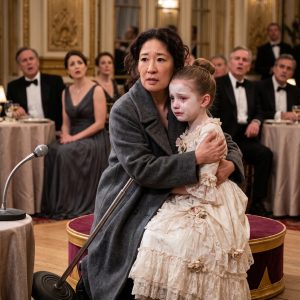
A young Black woman rushed inside, cradling a small, trembling child against her chest. The little girl, two-year-old Lila Brooks, was ghostly pale, her cheeks streaked with tears. Her tiny hands clutched at her aunt’s shirt as she whimpered, each shallow breath weaker than the last.
Danielle Carter—Lila’s aunt—had driven like her life depended on it. Her voice shook as she reached the reception desk.
“Please, my niece needs help! She’s been screaming in pain for hours—she can barely breathe!”
The receptionist barely looked up, pressing a button to call for a doctor. Moments later, Dr. William Crane emerged—a tall man in his fifties, his lab coat spotless, his expression carved in stone. He studied the child from a distance, then crossed his arms.
“Does she have insurance?” he asked flatly.
Danielle froze. “What? I—I don’t know, but she needs help now!”
Dr. Crane’s voice hardened. “Hospital policy. No insurance, no treatment. Take her to a community clinic—they handle these kinds of cases.”
Danielle stared at him, disbelief flooding her face. “She’s a baby! Look at her! She’s in pain!”
He sighed, exasperated. “Ma’am, we see this all the time. People overreact to avoid paying. I’m not falling for it.” Then, under his breath—just loud enough—he muttered, “People like you never do.”
Gasps rippled through the waiting room. Lila’s cries grew weaker as Danielle tried to comfort her, her own tears spilling freely. “Fine,” she snapped, her voice trembling with fury. “If you won’t help her, I’ll call her father. And when he gets here, you’ll wish you hadn’t said that.”
Dr. Crane gave a short, dismissive laugh. “Call whoever you want. But I’m not touching that child without proof of payment.”
Danielle fumbled for her phone, her hands shaking as she called her brother. She barely got the words out between sobs. Minutes later, the air in the emergency room shifted—like a storm had just rolled in.
The glass doors slid open again.
A tall man in a charcoal suit strode inside, his presence commanding instant silence. His eyes locked on the little girl in her aunt’s arms, then on the doctor. His jaw tightened.
Michael Brooks.
Not just Lila’s father—but a respected civil rights attorney, and, as fate would have it, a long-standing member of the hospital’s board of trustees.
He walked straight to the doctor, voice low but razor-sharp. “What happened here?”
Danielle tried to speak, but the truth was already written in her tear-streaked face—and in Lila’s limp body.
Michael turned to Dr. Crane. “You’re the attending physician?”
“Yes,” Crane replied stiffly. “But there was a misunderstanding about—”
Michael cut him off. “You refused treatment to a two-year-old in visible distress because you assumed her family couldn’t pay. That’s not a misunderstanding. That’s malpractice. And discrimination.”
Dr. Crane paled. “Sir, I—”
But Michael was already dialing. In full view of the staff and waiting patients, he spoke calmly into his phone. “This is Michael Brooks. I’m at Riverside’s ER. One of your doctors denied emergency care to my daughter due to racial and financial assumptions. I’m invoking an immediate ethics review.”
The room went dead silent. Nurses stopped mid-step. The receptionist looked like she wanted to disappear.
Within minutes, the hospital’s chief administrator hurried in, face ashen. After hearing eyewitness accounts, the decision was swift. Dr. William Crane was suspended pending investigation—his medical license soon placed under state review.
As security escorted the once-confident doctor away, Michael knelt beside his daughter, his voice breaking the tension with a tenderness that silenced even the whispers. “It’s okay, baby. Daddy’s here now.”
Lila whimpered softly, clutching his thumb with her tiny hand.
A new team of doctors took over instantly. Within moments, they diagnosed her with acute appendicitis—seconds from a dangerous rupture. She was rushed into surgery and, thanks to swift action, her life was saved.
Hours later, as she slept peacefully in recovery, Michael sat beside her hospital bed. Danielle whispered, “I’ve never seen anyone handle something like that.”
He didn’t look away from his daughter. “No one,” he said quietly, “should have to fight to be treated like a human being. Not her. Not anyone.”
By morning, Riverside Memorial issued a public apology to the Brooks family and launched a full investigation into racial bias within its emergency department. Dr. Crane’s suspension became indefinite.
But for Michael, it was never about revenge—it was about change.
And as he held his daughter’s hand, feeling the warmth return to her skin, he made a silent vow: no child would ever be denied care again—no matter what they looked like, or what someone assumed about their worth.