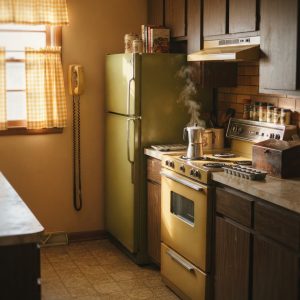
My name is Ruth Vandermeer. I’m seventy-one years old, and until the second week of April I lived in the house my husband Peter and I bought in 1978 with a down payment we saved by not taking a honeymoon.
Peter died in 2021. The house stayed.
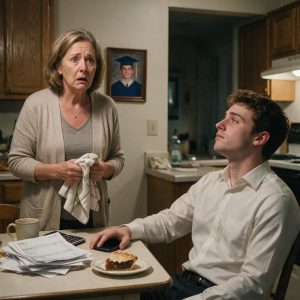
Last spring my son Gregory sat at my kitchen table and told me he was worried about me. Not about my mind — about the roof, the taxes, the driveway that heaves every February. He said a house shouldn’t be a burden to a woman living alone.
He said if it were his, on paper, he could refinance, fix the roof, handle everything. He and Danielle and my grandson Micah would move in. I’d have the downstairs bedroom and my own bathroom. Family in the house again.
I said yes on one condition.
“You don’t put me anywhere. Ever. Whatever happens.”
He looked genuinely hurt that I’d asked. “Mom. You’re my mother.”
We signed at a title company in a strip mall next to a nail salon. It took nineteen minutes.
The Eleven Weeks
In February, Gregory’s company sent him to Charlotte to open a distribution center. Eleven weeks, maybe twelve.
The morning he left, Danielle hugged me on the porch and said, “It’s going to be us girls.”
Within nine days she had started.
I want to be precise about this, because precision is the whole story.
She began leaving the back door standing open — not unlocked, open — and then finding it and closing it in front of me and saying, gently, “Ruth, honey, we have to be careful.”
She moved my pill organizer from the second shelf to the drawer, and when I asked about it she found it in under four seconds and set it down in front of me with a look I can only describe as pity performed for an audience that wasn’t there.
She started calling me sweetheart. Not warmly. The way you’d speak to a dog that had an accident on the carpet.
I noticed all of it. I want that understood. I noticed every single piece of it, in real time, as it happened.
I just didn’t say anything.
The Phone Call
On the fourth Tuesday I came down the hall in socks and heard her in the kitchen.
“Greg, she left the stove on again. Third time. I’m scared to leave Micah alone with her, I really am.”
My stove is a Whirlpool with a thirty-minute auto shutoff. I bought it in 2019 with my own money after Peter died because he’d always been the one to worry about that sort of thing and I decided to buy my way out of the worry.
I said her name.
She turned around holding the phone against her chest and smiled at me — a real, open, unbothered smile — and she did not cover the receiver.
“Yes, sweetheart, I know you’re confused. Why don’t you go sit down.”
That was the moment I understood that she was not going to stop, and that she was not afraid of me, and that she believed there was no version of the next few months in which I was a problem.
What She Never Asked
Danielle and I lived under one roof for eleven months. In that time she never once asked me what I did for a living.
Gregory knew. I assume he mentioned it at some point in six years of marriage and she filed it under things about his mother that didn’t matter.
I was a certified court stenographer for the Eighth Judicial District for thirty-one years. I retired in 2016.
Thirty-one years of sitting four feet from people who were lying, and writing down exactly what they said while they said it.
You do that for three decades and it stops being a job. It becomes the way your head works. Somebody says something to me and I hear it in transcript format — speaker, date, time, verbatim. It never turned off. It didn’t turn off when Peter got sick and it certainly didn’t turn off when a thirty-eight-year-old woman started building a case against me in my own kitchen.
I didn’t have to decide to keep a record.
I already had one. I’d been keeping it since the ninth day.
The Evaluation
The woman with the clipboard came on a Thursday. Danielle had arranged a geriatric assessment.
I answered every question correctly. I know I did.
But an evaluation is not just answers. It’s context. And Danielle had spent forty minutes with that woman before I was invited into my own living room, and she had a folder, and she cried twice.
The report said I presented well but that collateral report from a live-in family member indicated significant functional decline inconsistent with presentation.
Collateral report. That’s the term. It means: someone who lives with you says otherwise, and we weigh that heavily.
Eleven days later I was at Brookmill Residence on Delacourt Road, in a room with a plastic mattress cover and a window facing the visitor parking lot.
I asked Danielle why, in the doorway, while she was already picking up her purse.
“Because your son loves you too much to do it himself. Somebody had to be the adult.”
What I Did For Eighteen Days
I asked the aide on my hall, a young man named Terrence, for a pen and a legal pad.
Then I sat down and did the only thing I have ever been truly excellent at.
I wrote it all out. Every entry dated. Every quotation marked as verbatim or as reconstruction, because a transcript that overstates its own accuracy is worthless. February 11: back door found open, 6:40 a.m., D. present in kitchen. February 19: pill organizer relocated, second shelf to lower drawer, D. locates in approximately four seconds. March 14, 4:12 p.m., verbatim: “Yes, sweetheart, I know you’re confused. Why don’t you go sit down.”
Fourteen pages.
Then I made two phone calls.
The first was to Deborah Ochoa, who clerked in Judge Halloran’s courtroom for nine years and left to go to law school at forty-one and now practices elder law in an office above a bakery downtown. I have known Deborah since she was twenty-three years old.
She listened for eleven minutes. Then she said, “Ruth. Fourteen pages, dated contemporaneously, by a certified stenographer. Do you understand what you’re holding?”
The second call was to my daughter Ellen in Portland, who Danielle had told, kindly, that visits were overstimulating for me right now.
Ellen booked a flight for that night.
Sunday
Danielle came on Sunday afternoon to bring me slippers and take a photograph for Gregory. She did this every week. The photograph was very important to her.
She sat down across from me in the common room and started her voice — the soft, slow, carrying one, pitched for the other residents and the aides to overhear.
“Sweetheart, how are we today. Did we eat?”
I said I’d eaten.
Then the door behind her opened, and she turned around in her chair to see who it was.
Deborah Ochoa was standing in the doorway with a briefcase. Ellen was behind her.
Danielle’s mouth came open and nothing came out of it.
Act Two
Here is what Deborah put on the table, in this order.
First: the fourteen pages, notarized, with a signed declaration.
Second: a records request already served on Brookmill for the intake file — including Danielle’s written statement, in which she had asserted, in her own handwriting, that I was unable to reliably state my home address. Deborah attached forty-one Christmas cards addressed in my hand, postmarked December, collected by Ellen from four relatives in six days.
Third: my medical records, which Ellen had requested as my healthcare proxy — a designation Danielle had never checked, because she assumed a woman who signs over a house doesn’t read what else she signed. My physician of nineteen years had documented no cognitive concerns at my January physical. None.
Fourth, and this is the one that ended it: the deed transfer itself. Deborah’s petition alleged undue influence and asked the court to void the conveyance, on the grounds that the transfer was made in reliance on an express promise — witnessed by the title agent, who remembered it, because I had said it out loud in that office in front of her — that I would not be placed in residential care.
Gregory flew home Wednesday.
He read the fourteen pages at my kitchen table, which was technically his kitchen table, in about forty minutes. Then he sat with his hands over his face for a long time.
He hadn’t known. I believe that. I also believe he didn’t want to know, and there is a difference between those two things but it’s a smaller difference than he’d like it to be, and he knows that now.
He signed the deed back to me on the ninth of May without being ordered to.
They separated in July. That wasn’t my doing and I take no pleasure in it. Micah stays with me two weekends a month and calls the downstairs bedroom “Grandma’s apartment.”
Brookmill terminated its intake coordinator after Deborah’s records request surfaced what Danielle had been putting in that coat pocket. That one I’ll admit I enjoyed.
What I’d Say To You
I’m home. The roof still needs doing.
If somebody in your life has started narrating you to other people — correcting you gently in front of witnesses, finding things you didn’t lose, telling your children things about you that you’d have to be in the room to dispute — don’t argue with them.
Arguing is what they’re counting on. An old woman insisting she’s fine is the best evidence they could ask for.
Write it down instead. Date it. Keep it somewhere they don’t go.
You don’t need to be a stenographer. You need a spiral notebook and the willingness to believe your own eyes for eleven weeks.
Danielle looked at me for a year and saw a woman who had stopped keeping track.
I was the only one in the house who never stopped.