I raised Maya to be kind. To hold doors, to share what she had, to look people in the eye when they spoke. But I never imagined she’d become someone’s miracle.
My name is Grace. I’m 38, divorced, and I work two jobs to keep our little apartment in a rust-belt town where factories closed before my daughter was born.
Maya is fourteen. Quiet. Bookish. The kind of kid who notices things other people miss—a limping dog, a kid eating lunch alone, the way someone’s smile doesn’t quite reach their eyes.
Last Tuesday started like any other. Maya was walking home from her shift at the library where she volunteers, cutting through the parking lot behind the old hardware store.
That’s when she heard the screaming.
A minivan had slammed into a telephone pole. Smoke was pouring from the hood. And inside, trapped in his car seat, was a little boy. Maybe three years old.
The driver—his mother—was slumped against the steering wheel, unconscious.
People were gathering. Filming on their phones. Shouting that someone should do something.
Maya didn’t shout. She moved.
She yanked the back door open, her hands shaking, and unbuckled the car seat straps she’d practiced on a hundred times babysitting the neighbors’ kids. She pulled that little boy out just as flames licked up from under the hood.
The fire department arrived four minutes later. By then, Maya was sitting on the curb, the boy in her lap, both of them covered in soot.
“You saved him,” the paramedic told her. “Another minute, and we’d be telling a different story.”
I got the call at work. I don’t remember driving to the scene. I just remember holding my daughter, feeling her heartbeat against mine, and thinking: This is who she is. This has always been who she is.
The mother survived. Concussion, broken collarbone, but alive. Her name was Diane.
For three days, we heard nothing. I figured that was the end of it—a terrifying story that would become a family legend, something Maya would tell her own kids someday.
Then on Friday evening, a black SUV pulled into our apartment complex.
A man stepped out. Late fifties, silver at the temples, wearing a coat that probably cost more than my monthly rent. He walked up to our door like he’d been there before.
“Mrs. Bennett?” he said when I answered.
“It’s Ms.,” I said. “Can I help you?”
“My name is Richard Hollis. Diane is my daughter. And the little boy your Maya saved—that’s my grandson, Caleb.”
I invited him in. What else could I do?
He sat on our secondhand couch, looking around at our modest living room without a trace of judgment. When Maya came out of her bedroom, he stood up like she was royalty.
“I’ve spent my whole life building a business,” he said, his voice rough with something I couldn’t name. “I’ve won awards. Made money. Lost my wife three years ago. And none of it—none of it—would mean anything if I’d lost that little boy.”
Maya looked at the floor. “I just did what anyone would do.”
“No,” Richard said firmly. “Anyone would have stood there. Waited for someone else. You moved.”
He reached into his pocket and pulled out an envelope.
“I’m not trying to buy your heroism,” he said, handing it to me. “But I want to do something. College. Trade school. Whatever Maya wants. I’ve set up a fund.”
I opened the envelope. My hands went numb.
“This is…”
“Enough to give her choices,” he finished. “Because she gave me back my family.”
Maya looked at me, then at him. Her voice was small but steady.
“I don’t want anything for doing what was right.”
Richard smiled. It was the first time his face had softened.
“That’s exactly why you deserve it.”
He left that night, but not before giving us his number and an invitation to visit whenever we wanted.
A week later, we drove out to his house—a beautiful old farmhouse on twenty acres. Caleb came running out, healthy and laughing, and threw his arms around Maya’s legs like he remembered.
Maybe he did.
Diane was there, still healing, tears streaming down her face as she hugged my daughter.
“I failed him that day,” she whispered. “I fell asleep at the wheel. I was so tired, trying to do everything alone…”
“You didn’t fail,” Maya said, and I’d never been prouder of her. “You survived. And now you get to keep being his mom.”
We stayed for dinner. Richard told stories about his late wife. Diane laughed for the first time since the accident. Caleb fell asleep in Maya’s arms.
On the drive home, the stars bright above the empty highway, Maya was quiet.
“Mom,” she finally said. “I don’t think I did anything special.”
I reached over and squeezed her hand.
“That’s what makes it special, baby. You didn’t think. You just loved.”
She leaned her head against the window, and I saw her smile in the reflection.
Our apartment was the same when we got home. The same creaky stairs, the same flickering hallway light. But something had shifted.
Because we learned something that week: ordinary people can do extraordinary things. And sometimes, a single moment of courage doesn’t just save a life.
It builds a bridge to an entirely new one.
Related Posts

He Kept a Money Jar for Six Days. Then He Told Me Who Took His Sister
The first thing I noticed was the coins. Nickels, mostly. A few crumpled ones. My son Theo had started hiding a mason jar under his bed, and…
The Signal at Gate 14
Officer Renata Ford had worked airport security for six years, long enough to develop an instinct for the wrongness that doesn’t show up on any scanner. It…

She Stopped Wearing Makeup. Hollywood Started Paying Attention Again
She Stopped Wearing Makeup. Hollywood Started Paying Attention Again. Pamela Anderson walked into Paris Fashion Week in September 2023 wearing nothing on her face. No foundation, no…

A toddler was thrown off a bridge into the bay during a 5-car crash.
A toddler was thrown off a bridge into the bay during a 5-car crash. A stranger jumped 30 feet after her. It happened May 2, 2021 on…

When My Widowed Father Kept Taking Women to the Same Restaurant, I Thought I Understood Grief. I Didn’t.
My mother died two years ago. My father, Daniel, was sixty-one, and for the first year he barely left the house except for groceries and the occasional…
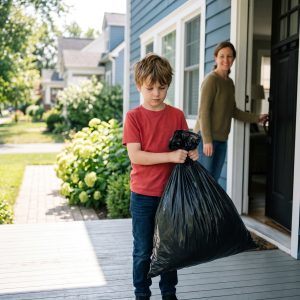
After four long years of home visits, interviews, and endless waiting, our son finally arrived. Ethan was seven, small for his age, with serious brown eyes.
After four long years of home visits, interviews, and endless waiting, our son finally arrived. Ethan was seven, small for his age, with serious brown eyes. It…