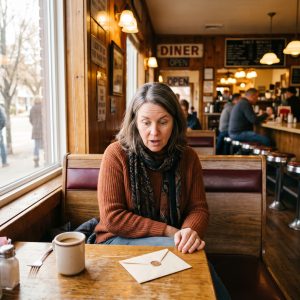
I used to count the years not by my age, but by the number of times my parents, Graham and Marilyn, forgot I existed on Christmas Day. When I was seven, they said they thought I was napping. By the time I was thirty-five, an analytical specialist at a risk-compliance firm, I knew the truth: I wasn’t just forgotten; I was a calculated oversight. I was the emergency fund, the bail money, the liability they remembered only when they needed something. Every year, I longed for an invitation to their perfect holiday tableau, and every year, the door was firmly shut.
Last year was the final straw. I drove four hours in a sleet storm to their house, uninvited, only to see them laughing through the window. My chair wasn’t set. When my mother opened the door, her face wasn’t relief, but irritation. “We thought you were working, Clare,” she’d said, blocking the warmth of the foyer. I simply handed her the expensive bag of gifts, turned around, and drove four hours back to my empty apartment, shedding the last of my foolish hope like a coat.
That night, the numbness that was my professional armor finally hardened into a decision. In my line of work, you drop a client who refuses to mitigate a risk. So, this year, I dropped my family.
The Fortress and the Forgery
The preparation took eleven months. I erased myself: new phone, scrubbed social media, a ghost in the digital world. And then, I bought the house. It wasn’t a cozy home; it was a fortress: a beautiful, dark, stone manor in the remote town of Glenn Haven. I bought it under a blind trust, a Limited Liability Company called Nemesis Holdings. To the outside world, Clare Lopez was gone.
The plan was for silence and peace. But my silence was their opportunity.
On the afternoon of December 23rd, my quiet was shattered. Two black SUVs and a locksmith’s van rolled up my driveway. Behind my iron gate stood my parents, Graham and Marilyn, and my younger brother, Derek. They hadn’t come to visit. They had a forged lease claiming tenancy in the basement—a lease Graham insisted I had signed. They were there to break in, install Derek’s industrial crypto mining rigs, and exploit my property for their financial panic.
Graham, seeing my disbelief, explained the audacity of their plan. He had found an old architectural forum post I’d made, and Derek had used the metadata and my mother’s stolen family records to track the house and forge my identity to set up his schemes. My rage was cold and clinical. They weren’t just taking my house; they were layering reality with lies, creating a paper trail that would paint me as the crazy, ungrateful daughter and them as the concerned saviors.
The Counter-Strike
They thought they had me trapped in a domestic dispute—a civil matter the local police wouldn’t touch. But they forgot what I do for a living: I don’t fight in the street; I fight in the fine print.
As they drilled into my historic front gate, I called Grant Halloway, a high-stakes litigation lawyer. Instead of filing a messy eviction, we went for a surgical strike. We filed an emergency zoning violation with the town’s Preservation Council. The manor was a Class A Protected Structure. Installing industrial-grade server equipment and tampering with the property’s historic features was a massive violation.
The preservation council—a jury of my most judgmental, history-loving neighbors—voted unanimously to issue a cease-and-desist order, threatening a $1,000-per-day fine for every single violation. It was the perfect leverage. Derek couldn’t move in his equipment without bankrupting himself with municipal fines.
But they weren’t done. On Christmas Eve morning, Derek, in a fit of spite, smashed the main electrical breaker on his way out, plunging my entire four-acre fortress into cold, dark silence. And Marilyn? She took to Facebook, posting a photo of a tired me, weeping that I had gone “off my medication” and abandoned them in the snow. They were waging a public war to discredit my sanity before I could speak the truth.
The Open House Finale
They thought the dark, silent house meant I had fled, defeated. They were wrong. I had hired an electrician to fix the breaker and discreetly install hidden security cameras. I was simply setting the bait.
I knew they would return on Christmas Eve night. They had to. Derek had a debt deadline looming, and their egos were too bruised to retreat. So, I set a trap of witnesses.
I invited the very people they were trying to defraud and evade: Andrea Mott, a local investigative reporter, the Preservation Council members, the original locksmith (who had realized he was tricked), and an off-duty officer hired to enforce trespassing laws. We drew the curtains and sat in silence, making the house look abandoned.
At 10:30 PM, the crowbar struck the front door.
Graham, Marilyn, and a frantic Derek smashed through the heavy oak door, weapons and fraudulent paperwork in hand, screaming about a “wellness check” and “taking back what’s theirs.” They stumbled into the dark foyer—and stopped dead.
They found themselves surrounded by the entire town council, a reporter recording every word, a policeman holding a taser, and me, standing in the cold, clear light of my self-made Christmas tree.
In that moment, the narrative flipped. The reporter had the story. The council had the violation. The police had the vandalism and the proof of conspiracy. I played the final card: an audio recording of Graham admitting they were only there to set up the rigs to stall Derek’s loan sharks. The lie of the “concerned family” shattered.
Officer Tate placed Derek in handcuffs for felony vandalism and breaking and entering. Then, he cuffed Graham as a co-conspirator. Marilyn, stripped of her stage, was arrested for conspiracy to defraud.
Final Reflection
As the police cars drove away, taking the toxicity of my family with them, the house fell silent again. The door was broken, the floor was snowy, and I was utterly alone. Yet, standing there with the quiet respect of the strangers who had witnessed my war, I felt a warmth I’d never known. This year, my Christmas wasn’t an obligation or a performance—it was a victory for self-possession. I realized that you don’t ask for permission to be happy, you build your own walls and lock the gates to those who only remember you when they need to take. The cost of the broken door was nothing compared to the price of my peace.
This article shares a personal story inspired by real-life experiences.