I almost didn’t take the call.
It came in on a Thursday afternoon, forty minutes before the end of my shift. A husband, Thomas Waverly, frantic and apologetic in the same breath, explaining that his wife had become “difficult” with the care agency they’d previously used, and could someone please come and assess her, because his mother said Miriam was deteriorating and he was scared, he was really scared.
I took the call. I always take the Thursday calls. No one else wants them.
Calloway Circle looked the way certain streets look when the residents have agreed, collectively and silently, to pretend the outside world doesn’t exist. The lawns were immaculate. The cars were clean. American flags hung from identical black brackets beside identical front doors.
Number 14 had a blue door and a wreath made of dried hydrangeas. Homemade. The kind of detail that signals effort, warmth, a person who cares.
Dolores Waverly answered before I could knock.
She was sixty-four, compact and energetic, with reading glasses pushed up into silver hair and a dish towel tucked into her apron. She had the face of a woman who had spent decades being described as “a rock” and “a godsend” and “I don’t know what we’d do without her.”
“You must be from the agency,” she said, pulling the door wide, already talking. “I am just so relieved. Thomas is beside himself, and I’m doing everything I can, but Miriam — bless her heart — she has simply stopped responding to reason. The doctors say it’s prenatal psychosis. Her mind is playing tricks. She thinks — ” Dolores lowered her voice to a pained murmur ” — she thinks I’m hurting her. Can you imagine?”
I said all the right things. I followed her through the house.
The kitchen was spotless. The living room was spotless. The hallway leading to the back bedroom was spotless, and it smelled of bleach and lavender, the combination you use when you need to cover something that doesn’t wash out easily.
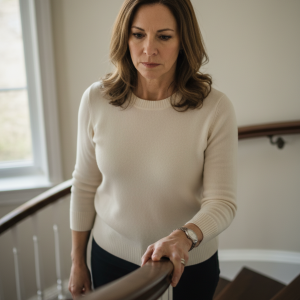
Miriam was in the corner of the bedroom in a nursing chair, feet flat on the floor, hands folded over her swollen belly. She was wearing a maternity top that had once fit her. It didn’t anymore. Her collarbones cast shadows. Her face was a geometry of sharp angles that shouldn’t have been there at seven months pregnant.
Her eyes, though. Her eyes were alert. Watchful. Not the eyes of a woman losing her mind.
Dolores positioned herself in the doorway and stayed there.
I introduced myself. I explained I was there to check vitals, ask a few questions, make sure everything was being properly documented. Routine. All routine.
Miriam nodded. She let me take her blood pressure. She let me check her pulse. She answered my questions in a flat, quiet voice — yes, she was sleeping; no, she wasn’t in pain; yes, Dolores was very attentive.
Every answer was a careful, practiced nothing. She was performing cooperation for the woman in the doorway.
Then I leaned forward to adjust the cuff, and I was close enough that my ear was near her mouth, and Dolores was too far away to hear, and Miriam’s lips barely moved.
She poisons the food.
I sat back. I wrote something meaningless on my clipboard. I kept my face completely still.
I finished the assessment in fifteen minutes. I told Dolores everything looked stable, that I’d file a report, that the agency would follow up. Dolores clasped my hand with both of hers and thanked me with the practiced sincerity of someone who has been thanking people strategically for decades.
I walked to my car. I sat in it for approximately ninety seconds.
Then I called my brother-in-law, Dennis, who works in financial crimes investigation and owes me more favors than either of us can count.
“I need you to pull everything you legally can on a Dolores Anne Waverly,” I said. “Whatever you can get me before five o’clock.”
“That’s two hours.”
“I know.”
Dennis called back in ninety minutes.
I was still sitting in the parking lot of a gas station three blocks from Calloway Circle, engine running, watching the time.
“Okay,” he said, and his voice had the particular flatness it gets when something has genuinely disturbed him. “So. Dolores Waverly has a life insurance policy on a Miriam Waverly, opened fourteen months ago. Face value of $475,000. Sole beneficiary: Dolores.”
Fourteen months ago. Thomas and Miriam had announced the pregnancy thirteen months ago.
“She opened it before Thomas knew,” I said.
“Before the public announcement,” Dennis confirmed. “But here’s the thing that really turned my stomach. There’s a secondary filing — a petition for emergency guardianship of an unborn child, drafted by a family law attorney in Dolores’s name, dated eight months ago. It was never filed. But it was drafted. It was ready.”
I stared at the gas station sign. The numbers on the price display blurred.
Dolores hadn’t decided to do this when Miriam got “sick.” She had planned it before the pregnancy was even announced. The sickness was the plan.
Thomas Waverly’s office was on the fourteenth floor of a glass building downtown. He was a project manager for a regional construction firm — patient, methodical, the kind of man who checks his work twice. He met me in the lobby when I said it was urgent, and he took me to a small conference room, and he sat across from me with his hands folded on the table like a man bracing for bad news about a building inspection.
I spread the papers out. The insurance policy. The guardianship petition. A printout Dennis had pulled showing the financial account Dolores had opened in her own name six months prior, funded by a transfer from Thomas and Miriam’s joint savings — $31,000, moved in increments small enough not to trigger automatic alerts.
Thomas looked at each document for a long time without speaking.
“She handles all our billing,” he finally said. “She offered. When Miriam got sick, she said she would manage everything so I could focus on work.”
“Miriam isn’t sick,” I said. “Miriam is being kept sick.”
The sound he made wasn’t a word. It was something that comes from a place beneath language.
He looked up at me. His eyes were red-rimmed, dry, the way eyes get when grief is too large and too sudden for tears.
“What do I do?” he whispered.
I had made one more call from the gas station parking lot, before I’d driven to his office. A contact who dealt in a particular kind of equipment.
I reached into my bag and set the small device on the conference table between us.
Thomas stared at it.
“You go home,” I said. “You walk in like nothing has changed. You tell her you’ve been worried about Miriam, that you want to talk through the care plan. You let her talk. That’s all. You just let her talk.”
His jaw tightened. He picked up the device.
“And if she doesn’t say anything?” he asked.
“She’ll say something,” I said. “People like Dolores always do. They’ve been waiting for someone to finally ask.”
I sat in my car on the street behind Calloway Circle, headphones on, phone patched through to the transmitter. The neighborhood was quiet in the early evening, the sky going gold and rose above the identical rooflines.
I heard Thomas’s key in the lock. The door. His voice calling out.
I heard Dolores’s footsteps.
I heard her say, warmly, easily, “Sweetheart, you’re home early. I made soup.”
And then Thomas asked her, quietly and carefully, about the insurance policy.
The warmth in Dolores’s voice didn’t disappear. It curdled.
What she said in the next four minutes — calmly, without remorse, as though explaining something obvious to a slow child — was the most methodical articulation of premeditated harm I have ever heard from anyone who had never been inside a courtroom.
She had decided, she explained, that Miriam was not the right kind of woman for this family. That the baby deserved better origins. That the money would fund a proper upbringing. That Thomas would grieve, naturally, but he would understand eventually, and she would be there to help him through it.
She said it the way someone describes a household budget.
Thomas didn’t respond. He had been coached not to. He stood very still, and the transmitter picked up his breathing, which was the controlled, effortful breathing of a man keeping himself from coming apart.
Thirty-one minutes later, Dolores Waverly was in handcuffs in her blue-doored kitchen, still wearing her apron, still insisting that everyone was overreacting.
Miriam was taken by ambulance to the hospital. She was dehydrated, severely malnourished, and showing early signs of a sedative compound that the toxicology screen later confirmed had been present in the herbal tea Dolores prepared for her every morning and every night.
She delivered a healthy boy six weeks later. They named him Ellis.
Thomas sent me a photo on the day they brought Ellis home. Miriam was sitting in the front seat of their car in the hospital parking garage, holding the baby against her chest, eyes closed, face tipped down toward his head. The way she held him looked like someone holding something they’d been told they would never have.
I’ve been a home health aide for eleven years. I’ve walked into a lot of rooms. I’ve seen people in every possible state of need and diminishment and fear.
But I’ve also learned this: the instinct that makes you take the Thursday calls, that makes you lean in close enough to hear what someone cannot say out loud — that instinct is not nothing. It is, sometimes, everything.
Miriam couldn’t shout. She couldn’t run. She couldn’t write a letter or make a call.
She moved her lips. Three words.
That was enough.