The house on Maple Street had stood for over a century, its Victorian gables and wraparound porch aging gracefully under the Vermont sky. Gerald Harrison had called it home since 1972, the year he married Elizabeth and brought her there as a young bride. Now, at seventy-six, with silver hair and hands weathered by decades of work, he sat in his favorite armchair and wondered how well he’d ever really known his wife.The sound had started three nights after Elizabeth fell.It was a Thursday evening when she’d slipped on the kitchen tile, her hip shattering with a sound that still made Gerald’s chest tighten. The surgery had gone well, the doctors assured him, but rehabilitation would take weeks. For the first time in their marriage, Gerald found himself alone in the house that had sheltered their family through births, deaths, holidays, and ordinary Tuesdays that now felt precious in retrospect.The silence was oppressive.Gerald had served twenty years in the Navy, had weathered storms at sea that should have killed him, had buried his parents and watched his children grow into adults with families of their own. He thought he knew what loneliness felt like. He was wrong.This was different. This was the absence of the woman who had been his compass for more than half a century.He heard it first on that Thursday night, as he lay in their bed, unable to sleep on Elizabeth’s side even though it would have been more comfortable. A scratching sound, deliberate and rhythmic, coming from directly above the kitchen.At first, Gerald dismissed it. Old houses made sounds. Mice in the walls. Branches against the roof. Nothing to worry about.But the sound persisted. And there was something about its pattern—scratch, pause, scratch scratch, pause—that felt almost intentional. As if whatever was up there was trying to communicate.On the fifth night, Gerald stood in the kitchen at two in the morning, staring at the ceiling, armed with nothing but a flashlight and a growing sense of unease.The attic.In fifty years, Gerald had never been inside it.The realization hit him with surprising force. He’d painted every room in this house. He’d replaced the roof, updated the plumbing, refinished the floors. But he had never, not once, been in the attic.The door at the end of the upstairs hallway had been sealed with a heavy brass padlock for as long as he could remember. Elizabeth had always been matter-of-fact about it: her parents’ old furniture, winter clothes they no longer needed, Christmas decorations that were easier to buy new than to dig out of storage.”Just junk, darling,” she’d say whenever he mentioned it. “Nothing worth the trouble of sorting through.”And Gerald, trusting and secure in their partnership, had simply accepted it.Now, standing in the dark kitchen listening to that rhythmic scratching, he felt the first crack in the foundation of his trust.The next morning, Gerald searched the house for keys. He was methodical about it, the way the Navy had taught him to be methodical about everything. He checked Elizabeth’s jewelry box, her desk drawer, the ceramic bowl by the front door where she kept spare keys for the shed and the garage.Nothing fit the attic lock.He tried every key on her keyring—the one she kept in her purse and never went anywhere without. Still nothing.Elizabeth was organized to a fault. She labeled everything, kept inventories, never misplaced important items. If none of her keys fit that lock, it was because she didn’t want him to have access.The thought lodged itself in Gerald’s mind like a splinter.That afternoon, he called his son, James, who lived thirty minutes away with his wife and two teenagers.”Dad? Everything okay?” James’s voice was warm, concerned.”Your mother’s fine,” Gerald said quickly. “Doing well in rehab. I just… I had a question about the attic.”There was a pause. Too long. Too careful.”The attic?” James said finally.”Yeah. I was thinking of going through some of the old boxes while your mother’s away. But I can’t find the key to the padlock.”Another pause.”Dad, I don’t think you should—””Why not?””Just… maybe wait until Mom gets home. She’d want to help you sort through things.”The splinter drove deeper.”James, do you know what’s up there?””No. No, I don’t. I just think you should wait.”But James had hesitated. And Gerald, who had raised this boy from infancy, who had taught him that honesty was the most important virtue a man could possess, heard the lie in his voice.After he hung up, Gerald sat in the living room for a long time, staring at a photograph on the mantel. It showed Elizabeth and him on their wedding day—she in a simple white dress, he in his Navy uniform, both of them impossibly young and full of hope.Had she been carrying secrets even then?That night, Gerald took a screwdriver to the attic lock.His hands shook as he worked the mechanism, guilt and determination warring inside him. This was his wife’s privacy he was violating. This was trust he was breaking.But the scratching had returned, louder now, more insistent.The lock gave way with a metallic snap.Gerald pushed open the door and was immediately hit by a wave of stale air—metallic, musty, carrying the weight of decades. He climbed the narrow wooden stairs, the beam of his flashlight cutting through the darkness.The attic was exactly as Elizabeth had described it: dusty furniture draped in sheets, boxes labeled with Christmas decorations, old lamps with broken shades. Nothing remarkable. Nothing worth hiding.Except for the trunk.It sat in the far corner, partially hidden by a tarp, as if someone had tried to make it invisible. Unlike everything else in the attic, which was covered in thick dust, the trunk looked recently tended. The brass hinges gleamed faintly in the flashlight beam.It had a lock.Gerald didn’t hesitate this time. He brought the screwdriver down hard, again and again, until the lock sprang open.Inside were letters. Hundreds of them.They were organized chronologically, each year bound with white string that had yellowed with age. The earliest bundle was dated 1966. The most recent was from 1978.Gerald picked up the first letter with trembling hands.The handwriting was neat, masculine, each letter carefully formed.My dearest Elizabeth,I’m writing this from somewhere I can’t name, looking at stars I can’t identify. But they’re the same stars you see back home, and that thought is the only thing keeping me sane.I think about our last night together. The way you smiled when I told you I’d be home by Christmas. The way you kissed me goodbye. I’m holding onto that moment like a lifeline.Stay strong, my love. I’ll be home soon. We’ll have that wedding we planned. We’ll have the life we dreamed of.All my love,
DanielGerald read it twice. Then he opened another letter. And another.Each one was a window into a love story he’d never known existed.Daniel wrote about the jungle heat, about watching his friends die, about the terror and tedium of war. But mostly, he wrote about Elizabeth. About the future they would build together. About the children they would have. About growing old on a porch somewhere, watching sunsets.The letters from 1967 had a different tone.My dearest Elizabeth,I got your letter today. I must have read it a hundred times, trying to make sense of the words.Pregnant.We’re going to have a baby.I cried, my love. I’m not ashamed to say it. Sitting here in this hellhole, surrounded by death, and you’ve given me the most beautiful news imaginable.Tell our son—I know it’s a boy, I can feel it—tell him his father is fighting to come home. Tell him I love him already. Tell him I’ll teach him to fish and to throw a baseball and to treat women with respect.I’ll be home soon. I promise.All my love,
DanielGerald’s vision blurred.Our son.He opened a letter from 1968. The handwriting was shakier, the paper stained.Elizabeth,They tell me you think I’m dead. They tell me you received a telegram. They tell me you’ve moved on.I don’t believe them.I’m alive. I’m coming home. Wait for me.Please wait for me.DanielBut she hadn’t waited.Gerald knew the timeline without needing to calculate it. James was born in March of 1967. Gerald had met Elizabeth at a church social in September of that year—a quiet, sad woman with a baby and no ring on her finger.He’d fallen in love with her kindness, her resilience, the way she smiled at James even when she looked like she hadn’t slept in days.When he’d proposed three months later, she’d told him about the father—a soldier, killed in Vietnam, never knowing about the baby.Gerald had held her while she cried and told her it didn’t matter. He would love James as his own.And he had.God, how he had.Now, sitting in the dust of the attic with letters scattered around him like confetti from someone else’s life, Gerald understood that Elizabeth had told him the truth—just not all of it.She thought Daniel was dead.But Daniel had survived.The later letters told the story. Daniel had been held as a prisoner of war, enduring three years of torture and deprivation in a camp the U.S. government didn’t acknowledge until years later. By the time he was released in 1971, Elizabeth had been married to Gerald for three years.The letter dated December 1971 was the shortest.Elizabeth,I saw you today. You were at the grocery store with your husband and James. He’s so big now. He has your eyes.You looked happy.I won’t interfere. But I can’t stay away either. Not completely.I’ll always love you.DanielGerald’s hands clenched around the paper.He read letter after letter, watching Daniel’s life unfold in carefully chosen words. He’d moved to their town in 1975, taking a job at the hardware store. He’d never married. He’d watched James from afar—attending his baseball games but sitting in the back row, showing up at his high school graduation but leaving before the reception.The last letter was dated 1978, two months after James graduated.Elizabeth,I won’t write anymore. It’s not fair to you, and it’s torture for me.I want you to know that I don’t regret loving you. I don’t regret coming back here to be near James, even if he doesn’t know who I am.Some loves don’t end just because circumstances change. Some loves are forever, even when forever looks nothing like we imagined.Be happy, my Elizabeth. That’s all I ever wanted for you.Yours always,
DanielGerald sat in the attic until his legs went numb.When he finally climbed down, the sun was setting. He drove to the rehabilitation center with the letters in a box on the passenger seat.Elizabeth was sitting up in bed, watching the news. She turned when he entered, her face lighting up the way it always did when she saw him.Then she saw the box.The color drained from her face.”Gerald—””How long were you going to keep this from me?” His voice was steady, but his hands shook as he set the box on her bedside table.Elizabeth closed her eyes. “I never wanted you to find them.””I found them. Now tell me the truth. All of it.”And she did.She told him about Daniel—her first love, her fiancé, the father of her child. She told him about the telegram that had destroyed her world, about the pregnancy that had isolated her from her family, about the desperation that had made her accept Gerald’s proposal even though she barely knew him.”I thought Daniel was dead,” she whispered, tears streaming down her face. “I mourned him, Gerald. I mourned him so deeply I thought I’d never feel anything again.””But he came back.””Not for two years after we married. By then, I had built a life with you. I loved you. I love you.””Did you see him?”Elizabeth nodded. “Once. He came to the house while you were at work. James was three. Daniel just wanted to see him. He stood in the doorway and cried. Then he left.””And the letters?””He sent them to my sister’s house. She’d bring them to me once a month. I know I should have thrown them away, but I couldn’t. They were the only proof that he’d really existed. That what we had was real.”Gerald sat down heavily in the chair beside her bed. “James knows, doesn’t he?”Elizabeth’s silence was answer enough.”When did he find out?””Daniel reached out to him when James turned thirty. He was dying—or he thought he was. Some kind of cancer scare. He wanted James to know the truth before it was too late.””And James just… accepted it?””He was angry at first. At me, at Daniel, at you for not telling him. But they started meeting. Just coffee, a few times a year. Daniel never tried to replace you, Gerald. He just wanted to know his son.”Gerald looked at his wife—this woman he’d loved for fifty-two years, who’d kept a secret this enormous, this devastating, hidden away in their attic like an old trunk of forgotten things.”Is he still alive?” Gerald asked quietly.Elizabeth shook her head. “He died last week. James went to the funeral. He didn’t tell you because… because he didn’t want to hurt you.””I raised him,” Gerald said, his voice breaking. “I taught him to ride a bike. I sat through every baseball game, every parent-teacher conference, every milestone. He’s my son.””He is your son,” Elizabeth said fiercely. “DNA doesn’t make you a father, Gerald. Love does. Showing up does. You did that. Daniel never tried to take that from you.””But you took the choice from me. You and James both. You decided what I could handle.””You’re right.” Elizabeth reached for his hand, and after a moment’s hesitation, he let her take it. “We were wrong. I was wrong. I was a coward, Gerald. I was terrified that if you knew the truth, you’d leave. That you’d look at James differently. That everything we built would crumble.””And now?””Now you know. And I’m still terrified.”Gerald looked down at their joined hands—hers delicate and age-spotted, his large and callused. They’d held hands through fifty-two years of joy and grief, through births and deaths, through ordinary moments that had somehow added up to a lifetime.”I need time,” he said finally.”I understand.”He stood to leave, then paused at the door. “Did you ever stop loving him?”Elizabeth met his eyes. “I loved the boy he was. But I chose you, Gerald. Every single day for fifty-two years, I chose you.”—Gerald drove home in silence. The house felt even emptier than before, haunted now not by loneliness but by ghosts of the past.He found James waiting on the porch.His son—because James was his son, in every way that mattered—stood when Gerald approached. He was fifty-four now, graying at the temples, with Elizabeth’s eyes and Gerald’s steady presence.”Mom called,” James said. “She told me you found the letters.”Gerald nodded, unable to speak.”I’m sorry,” James said. “I’m so sorry, Dad. I should have told you.””Why didn’t you?””Because you’re my father. Because telling you felt like betraying you. Because I didn’t want you to think that meeting Daniel changed anything between us.””Did it?”James shook his head. “No. He was a good man who had a terrible thing happen to him. I’m glad I got to know him. But he wasn’t my dad. You are.”Gerald felt something break loose in his chest—a knot of anger and hurt and fear that he’d been carrying since he’d opened that trunk.He pulled James into a hug, the way he’d done when James was a boy with scraped knees and hurt feelings.”I love you,” Gerald said. “That hasn’t changed.””I love you too, Dad.”—Three weeks later, Elizabeth came home from rehab.Gerald had spent those weeks in reflection, walking through their house, remembering their life together. He’d read through all of Daniel’s letters, trying to understand the man who’d loved his wife first, who’d suffered unimaginable hardship, who’d given up his own happiness so that Elizabeth and James could have peace.He’d also found something else in the attic, tucked beneath the trunk: a photo album he’d never seen before.It was filled with pictures of Daniel—young and handsome in his uniform, laughing with Elizabeth at what must have been a dance, holding Elizabeth’s hand in front of a church. There were newspaper clippings about his military service, about his capture, about his return home.There was also a single photograph of Daniel from much later—graying, weathered, standing in the back of a crowd at James’s high school graduation, his eyes fixed on the stage with an expression of such profound love and loss that Gerald had to look away.He’d lost everything, Gerald thought. And he’d still found a way to be grateful for what little he could have.When Elizabeth walked through the door, leaning heavily on a walker, she looked fragile in a way Gerald had never seen before.”Welcome home,” he said.She searched his face, looking for signs of anger or rejection. Instead, Gerald took her hand and led her to the couch, where he’d laid out the photo album.”I think,” he said quietly, “that it’s time we stopped hiding parts of our story. Even the painful parts.”Elizabeth’s eyes filled with tears. “Gerald—””He loved you,” Gerald said. “And he was a good man. I wish I’d known him. I wish I’d known the full truth from the beginning. But I understand why you were afraid.””I’m still afraid,” Elizabeth whispered.”Don’t be.” Gerald squeezed her hand. “We’ve built something strong enough to survive the truth. We have children who love us, grandchildren who adore us, and fifty-two years of memories that nobody can take away.””Do you forgive me?”Gerald thought about Daniel’s letters, about the love they contained, about the sacrifice of a man who’d stepped back so that the woman he loved could be happy.”I forgive you,” he said. “And I think… I think I forgive him too. For surviving. For loving you. For giving us the chance to have this life together.”Elizabeth leaned her head against his shoulder, and they sat together in the afternoon light, two people who’d weathered storms they’d never imagined, who’d kept secrets they shouldn’t have kept, who’d loved imperfectly but deeply.The attic door upstairs stood open now. The letters were packed away, but not hidden. They were part of the story—the full, complicated, beautiful story of a love that had survived war, loss, time, and truth.And in the end, Gerald thought, that was enough.
Related Posts

A Daughter’s Love Beyond Bars: 5-Year-Old’s Heartbreaking Graduation Moment Outside Prison Walls
In a world that often rushes past moments of genuine emotion, one photograph stopped the internet in its tracks. The image captures something so pure, so heartbreaking,…
Teen Hero Swims 4 Hours Through Freezing Ocean to Save His Family from Certain Death
The sun was setting over Geographe Bay in Australia when 13-year-old Ryan’s world turned into a nightmare. What started as a peaceful family outing on the water…
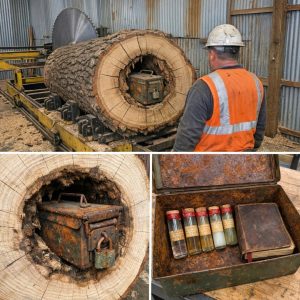
Sawmill Workers Split Open Hollow Log and Discover Mysterious Rusty Box Hidden Inside
The morning started like any other at the timber mill in rural Oregon. Workers were processing logs as usual when they heard an unusual metallic clang that…

Father Films Son Being Swallowed by Humpback Whale in Patagonian Waters
The waters off Chilean Patagonia are known for their breathtaking beauty and abundant marine life. But on February 8, 2025, those same waters became the setting for…

The Algorithm of Escape: How a Pregnant Woman Counted 294 Beatings, Then Erased Her Husband’s Empire with a Single Password
The Mathematician’s Daughter I learned to count before I learned to speak. My mother used to tell the story at dinner parties—how at eighteen months old, I…

A Daughter’s Love Shines Through: Tallulah Willis Honors Family Legacy With Heartfelt Throwback Photos
The bond between parent and child transcends time, circumstance, and even the cruel progression of disease. In recent months, Tallulah Willis, the youngest daughter of Hollywood icon…