I never planned on falling in love again.
After Marcus left — packed a bag on a Tuesday, gone by Thursday — I spent fourteen months eating cereal for dinner and pretending to my six-year-old daughter Nora that Mommy was just tired. Not broken. Just tired.
Nora was my whole world. She had her father’s stubborn chin and my nervous habit of chewing her bottom lip when she was thinking hard. We built a life together in that small house, just the two of us. Friday pizza nights. Stuffed animals arranged in very specific, non-negotiable order along her headboard. She’d crawl into my bed during thunderstorms and we’d make shadow puppets on the ceiling until she fell asleep mid-giggle.
Then I met Daniel.
He came into my life quietly — a friend of a friend at a birthday dinner, the kind of man who refills your water glass without being asked and actually listens when you talk. He was patient with Nora. Brought her little things — a bookmark shaped like a giraffe, a rock he said looked like a dinosaur egg. She seemed to like him. Or at least, I told myself she did.
We moved in together after eleven months. Everyone said it was the right time.
The first thing I noticed was small enough to dismiss.
Nora stopped running to the front door when I came home if Daniel was already in the room. She’d stay where she was — on the couch, at the kitchen table — and wait until he left the space before she’d come to me. I thought she was just adjusting. Kids need time. That’s what every article said. That’s what I told myself at 2 a.m. when the unease crept in.
Then her teacher called.
Mrs. Aldridge said Nora had been drawing the same picture repeatedly during free time. A house. A woman and a small girl inside. And outside the house — a dark figure with no face. Just standing. Always standing outside.
“Is everything okay at home?” Mrs. Aldridge asked carefully.
“Of course,” I said. And I believed it.
But I started watching more closely after that. The way Nora’s shoulders rose slightly when Daniel walked into a room. How she’d stopped singing to herself — she used to sing constantly, made-up songs about clouds and her stuffed rabbit. The singing just… stopped.
I asked her about it one night while I braided her hair. “Do you like living here, baby?”
“Mm-hm,” she said. Too fast. Eyes on the mirror. Not on me.
I asked if she liked Daniel.
A pause. Just a breath too long.
“He’s okay,” she said.
I didn’t push. I should have pushed.
Three weeks later, I was driving her home from ballet. It was dark out, rain on the windshield, and she’d been quiet the whole ride — the heavy kind of quiet that has weight to it. I glanced at her in the rearview mirror. She was staring at her hands in her lap.
“Nora? You okay, love?”
She didn’t answer right away.
Then, in the smallest voice — the voice she used when she was telling me something she wasn’t sure she was allowed to say — she said:
“Mommy, Daniel told me not to tell you things.”
I kept my eyes on the road. My hands tightened on the wheel.
“What kind of things, baby?”
Another silence. The rain got louder.
“He said if I told you I was sad, it would make you sick. He said mommies get sick when little girls are too much trouble.”
I pulled over.
I don’t fully remember doing it — one moment I was driving, the next I was on the shoulder of the road with the hazard lights clicking and my daughter watching me with wide, uncertain eyes, waiting to see if she’d done something wrong by telling me.
I turned around in my seat and I looked at her — really looked at her — and I understood then what I’d been refusing to understand for months. This wasn’t adjustment. This wasn’t a phase. Someone had been quietly teaching my daughter that her feelings were a burden. That her sadness was dangerous. That she needed to manage me instead of trusting me.
She hadn’t stopped running to me when I came home because she was adjusting.
She’d stopped because she’d been told to be smaller.
I reached back and took her hand.
“Listen to me,” I said. “You could never — ever — be too much trouble for me. Your feelings don’t make me sick. They make me your mom. You can always tell me. Always. Okay?”
Her chin wobbled.
Then she climbed over the center console and into my arms, right there on the side of that rain-soaked road, and she cried in a way she hadn’t let herself cry in months. And I held her and I cried too, and I made her a promise I have kept every single day since.
Daniel was gone within the week.
It wasn’t dramatic. It wasn’t a screaming match. I simply told him what Nora had told me and watched his face cycle through denial and then something else — something that looked almost like relief, like a man who’d been caught and was tired of running.
The hardest part wasn’t ending it.
The hardest part was realizing that I had been so hungry to build something whole again that I hadn’t noticed my daughter quietly dismantling herself to fit inside it.
She sings again now. Made-up songs, cloud songs, rabbit songs. She runs to the door.
I will never again mistake my own hope for her happiness.
Related Posts

Millions of Bathrooms Are Hiding This — And Most People Don’t Know What It Is
It appeared out of nowhere. On the tile. Oddly shaped, slightly gelatinous, and completely unidentifiable. Neither of them had a clue what they were looking at —…

He Stabbed a 23-Year-Old Refugee in Front of Witnesses on a Packed Train. Now the Courts Say He Can’t Be Tried
Iryna Zarutska fled a war. She survived months hiding in a bomb shelter. She crossed an ocean for safety. On August 22, 2025, she boarded a light…

The American Pope Said Two Words to Trump — and the World Stopped
The deadline was 8:00 PM. The bombs were ready. Then a man from Chicago said two words that echoed louder than any weapon. On Tuesday, April 7,…

The Famous Leg in The Graduate’s Iconic Poster Didn’t Belong to Who You Think
When Dustin Hoffman walked into the casting office for The Graduate, the producer didn’t even recognize him as an actor. What happened next set off a chain…

The Last Photo of Athena Strand: A FedEx Driver’s Guilty Plea Exposes the Truth Behind a 7-Year-Old’s Final Moments
More than three years after a little girl vanished from her father’s Texas property, a single black-and-white photograph stopped a Fort Worth courtroom cold — and shattered…
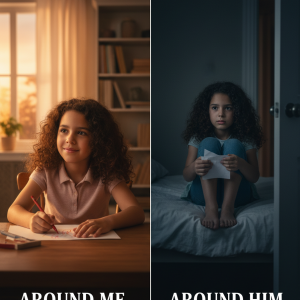
My Daughter Stopped Talking Every Time My New Husband Walked In. One Night, She Slipped a Drawing Under My Pillow — And Everything Changed.
I never planned to fall in love again. After Marcus left when Zoe was barely three years old, I told myself that was enough. I was enough….