The church clock read 3:41 when my almost-sister-in-law appeared in the doorway, holding a crumpled envelope as though it might burn her fingers. My floral bouquet lay heavy across my lap, its damp, tightly wrapped stems slowly darkening the pristine white fabric of my wedding dress. Beside me, the old iron radiator next to Grandma June’s empty chair clicked and hissed, protesting the late October chill.
Somewhere beyond the closed solid oak door, the organist had finally stopped playing. She had cycled through “Jesu, Joy of Man’s Desiring” three times, and the sudden absence of the music left a silence that felt heavier than the thick Kansas humidity.
Tammy’s mascara had streaked in dark, jagged lines down her pale cheeks. She stood in the doorway, her lavender bridesmaid dress rustling against the doorframe, but she couldn’t bring herself to look directly into my eyes.
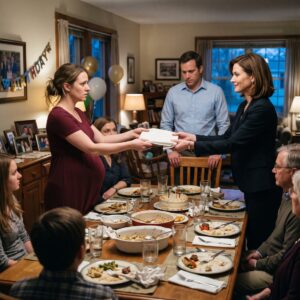
“Mom says you need to give the ring back today,” she whispered, her voice trembling. She thrust the envelope forward. “And… she says our family expects you to repay nine thousand dollars. For the rehearsal dinner and the cruise.”
I didn’t speak. I just stared at the figures penciled onto the back of a standard-issue church offering envelope. There it was, written in Lorna’s unmistakable, careful bookkeeper handwriting: $2,100 for supper. $6,900 for the cruise. The total was meticulously calculated and underlined twice, pressing so hard into the paper that the lead had nearly torn through.
My groom, Derrick, had already informed his brother by a cowardly text message that he wasn’t coming to the church. And now, his mother was sending me a handwritten invoice while 140 wedding guests shifted uncomfortably in the sanctuary just fifty feet away.
At thirty-one years old, I had spent the last fourteen months imagining almost every single detail of my wedding day. I had pictured the flowers, the music, the vows, and the taste of the vanilla buttercream cake. But I had never once imagined that I would be sitting in my tailored bridal gown, wearing a veil, wondering exactly how much an abandoned bride was supposed to owe her runaway groom’s family.
My name is Amy Jo, and I live in Chanute, Kansas. It’s the kind of Midwestern town where people still remember exactly what your grandmother served at a church basement supper twenty years ago, and where a broken engagement isn’t just private heartbreak—it’s public history.
I had worked at the local pharmacy counter for nine years. I knew everyone’s names, their children’s names, and their ailments. I had dated Derrick for four of those years, which felt like more than enough time to believe I thoroughly understood the man I was supposed to marry. He was quiet, steady, a little avoidant of conflict, but I had always interpreted his silence as a strong, comforting presence.
His mother, Lorna, had always treated me with a fierce, protective kindness. She was a practical woman who kept the books at the local lumberyard, a woman of deep faith and rigid expectations. When my own mother was dying of ovarian cancer three years ago, Lorna had sat beside me in the waiting room of a Wichita hospital for six consecutive nights. She brought me lukewarm coffee and held my hand while the monitors beeped.
When Derrick proposed, Lorna had given him her own mother’s engagement ring to use. It was a modest, beautiful round diamond set in warm yellow gold from 1948. The ring had never been about financial value to me; I treasured it because Lorna had explicitly entrusted me with a piece of her family’s history. It meant I was chosen. I was part of them.
And now, she wanted it back, bundled with a bill for a honeymoon I would never take.
My father, Ray, was sixty-six years old. He was a retired cement-plant maintenance worker and a Gulf War veteran who rarely spoke more than three sentences at a time. He had bought his first brand-new charcoal-gray suit since my mother’s funeral specifically so he could walk his only daughter down the aisle. He had personally written a check for $4,900 for the catered reception dinner, and another $1,500 to hire a four-piece country-western band from Parsons.
The celebration was fully arranged for 140 people at the local VFW hall. My Aunt Deb had spent three days baking and frosting an elaborate four-tiered cake, and the VFW auxiliary volunteers had spent their entire Saturday morning decorating the folding tables with white crepe paper streamers and Mason jars packed with autumn wildflowers.
At three o’clock, I was supposed to have walked down the aisle. Instead, at 3:20, Derrick’s older brother Jeff had burst into the bridal room, his face flushed and his phone gripped tightly in his hand.
“He’s not coming,” Jeff had choked out, looking at my father rather than me.
Jeff had shown us the text message. Derrick had simply written: I can’t. Tell her I’m sorry.
I had frantically dialed Derrick’s number eleven times. Every single attempt went straight to his voicemail. Jeff had eventually managed to get through to him by calling from a different number. He learned that Derrick was currently sitting in the cab of his Ford pickup out at the county lake where he liked to fish. He was perfectly safe, completely sober, and simply unwilling to walk into the church. When Jeff pushed him for a reason, Derrick refused to explain himself and powered off his phone.
When my Daddy heard this, his jaw locked. The muscles in his neck jumped. He quietly offered to drive his truck out to the lake, pull Derrick out of his cab by his collar, and drag him back to the altar.
“No, Daddy,” I had whispered, placing my hand over his calloused knuckles. “Don’t.”
Whatever love I had foolishly believed Derrick and I shared, I knew with absolute certainty that I couldn’t begin a marriage by having my aging father physically force an unwilling man to say “I do.”
That was when Grandma June spoke up. She was eighty-four years old, leaning heavily on her wooden cane, and she possessed the kind of ruthless prairie practicality that allowed her to solve problems before anyone else had even finished panicking.
“What,” Grandma June asked, her voice cutting through the tension in the room, “is happening to the hot supper waiting over at the VFW?”
Daddy blinked, caught off guard. He explained that the roast beef, mashed potatoes, green beans, and yeast rolls were already cooked in the warming trays. The band had been paid in full. The deposit was non-refundable.
“Well,” Grandma June said, adjusting her glasses. “One hundred and forty people traveled to this town to celebrate with us. Most of them haven’t eaten since breakfast. And furthermore, I have never in my life enjoyed a proper wedding dance.”
She paused, looking at me with fierce, loving eyes. “Your Grandpa and I married quietly at the justice of the peace in 1962, and we went straight home to milk the Holsteins. I am wearing my good pearls, Amy Jo. And I intend to hear that band.”
I looked at my father’s pristine new charcoal suit. I looked at my grandmother’s determined, wrinkled face. Then I looked down at the tight, uncomfortable white satin heels pinching my feet.
I made a decision.
“Tammy,” I said, looking my almost-sister-in-law in the eye for the first time since she handed me the bill. “Tell Lorna she will get her ring back tonight. But I am not paying her a dime for a cruise her son booked. Now excuse me.”
I reached down, unbuckled the expensive satin heels, and tossed them into the corner of the room. I reached into my overnight bag and pulled out the white canvas sneakers I had packed for dancing later in the evening. I slipped them on and tied the laces tight.
There wasn’t going to be a wedding. But there was still going to be a supper.
Daddy insisted on addressing the waiting guests himself. I had never once in my life heard him speak before a gathering of more than five people, let alone a packed sanctuary. We walked down the side hallway and entered through the door near the choir loft. Daddy stood at the front of the church, refusing to step up onto the elevated platform, keeping himself on the same level as the guests.
The sanctuary fell deadly silent. People leaned forward in the wooden pews, their faces a mix of confusion and dawning horror as they saw me standing there, wearing a wedding dress but no veil, my father by my side without a groom in sight.
In a voice far steadier and louder than I expected, Daddy delivered the news. He didn’t sugarcoat it, and he didn’t raise his voice. He simply stated that Derrick had decided not to attend, that the groom was safe but absent, and that the marriage ceremony would not be taking place today.
A collective gasp echoed off the stained-glass windows.
“However,” Daddy continued, squaring his shoulders, “there is a hot dinner waiting at the VFW hall. It is fully paid for. The beef is carved. And I would consider it a personal favor if you would all join my daughter and me to eat it.”
I took a step forward, looking directly toward the right side of the aisle—Derrick’s side. Many of his aunts, uncles, and cousins were already looking down in deep shame, reaching for their purses and suit jackets to make a hasty exit.
“That invitation includes everyone,” I called out, my voice echoing slightly in the large room. “Both sides of the aisle. None of you did anything wrong today. Please, come eat.”
For a long, agonizing moment, nobody moved. The tension was thick enough to choke on. Then, an eighty-year-old veteran named Harold Dawson, who had served with my father’s older brother, stood up from the third row. He adjusted his suspenders loudly.
“Well,” Harold announced to the silent room, “I served two tours in Korea, and I have never once in my entire life turned down a free roast beef dinner. I’m going.”
A ripple of nervous laughter broke the stunned silence. It was exactly the permission the room needed. Slowly, people began to stand, murmur to one another, and make their way out the heavy wooden doors toward their cars.
By half past five, the VFW hall was full. I was standing behind the metal steam tables, wearing a heavy floral catering apron tied securely over my white wedding dress. I couldn’t bear the thought of sitting at the decorated head table, staring at the empty chair beside me while 140 people quietly watched me grieve. So, I had asked Connie, the head caterer, for a large metal serving spoon.
I decided to make myself useful.
As the guests came through the buffet line, they offered quiet condolences, tight hugs, and unexpected memories of their own. Harold told me about the hometown sweetheart who had married a shoe salesman while he was stationed overseas, and the wonderful woman he later met and loved fiercely for fifty-eight years. Derrick’s Aunt Judy silently pressed her warm hand against my cheek, her eyes swimming with apologetic tears. My six-year-old flower girl, Emma, happily skipped around the perimeter of the hall, joyfully scattering her unused rose petals across the worn linoleum floor.
Then, the heavy front door of the VFW hall opened.
Lorna walked in.
She had been sitting alone in her sedan in the church parking lot since learning that her son had abandoned me. Now, she walked slowly across the hall, her purse hanging rigidly from the crook of her arm. The ambient chatter in the room instantly died away. The clinking of silverware against porcelain stopped. Every eye in the room turned to watch the groom’s mother approach the jilted bride.
She stopped directly across the steam table from me. Her eyes were red-rimmed, her jaw tight with a mixture of overwhelming embarrassment and misplaced defensive anger.
“I want my mother’s ring,” Lorna said, her voice tight and low. “Right now.”
I had already made the decision to give it back. I didn’t want a piece of jewelry from a man who didn’t want me. But the coldness of her demand—delivered while I stood in a wedding dress, serving dinner to her own family—hurt far more than I anticipated.
I looked her directly in the eye. I didn’t flinch.
“Lorna,” I said, keeping my voice remarkably calm. “You will have your mother’s ring back tonight. It will be cleaned and safely placed inside its original velvet box. But I am not taking it off to hand it to you while I have hot beef gravy dripping from my fingers.”
She stared at me, her mouth slightly parted. She had expected a screaming match, or perhaps for me to dissolve into a puddle of tears. She hadn’t prepared for quiet dignity.
Before she could speak, I picked up a pair of tongs, placed two generous slices of hot roast beef onto a clean ceramic plate, added a scoop of potatoes, and held it out to her over the steam table.
“There is a seat for you at the head table,” I told her softly. “It’s the exact same seat that was always going to be yours. Please eat.”
Lorna hesitated. Her hands gripped the handle of her purse until her knuckles turned white. From just a few feet away, her sister Judy stepped out of the buffet line.
“Lorna,” Judy said gently, but with a steel edge to her voice. “Your family is in this room. You can either sit down and break bread with us, or you can go back to your car alone. But don’t you dare make a scene with this girl.”
After a long, breathless moment, Lorna’s shoulders dropped. The defensive posture melted away, leaving only an exhausted, heartbroken older woman. She reached out with trembling hands and accepted the warm plate. I watched her walk toward the head table, wondering whether Derrick’s cowardly decision had permanently destroyed two relationships instead of just one.
When the last guest had finally been served, Connie physically took the serving spoon out of my hand and ordered me to sit down. As I approached the head table, I saw that someone—likely my father—had quietly removed the empty chair intended for Derrick.
Grandma June sat on my left side, Daddy on my right. Lorna sat two seats down, carefully cutting her roast beef into tiny, uniform pieces that she pushed around but barely swallowed.
Just as folks were finishing their cake, the bandleader approached our table, removing his cowboy hat. He offered to pack up his equipment and cancel the music, assuming a dance would be too painful.
Grandma June slammed her cane against the floorboard. “Absolutely not,” she declared. “Plug the guitars back in.”
I looked at the bandleader and asked him to play the old Anne Murray waltz I had specifically chosen for my mother. She used to sing it while washing dishes at our kitchen sink.
As the opening acoustic notes filled the cavernous hall, nobody moved toward the empty wooden dance floor. People looked down at their laps, unsure of the protocol.
Then, Grandma June pushed back her metal folding chair. She took her wooden cane in her left hand, walked to the edge of the dance floor, and held her right hand out to me.
“I believe this is mine,” she said, her eyes crinkling at the corners.
I stood up. I walked out under the cheap white streamers, and the two of us stepped onto the linoleum—one woman in her early thirties wearing a stained wedding dress and canvas sneakers, the other in her eighties leaning heavily on a cane. We couldn’t manage much more than a gentle, rocking sway to the music.
“I’m sorry, Grandma,” I whispered, my voice finally breaking as the emotion of the day caught up to me. “I’m sorry this is the dance you had to wait so many years for.”
Grandma June pulled me closer, her frail arms surprisingly strong. “Oh, honey,” she murmured into my ear. “You need to learn the difference between a hard day and a truly bad one. A bad day is a day when there is nobody left to feed, and nobody willing to dance with you. Look around.”
I opened my eyes and looked over her shoulder. Standing around the edges of the dance floor were 140 people who had stayed. They hadn’t stayed for the food; they had stayed for me.
I finally began to cry, burying my face against Grandma June’s soft cardigan. And slowly, one by one, the room joined us. Daddy walked out and asked Aunt Deb to dance. Derrick’s cousins nervously asked my cousins. Soon, the floor was crowded with people swaying to the music, and little Emma was twirling through the maze of adults, throwing her last remaining flower petals high into the air.
Later that evening, after Daddy had taken his turn spinning me around the floor, I went to the back room of the hall and washed my hands thoroughly with coarse soap. I dried them, twisted the vintage 1948 diamond ring off my left hand, and polished it with a paper towel. I placed it inside its worn green velvet box, snapping the lid shut.
I walked out to the head table, where Lorna was now sitting completely alone, staring blankly at the wall. I slid the green box across the white tablecloth.
She didn’t look at the ring. She looked up at me, and finally, the dam broke. Tears spilled over her eyelashes, ruining the rest of her makeup. She confessed that Derrick hadn’t given her any warning either. She had lovingly ironed his white wedding shirt that very morning. She had watched him drink a cup of coffee at her kitchen island, kissed his cheek, and heard him promise to see her at the church.
When Jeff showed her the text message in the parking lot, the sheer, crushing embarrassment had caused her to panic. She had spent twenty-six years keeping books at the lumberyard; when her world fell apart, the only way she knew how to cope was to find a pencil and calculate the math. She wanted to control something, anything, in a situation that had spiraled utterly out of control.
“Sending Tammy in there… with that envelope,” Lorna sobbed, covering her face with her hands. “It was cruel. I was just so ashamed of my boy. I am so sorry, Amy Jo.”
I reached out and placed my hand over hers.
“Lorna,” I said quietly. “I remember more about you than that envelope. I remember the nights you sat with me in the ICU. I remember the Sunday dinners. It was a privilege to wear your mother’s ring. But it belongs with you.”
She pulled the box toward her chest and wept. I did not agree to pay the $9,000 for the rehearsal or the cruise; Derrick’s family had signed those contracts, and Lorna never brought up the demand again.
The band played until nine o’clock. Daddy and I were the very last people to leave the VFW hall. We walked outside and sat down together on the cold concrete steps leading to the parking lot. The crisp autumn air felt wonderful on my face. Daddy’s charcoal suit was still remarkably neat, while the hem of my white dress was permanently stained with spilled beef gravy, floor wax, and crushed pink flower petals.
We sat in comfortable silence for a long time, watching the stars over the Kansas plains.
Finally, Daddy let out a long sigh, patted his knees, and looked at me. “Well,” he said deadpan. “I’ve been to worse weddings.”
I let out a startled bark of laughter, which quickly turned into genuine, breathless giggles until my ribs ached.
Life did not magically become easy just because I found a way to feed my guests that afternoon. I spent two full weeks sleeping in my childhood bed at Daddy’s house. I cried more than once hiding in the stockroom at the pharmacy, and for months, I felt a sharp, breathtaking ache in my chest whenever I passed a bridal display in a store window or heard an Anne Murray song on the radio. I grieved heavily for the future I had mapped out in my head, and it took a long time to untangle my self-worth from Derrick’s cowardly exit.
Months later, Derrick finally slunk back into town. He eventually offered a stammering, vague apology, first to my father on his front porch, and then to me at a local coffee shop. I didn’t yell at him. I simply looked at the man I had almost married and told him that I genuinely hoped he would learn how to speak difficult truths before he made other people pay the price for his silence.
Not long after that conversation, anonymous postal money orders for two hundred dollars began arriving at Daddy’s house on the first of every month. They were clearly intended to slowly repay the $6,400 my father had spent on the reception. We never officially learned who arranged them—Derrick didn’t have that kind of discipline, so I always suspected it was Lorna quietly making amends the only way she knew how.
Daddy never cashed a single one for himself. He signed every money order over to the VFW auxiliary’s community funeral dinner fund. Over the course of thirty-two months, the full amount was anonymously donated. For nearly three years, grieving families throughout our county shared warm meals paid for by money that had once been meant for a wedding that never happened.
The story that people repeated around Chanute eventually became very different from the one I had feared they would tell. They didn’t talk about the bride who got dumped. They talked about a young woman serving roast beef in white canvas sneakers, a fiercely proud grandmother claiming her first wedding dance after sixty years, and a room full of people who chose to stay together when the reason for celebrating had vanished.
Lorna and I never officially became family. But three weeks after the non-wedding, she returned Aunt Deb’s heavy glass cake stand, washed and polished to a shine, with a large jar of her famous homemade dill pickles resting on top. And on Sunday mornings at church, during the passing of the peace, she still turns around from the pew in front of me to briefly, tightly, squeeze my hand. We don’t discuss the envelope, and we never mention Derrick. There are things we have silently forgiven without needing to drag them into the light every week.
The following March, Grandma June turned eighty-five. We rented out the exact same VFW hall to celebrate. I hired the four-piece country band from Parsons again. When the white-bearded bandleader saw me walk through the door, he just smiled and knew exactly which song to play first.
Grandma June rose slowly from her folding chair. She steadied herself with her wooden cane, walked to the edge of the floor, and held out her hand exactly as she had on that difficult October afternoon.
“I believe this is mine,” she said, her eyes shining behind her glasses.
I took her hand and led her out onto the floor, swaying beneath the crepe paper streamers as our relatives gathered around us, clapping to the beat.
I still have the canvas sneakers I wore on the day Derrick left me standing at the church. There is a dark, stubborn gravy stain on the left toe that no amount of scrubbing with bleach has ever been able to remove, and I no longer try to get it out. Those cheap shoes carried me through one of the hardest, most humiliating afternoons of my life, walking me out of a cramped bridal room where I could barely breathe, and onto a dance floor crowded with people who absolutely refused to let me face my disappointment alone.
When I look back at that day now, what I remember most clearly isn’t the empty place at the altar. It isn’t the hissing radiator, or the $9,000 bill scribbled on an envelope, although neither memory has completely disappeared.
What I remember is my stoic father standing before a silent church and inviting everyone to supper. I remember Grandma June’s hand extended firmly toward mine. And I remember the beautiful, unexpected sound of laughter filling a room where I had expected to find only pity.
I never got the perfect wedding I had planned. But I got a dance worth remembering. And when Grandma reached for my hand again on her eighty-fifth birthday, I knew without a doubt that I was exactly where I was always meant to be.