A music director mocked a boy’s cello on stage. His mother opened an old ledger, and one line in her grandfather’s handwriting changed everything.
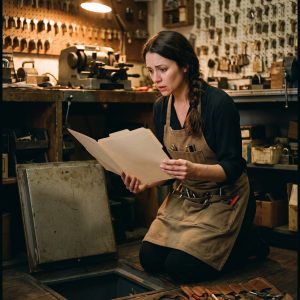
I tune and repair violins for a living, so I heard the problem before I saw it.
From the back row of the school auditorium, I caught one cello sitting a hair flat, with a faint buzz in its lower seam.
That buzz means old glue is letting go. It was my son’s cello.
Ten minutes before the winter concert, Mr. Lisle, the orchestra director, clapped his hands on stage.
“Theodore Archer. Bring that thing up here.”
Theo is ten. He crossed the stage in his too-big white concert shirt, hugging the cello to his chest, his ears already turning red.
Mr. Lisle, in his gray tweed jacket, took it by the neck like something pulled from a gutter. He rapped the back with his knuckles, and the microphone caught the hollow knock.
“Parents, this is what happens when a family can’t afford a real instrument. Plywood. A pawn-shop toy.”
Someone in the third row laughed. A few others joined in.
“It will not sit beside the school’s instruments,” he said. “Theodore can turn pages.”
Theo didn’t argue. He only searched the dark for me, and his shoulders folded inward.
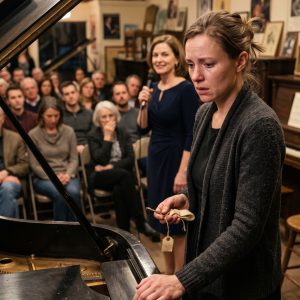
I stood up in my green coat and walked down the aisle. My hands were steady, which surprised me.
“Mr. Lisle, that cello sat on my workbench for three weeks. I restrung it myself.”
“Then you know it’s junk.”
“I know it better than that.”
He smiled for the audience. “Ma’am, you fix fiddles. I direct an orchestra. Please sit down.”
From the stage, Theo whispered, “Mom, it’s okay. I don’t have to play.”
That sentence undid something in me. It was how a child sounds when he has already practiced being embarrassed.
For three weeks, I had carried one thing in my bag, waiting until I was certain.
Now I was.
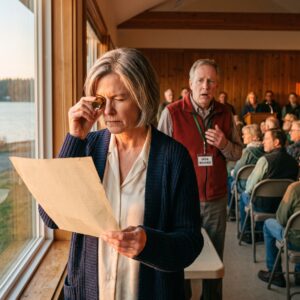
I pulled out a worn green ledger with a faded ribbon marking one page. I opened it and held it up at the edge of the stage, turned toward him.
“Read the first line, Mr. Lisle. Out loud, please.”
He glanced down, still smiling.
The smile went first. Then the color in his face.
His lips began to shape a name, but no sound came out.
Mr. Lisle shoved the ledger away from his face. Then he seemed to remember that two hundred people were watching, and he let out a laugh.
“This is a school event, Mrs. Archer. You are disrupting it.”
He raised his voice toward the rows behind me. “She repairs instruments for money. I’d ask what she charges.”
Nobody laughed this time.
“I can have your son removed from this program,” he said, lower, just for me. “One phone call, and he never sits in my orchestra again.”
“You could,” I said. “Read the first line.”
“I will not be told what to do in my own auditorium.”
“It’s the school’s auditorium.”
He turned toward the front row. “Principal Hale, security, please. This woman is harassing a faculty member.”
Principal Hale did not move. She was looking at the ledger, then at the cello in his hands, then at me.
“My grandfather wrote that page himself,” I said quietly. “He kept every sale for forty years and never skipped a line.”
“Your grandfather has nothing to do with me.”
“Then it will be a very short line.”
Up on the stage, Theo had stopped breathing. So had I.
Mr. Lisle’s fingers tightened on the cello’s neck. For a second, I thought he might simply hand it back and walk away.
Instead, he looked at the rows of faces and understood that he couldn’t.
I held the ledger up again.
He bent down. His finger found the line.
“March the ninth,” he read. “Eleven years ago.” His voice cracked. “Received from—”
“Warren Lisle,” he finished, so quietly the microphone barely caught it. “One cello. Four hundred dollars, cash.”
Nobody in that auditorium moved.
“Keep reading,” I said.
He didn’t have to. Anyone near the front could see the next lines in my grandfather’s slanted ink: Seller nervous. Asked me not to write his name. Wrote it anyway. Inside lower rib, brass plate: Marlow Youth Music Trust, No. 14.
I let that sit for a moment. Then I said the rest aloud, for the room.
“Eleven years ago, Mr. Lisle ran the instrument program for the Marlow Youth Music Trust. A widow had donated an 1890s cello so that children who couldn’t afford a good one could learn on it. He told the Trust it was ruined in a basement flood. The insurance paid out. The cello went to a dealer two towns over, for cash.”
I looked up at him.
“That dealer was my grandfather.”
“He never sold it. It bothered him, so he put it in his attic and wrote everything down. When he died, I inherited the attic. When Theo asked to learn cello, I found this one and opened the lower seam to fix the glue. The brass plate was exactly where the ledger said.”
“I called the Trust three weeks ago, and they confirmed it. I told no one else, because I needed to be certain. And I needed someone from the Trust to hear this with their own ears.”
In the third row, a white-haired woman stood up. She was Mrs. Ostrander, the Trust’s director. She hadn’t laughed once.
“Warren,” she said, “put the cello down.”
“This is a misunderstanding,” he started.
“Two weeks ago, you told Theo to leave it at school ‘for safekeeping,’” I said. “He told you I needed it for repairs. Tonight you wanted it called plywood in front of everyone, so that when it vanished, nobody would ask.”
He set the cello on the stage floor as though it had turned hot.
Principal Hale climbed the steps. “Mr. Lisle, my office. Now.”
The security guard he had called for walked past me and stood beside him.
By Monday, he was on leave. By the end of the month, the Trust’s attorneys and an insurance company had a great many questions for him, and he had very few answers.
But that night, I wasn’t thinking about Warren Lisle.
Mrs. Ostrander knelt in front of Theo. “That cello belongs to the Trust, sweetheart. But the woman who gave it wanted a child to play it, not to keep it in a case. I think she’d say you’ve earned it.”
Theo looked at me. I nodded. The Trust would keep the paperwork, Theo would keep the cello for as long as he played it, and I would keep it in tune.
The concert began twenty minutes late. The people who had laughed applauded loudest, and some of them couldn’t look at me.
Theo took the center chair. He didn’t look at the audience. He looked at the cello, and he drew the bow across the lowest string.
The seam didn’t buzz. It wasn’t flat.
After eleven years in an attic, it sang as though it had only been waiting for someone to ask.