A document examiner spots her stepbrother’s forged deed. Then the paper itself reveals who he owed and why he needed her mother’s house.
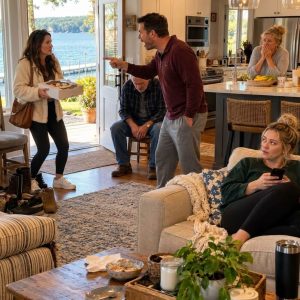
My stepbrother was sitting at my mother’s kitchen table with a stack of papers and a smile when I walked in. My mother’s hands were shaking around a cold cup of tea.
“Tessa, good timing,” Brandon said. “We’re just finishing up.”
I’m a forensic document examiner. For eleven years I’ve testified in courtrooms about signatures people swore were real.
So before I said hello, I looked at the top page.
It was a quitclaim deed. The signature read Ruth Ellen Hale, and the pen had lifted three times in a name my mother writes in one smooth motion.
I set my bag down slowly.
“What is this?” I asked.
“Housekeeping,” Brandon said. “Mom signed this morning. The house goes into my name so it’s protected.”
My mother’s house. The yellow farmhouse the bank took from us when I was twelve.
I had bought it back for $310,000. Then I spent nine months restoring the porch her mother built and the apple trees she used to cry over.
“Mom?” I said.
She looked at the table. “He said it was for the insurance, honey.”
Brandon laughed softly. “See? She understands. Don’t make this dramatic.”
Through the window, a moving truck was backed up to the porch. Two of his friends were carrying her china cabinet toward it.
“Put it down,” I said, without raising my voice.
They looked at Brandon. He waved a hand. “Keep going.”
“The notary already stamped it,” he told me. “It’s done. Nobody’s reversing anything because you’re upset.”
“I’m not upset,” I said. “I’m reading.”
“Read all you want. It’s legal.”
I asked for a lamp. My mother brought the one from the hall, her hands still trembling.
I tilted the signature page under the light, the way I have a thousand times at work. Raking light shows what ink hides.
Across the bottom, faint as scratches, were grooves pressed into the paper by a sheet that had lain on top of it. Someone had written on that sheet hard enough to leave words behind.
Brandon stopped smiling.
“Give me that,” he said.
I held the page higher. The grooves sharpened into letters, one line at a time, and the first word was a name I knew.
Part 2
“Give me that page, Tessa.” Brandon was on his feet, and his chair scraped the floor.
“No.”
“That’s a legal document. You’re tampering with it.”
“I’m looking at it,” I said. “There’s a difference, and I testify on it for a living.”
He turned to my mother. “Ruth, tell her. I have power of attorney. You said you wanted me to handle things.”
Her eyes filled. “I said I wanted help, Brandon. I didn’t say…”
“She’s confused,” he told me, loud enough for his friends in the doorway to hear. “She’s seventy-one. I’m the one who’s been here.”
I almost admired how fast the story changed.
“Mom,” I said gently, “what time did you sign this?”
“Early. Brandon drove me to the bank.”
“Which bank?”
She frowned. “We didn’t go inside.”
Brandon took a step toward me. “Enough. Those men are going to finish loading, and you’re going to step aside, or I’ll have the sheriff remove you from my property.”
“Your property,” I repeated.
“Mine as of nine o’clock this morning.”
I set my phone on the table and photographed the page from three angles, unhurried. My hands didn’t shake. They never do when the paper is on my side.
“Brandon,” I said, “you should sit down. The first line pressed into this page is a name, and the number beside it is
Part 3
…one hundred eighty-six thousand, four hundred dollars.”
The kitchen went silent.
“The name is Calder Pike,” I said. “Under it, in your block capitals: Payoff due the thirty-first. Collateral: 14 Orchard Lane.”
I looked up. “That’s this house, Brandon. You pledged a house you don’t own to a man you can’t pay.”
His friends stopped moving. One of them quietly set the china cabinet down.
“That’s not…” Brandon started.
“You wrote it on a sheet laid over the deed. You pressed hard, because you always do when you’re afraid.”
I turned to my mother. “Mom, when you signed, was anyone else present? A notary?”
“Just Brandon,” she whispered. “In his truck, in the bank parking lot. A woman came to the window for a minute and stamped something.”
“Stamped it without watching you sign,” I said. “That’s a violation of her commission, and it voids the acknowledgment. I’ll have the county confirm it, but I already know what they’ll say.”
Brandon’s voice cracked. “I was going to fix it. I just needed time.”
“You needed my mother’s name.”
He sank into the chair as if someone had cut a string.
Then tires crunched on the gravel. A gray sedan stopped behind the moving truck, and a man in a wool coat stepped out holding a folder.
“Brandon Keel?” he called. “Calder Pike sent me. I’m here to look at the collateral.”
Brandon made a sound I will never forget.
I walked out onto the porch my grandmother’s hands had built. I introduced myself and handed the man my phone, the deed, and my copy of the title I’d recorded in my mother’s name nine months earlier.
“This property has one owner,” I said. “She has signed nothing in her right mind, and the page you’re holding was forged. If Mr. Pike lent against it, he lent against air.”
The man read for a long minute. Then he closed the folder.
“I’ll let Mr. Pike know,” he said. “He’ll want to speak to Mr. Keel personally. And probably to the sheriff.”
He didn’t look at Brandon when he drove away.
The deputy arrived within the hour, took my statement, and photographed the grooves under my lamp. The notary, I learned later, surrendered her commission by the end of the week. Brandon’s friends carried the china cabinet back inside without a word.
Brandon left in the back of a county car. He didn’t look at my mother.
That evening, she sat on the porch with a blanket around her shoulders, watching the orchard go gold.
“I’m so sorry, Tessa,” she said. “I let him in. I signed because he sounded like Walt.”
“You signed because you trusted someone,” I said. “That’s not a crime. That’s just the thing he used.”
She took my hand. Hers had stopped shaking.
Years ago, a bank took this house from us because we had nothing but good faith. Now the deed was safe, the locks were new, and the trees were heavy with apples.
I have spent my life proving that paper can lie. That night, I finally understood that it can also protect the people you love.