At our 15th-anniversary gala, my partner handed me a plaque instead of my company. I set a brass key on the podium. Read what it opened.
Gordon Pike thanked me for fifteen years of “answering phones” while two hundred people applauded.
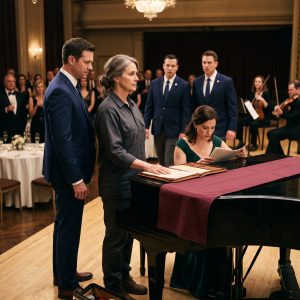
I stood in the middle of our showroom, in my good green dress, holding a gold-painted plaque and smiling like a woman at the dentist.
Then I read the screen behind him, and I found the lie.
“Record year,” the slide said. “$4.82 million.”
It was $3.97 million.
I knew because I had closed those books myself, at midnight, three weeks earlier. In fifteen years, I had never let a wrong number walk past me.
Gordon didn’t know that. He had never once asked what I did all day.
“Tessa has decided to step back,” he told the room, one hand on my shoulder like I was a coat he was returning.
I had decided nothing.
“She’s been the heart of this place,” he went on. “Well. The front desk of it.”
People laughed. Someone near the stone samples said, “Aww.”
At table four, a man in a gray suit studied me the way you study a used car. Mr. Hadley, the investor from Denver.
Gordon, sleek in his navy suit, leaned into the microphone. “Pike & Marlow becomes Pike Stone Group on Monday. New investors, new energy. And Tessa finally gets to relax.”
He turned to me, lips barely moving. “Take the plaque, Tess. Don’t make this weird.”
Fifteen years ago, I mortgaged my mother’s house to buy our first pallet of tile.
I slept on the office floor during the flood. I skipped three paychecks so his could clear.
“Gordon,” I said quietly, “my name is on the door.”
“On the sign,” he said. “Not on the deed. Signs get repainted.”
He glanced at the cameras and smiled. “Honestly? You were great with the paperwork.”
Paperwork.
I looked down. The plaque read: TESSA MARLOW, 15 YEARS OF DEDICATED SUPPORT.
Support. Not partner. Not co-founder.
The whole room waited for me to cry.
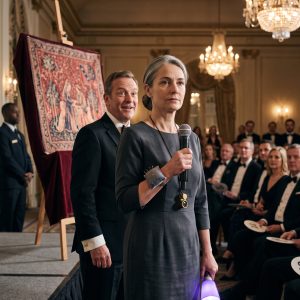
“Thank you,” I said, clear enough to reach the back wall. “May I say a few words?”
Gordon laughed, relieved, and waved at the microphone. “Keep it short, folks, there’s brisket!”
I walked to the podium and set the plaque down beside the microphone.
Then I opened my clutch and took out the thing I had carried every single day since March.
A small brass key, with a paper tag tied to it by a loop of string.
I laid it next to the plaque and turned the tag toward Gordon, so that only he could read the number written there.
His smile stayed exactly where it was.
But the color left his face, and his hand began to shake.
* * *
Gordon recovered in two seconds. Recovering was the only kind of speed he had.
“Tess, that’s company property,” he said into the microphone, laughing, and reached for the key.
I closed my hand over it first.
“Not here,” he whispered. A young man from the catering staff appeared at his elbow with a folder, and Gordon slid a single page across the podium. “Sign the transition letter. Take the check. Go home with some dignity.”
The check was already printed. Twenty-five thousand dollars, for fifteen years.
At table four, Mr. Hadley raised one eyebrow.
“Twenty-five thousand,” I said. “That’s generous.”
“It’s more than most front desks see,” Gordon said, and a few people chuckled again.
“I’ll sign,” I said. “Right after I tell everyone what this is.”
Gordon stopped smiling. “Cut her mic,” he told the sound technician, barely moving his mouth.
The speakers died with a soft pop. Two hundred people leaned forward at once.
I didn’t need a microphone. I had spent fifteen years talking over forklifts.
“Gordon is right about one thing,” I said, and my voice carried to the back wall. “I’m good at paperwork.”
At table seven, a quiet man in a navy blazer set down his water glass. I had mailed him that invitation myself.
“This key has a number on its tag,” I said, lifting it so the light caught the brass. “Gordon knows that number. He spent most of March looking for this key. He went through my desk twice.”
“Tessa,” Gordon said, and his voice cracked. “Stop.”
I looked straight at him for the first time all night, the way you look at a number you’ve finally checked. Then I turned back to the room.
“It opens the padlock on Cage 114,” I said. “At the back of our warehouse. The one Gordon calls dead stock.”
* * *
Nobody breathed.
“You can’t open that,” Gordon said. “That’s company—”
“It’s my lock,” I said. “I changed it in March.”
Mr. Hadley was already standing. “Show me.”
So I led two hundred guests through the double doors in their evening clothes, phone flashlights swinging across the concrete, past the forklifts and the pallet racks. Gordon followed. Leaving would have said everything.
Cage 114 sat in the far corner, chain-link and padlocked beneath a buzzing light.
“Every December,” I said, fitting the key into the lock, “Gordon asked me to book a few big sales to a customer called Meridian Build Group. Delivered. Invoiced. Counted as revenue. I never saw one truck leave for them.”
The lock clicked. I swung the gate open.
Inside stood two hundred and twelve pallets of porcelain tile, wrapped in plastic gone cloudy with dust. Every one carried a shipping label for Meridian Build Group, with a delivery date months in the past.
“Eight hundred and fifty thousand dollars,” I said. “That’s the distance between the slide on that screen and the truth. Sales that never left this building.”
Mr. Hadley walked the length of the cage reading labels by the light of his phone. He knelt and drew one finger through the dust on a pallet.
“Has Meridian paid a single dollar?”
“They’re a slow payer,” Gordon said. His voice had gone thin.
“Meridian Build Group is a mailbox in a strip mall twenty minutes from here,” I said. “I drove out there in April. The man renting it sells phone cases.”
A gray binder sat on a shelf inside the cage. I took it down.
“Every pallet is logged here,” I said. “Date, count, photographs, initialed by Ruben and Dawn from the warehouse floor. Gordon told them to hold this stock. His exact words were, ‘Tessa will sort out the paperwork.'”
I turned to the last tab.
“I sorted it out. Every line.”
I held the page toward Gordon. He didn’t take it, so I read it aloud.
“The Founders’ Agreement. Signed in 2011, notarized. Section seven. Neither partner may present the other as an employee, bring in outside investors, or rename the company without the written consent of both. Any breach converts the breaching partner’s shares to non-voting, effective immediately.”
I looked up.
“You introduced me as the front desk tonight, Gordon. In front of two hundred witnesses and a camera.”
Mr. Hadley let out a slow breath. “Mr. Pike, you told me you controlled this company outright.”
“Technically—”
“Technically,” Hadley said, “I’m finished.” He took a folded term sheet from his inside pocket, tore it in half, and turned to me. “Ms. Marlow, I’d like to speak with the actual owner. Monday morning, if you’ll have me.”
“Nine o’clock,” I said. “I’ll bring the real numbers.”
By Monday, Hadley’s firm had withdrawn. By Friday, Gordon’s lawyer had told him to resign. Three weeks later he sold me his shares at a price built on the real figures, and for the first time in his life, he read every page before signing.
That night, sitting on a pallet in the empty showroom, I called my mother, who still lives in the house I once mortgaged for a pallet of tile.
“Did you do it?” she asked.
“I did.”
“Good. Now go eat some of that brisket.”
I kept the plaque. It hangs by the loading dock now, above a hand-lettered card that reads: SUPPORT, THE PART THAT HOLDS EVERYTHING UP.
The morning his shares became mine, a man on a ladder painted Gordon’s name off the sign above the door.
He had been right about one thing, after all.
Signs get repainted.
This story is a work of fiction. Names, places, and events are invented, and any resemblance to real people or businesses is coincidental.