A porter’s whisper stopped a $2 million auction. Six years of hidden proof exposed the auctioneer and cost him his license, firm and name.
I was wiping dust off a gilded frame when I realized the painting on the easel was lying.
For six years I had worked the back rooms of Pryce & Alder Auctioneers, unpacking crates and wheeling lots onto the stage. Nobody there remembered I once held a master’s degree in paintings conservation.
Gideon Pryce remembered. He just made sure nobody else did.
That night was the biggest sale in the firm’s history. The centerpiece was Harbor at Dusk by Tobias Wren, described in the catalog with one proud line: “Untouched. Never restored. Original surface throughout.”
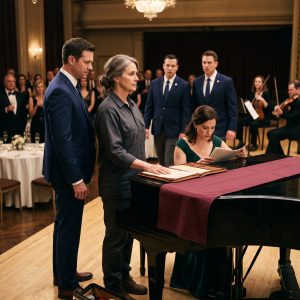
I stood beside the stage in my gray apron, gripping the lot cart. The house lights were down, and the spotlight raked across the canvas. In the lower left corner, the varnish had a dull, flat patch where the shine didn’t match.
Untouched paintings don’t do that. Repaired ones do.
“Do I hear one million?” Gideon called from the podium, silver hair perfect, voice smooth as warm honey. “One million for a masterpiece nobody has touched in a hundred and forty years.”
A paddle rose in the front row. It belonged to Edmund Hale, a retired shipping magnate who only ever paid for perfect condition.
“One-two,” Gideon said. “One-three.”
My hands were shaking.
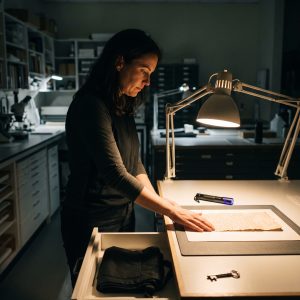
Six years earlier, Gideon had bought that canvas cheap, water-damaged and flaking. He hired me to save it, in secret, over four months.
Then he paid me, thanked me, and let me go. Within a year he’d told every museum in the state I was unreliable.
Nobody ever asked me what I had done to that painting. That was the point.
I’d stayed quiet for six years. Tonight, I ran out of quiet.
I climbed the side steps and leaned toward the podium. “Mr. Pryce, the catalog is wrong,” I whispered. “That canvas has been restored.”
His smile never moved. He covered the microphone with one hand. “Get off my stage, Ines.”
“Mr. Hale is about to pay two million dollars for a condition that doesn’t exist.”
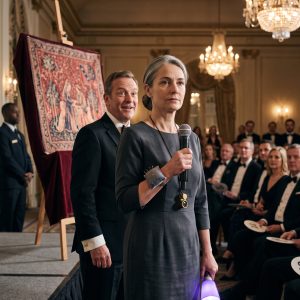
Gideon uncovered the microphone. “Ladies and gentlemen, forgive the interruption. Our porter has developed an opinion about art.”
Laughter rolled through the room. My face burned.
“Back to your cart, Ines,” he said, warm as ever. “Let’s leave the paintings to people who are still trusted with them.”
Every face in that room was embarrassed for me. Not one of them doubted him.
Then I reached into my apron pocket and took out a pen-sized ultraviolet light. I had carried it every single day for six years. It was the one tool he never thought to take.
“Mr. Hale,” I said, loud enough to carry. “Give me ten seconds with that canvas.”
“Security,” Gideon snapped.
Hale lifted his cane. “Let her.”
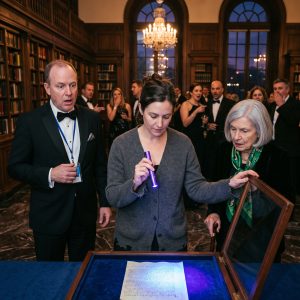
The room went silent. I stepped to the easel and clicked on the light.
The old varnish glowed a pale, ghostly green. But the lower left third of the canvas stayed dark, a ragged patch of newer paint, as clear as a map.
Gasps broke out. Gideon’s knuckles went white around the gavel.
“That isn’t damage, Mr. Hale,” I said. “That’s my work. I repainted that corner myself, and I documented every day of it.”
Gideon had spent six years erasing me. Before midnight, this entire room would watch him lose the sale, his license, and the name above his door.
Gideon laughed. It was a practiced laugh, the kind that fills a room.
“A bitter former employee with a flashlight,” he said. “Mr. Hale, shall we also check the chandelier for her fingerprints?”
A few people chuckled.
“Anyone can claim a repaint,” he continued. “Where is your proof, Ines? A treatment report? Photographs? Anything like that would have belonged to this firm, and I assure you we have no such file.”
“I know,” I said. “You made sure of that.”
His smile flickered for half a second. Then it returned, brighter and colder.
I turned to Hale. “Along the bottom edge, under the retouching, I wrote my initials and the date in thin lead-white, then sealed them beneath the varnish. Any conservator can find them under magnification.”
“And if you’re wrong?” Hale asked.
“Then I’ll pay for the lab myself, and you can have me removed.”
That was when Gideon made his mistake. He spread his arms toward the room and the camera on its tripod, its red recording light glowing.
“Fine! Test it tonight,” he said. “I’ll stake my firm and my auctioneer’s license on this painting. Nobody here believes a porter can tell a masterpiece from a mop bucket.”
Somewhere in the back, someone whispered, “He just said that on the record.”
Hale turned in his seat. “Dr. Nandakumar?”
A woman in a navy blazer rose from the third row, a jeweler’s loupe hanging from a cord around her neck. She walked to the easel without a word and knelt at the bottom edge.
The room held its breath.
Then she looked up. “There are letters here,” she said quietly. “Lead white, under the varnish. I.C., and a date six years ago.”
Gideon’s grip tightened. “Any forger can add letters.”
“Then let’s compare it with what the painting looked like before,” I said.
I took my phone from my apron and opened a folder Gideon never knew existed.
On the screen was a photograph of the ruined canvas, and pinned to its frame was a tag in Gideon’s own handwriting.
Hale took my phone in both hands. He read the tag aloud, slowly, like a man reading his own verdict.
“Property of Pryce & Alder. Water damage, lower left. Approximately thirty percent paint loss. G. Pryce.”
He looked up at the podium. “And your catalog says ‘untouched.'”
Gideon’s mouth opened and closed. “Photographs can be fabricated.”
“So can catalogs,” Dr. Nandakumar said, rising to her feet. “Paint chemistry can’t. The retouching in that corner sits on top of the old varnish, exactly where she said, and her initials are buried under the newer layer. Nobody adds that without lifting the whole surface.” She turned to Hale. “I would not bid on this lot.”
Hale lowered his paddle. He laid it on the empty seat beside him as if it had suddenly become heavy.
“Mr. Pryce,” he said, “I pay for paintings that are what they claim to be. I do not do business with men who sell otherwise.”
He stood, and the front row stood with him. Paddles dropped into laps. Coats were gathered. Within five minutes, the biggest sale in the firm’s history had become a half-empty room and a man holding a gavel over nothing.
Later, in the corridor behind the stage, Gideon caught my sleeve.
“I gave you work,” he hissed. “When nobody else would. You’d be nothing without me.”
“You gave me a cart,” I said, and gently took my sleeve back. “I would have preferred my career.”
His own words finished the job. The sale had been recorded, and so had his promise to stake his license on that canvas. The state consumer protection office opened an inquiry the next morning. Investigators pulled the firm’s files and found that Harbor at Dusk was not the only lie. Over eight years, Gideon had rewritten the condition reports on eleven lots, hiding cleanings, repairs, and repainting so the pieces would fetch far more. Six buyers were owed refunds. The heirs of the estate that had sold him the damaged canvas for almost nothing took him to court to reopen the original sale.
The licensing board revoked his auctioneer’s license that spring. Pryce & Alder closed soon after. I wasn’t there the day workers took the brass sign down from above the entrance, but I heard it made a smaller sound than anyone expected when it hit the pavement.
The night of the auction, I walked out into the cold with my gray apron folded over my arm. I never wore it again. I sat in my car and cried for the first time in six years, and it felt like setting down something I’d carried so long I had forgotten its weight.
A week later, Edmund Hale asked to meet me. Dr. Nandakumar sat beside him, and she spoke first. “In twenty years, I’ve rarely seen a retouch that clean,” she said. “It took a lab and a loupe to find where your work ends and the painter’s begins.”
Hale tapped his cane on the floor. “A hand like that doesn’t belong on a lot cart.”
He funded a conservation studio and insisted I run it. When the sign went up, it had one name on it. Mine.
The court awarded Harbor at Dusk to the heirs, who lent it to the city museum. They let me write the wall label. On opening day I stood in front of the painting, the lower left corner glowing faintly under the gallery lights, as healed as it had been the week I finished it.
The label read: “Restored by Ines Calloway.”
Varnish yellows. Paint cracks. Lies fade. But what’s real stays underneath, and sooner or later, somebody shows up with a light.