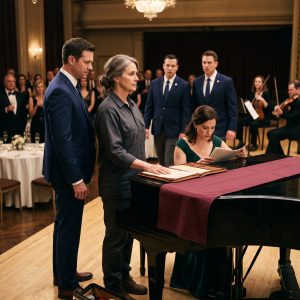
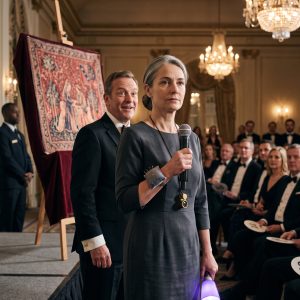
Demoted to pouring champagne at his gala, a conservator pulled a tiny light from her apron and exposed the $1.8M journal fraud in front of everyone.
My fingertips can tell a hundred-year-old page from a forty-year-old one in the dark.
That was my job at Ashgrove & Dane Auctioneers. Fourteen years of it.
I was the one they called when a letter smelled wrong, when a signature looked too confident, when a “lost” diary surfaced three days before a sale.
So when the Hartwell Journal arrived in June, I knew within a minute.
Cold lab, raking light. I slid my thumb along the edge of a page and felt it: too smooth, too even.
Under my UV lamp it lit up bright blue. Optical brighteners, the kind added to paper in the 1950s. Josiah Hartwell supposedly wrote that journal in 1871.
I wrote a four-page report and put it on Desmond Pryce’s desk.
Pryce had been our director for five months. He wore a watch worth more than my car and said “synergy” like a prayer.
“Revise it,” he said.
“It’s a fake, Desmond.”
“It’s a one-point-eight-million-dollar lot. Revise it.”
I refused.
Two days later, my title went to his nephew, Colin, a twenty-six-year-old who couldn’t tell vellum from a napkin.
My new job description was “event support.”
Which is how I ended up at the October preview gala in a black server’s apron, carrying champagne through a ballroom full of people ready to bid on a lie.
“Careful with those, Wren,” Pryce told a cluster of donors. “She’s good with fragile things. It’s the only reason we kept her.”
They laughed.
I smiled. I didn’t cry.
I’d done my crying in June.
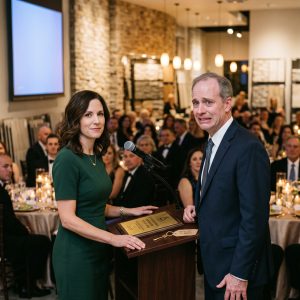
At nine o’clock, he stood beside the glass case in the center of the room, the journal open under soft light like a holy relic.
“Ladies and gentlemen, the Hartwell Journal. Authenticated by our conservation department.”
Colin beamed beside him, clutching the catalog.
Dr. Lucille Verhoeven, a museum trustee who had flown in for the sale, leaned toward the glass.
Silver bob. Steady gaze. The kind of woman who makes salesmen sweat.
“Who examined the paper?” she asked.
“Colin did,” Pryce said smoothly. “Our head of conservation.”
“Then he can tell me the mill.”
Colin’s smile slipped. “The mill is… era-appropriate.”
Nobody moved.
I set my tray on a side table. I slid my hand into my apron pocket and closed it around my ultraviolet penlight.
“Dr. Verhoeven,” I said. “There is no mill. And I can show you without touching the page.”
Every head turned. Pryce’s smile didn’t fade. It hardened.
“Wren. This isn’t the time.”
“It’s exactly the time,” I said. “This room is about to pay for it.”
I met his eyes, dry-eyed and steady.
“Dim the chandeliers, Desmond. Ten seconds. Then tell everyone who really examined this journal.”
For a moment, nobody breathed.
Then Pryce laughed. A warm, generous host’s laugh, the one he saved for donors.
“Wren used to run our conservation lab,” he told the room. “She’s still a little sore about the restructuring. Let’s indulge her, shall we? Lights, please.”
He thought I was about to humiliate myself.
The chandeliers faded. The ballroom turned the color of dark tea.
I walked to the case. Nobody stopped me. Dr. Verhoeven stepped aside to make room.
I clicked the penlight and swept the violet beam across the open page.
The paper didn’t glow. It blazed.
Cold, electric blue from edge to edge, while the brown ink sat on top of it, dull as dirt.
Somewhere near the back, a woman whispered, “Oh my God.”
“Optical brighteners,” I said evenly. “Added to paper in the 1950s. Josiah Hartwell died in 1889.”
Colin stared at his shoes.
Pryce stepped between me and the case, still smiling, though it had begun to look like it hurt.
“A party trick,” he said. “Any lab on earth will clear this journal. I’ll stake my license on it. In front of all of you.”
He said it loudly, so everyone could hear.
That was his mistake.
“I filed my full report with your insurer on June nineteenth,” I said. “Along with a photograph of that page under this exact light.”
The smile slipped for the first time.
“That’s confidential,” he snapped.
“Not anymore,” said a voice by the door.
A man in a gray suit, who had stood unnoticed all evening, crossed the floor with a slim leather folder under his arm. Mr. Teague, from Northgate Fine Art Underwriters. I had met him once, in June.
He looked at Pryce and opened the folder.
“Mr. Pryce, I’d like you to explain why this is the second Hartwell journal you’ve sold.”
The ballroom was so quiet I could hear ice shifting in the champagne buckets.
“Last April,” Teague said, “Ashgrove & Dane sold a set of Hartwell letters to the Merrow Museum for nine hundred thousand dollars. Same dealer. Same provenance papers. Same authentication wording, signed by a twenty-six-year-old with no credentials, on Mr. Pryce’s own letterhead.”
Dr. Verhoeven’s hand went still on the edge of the case.
“I sit on the Merrow’s board,” she said. “I didn’t fly in to bid tonight.”
Pryce’s eyes slid toward her.
“In September, my office received a very polite letter. No accusations. Just a request that I attend this evening and look closely at what was being sold.” She turned to me. “It was signed by the woman who’s been pouring my champagne.”
Every head followed her gaze. I kept the beam steady on the page, still burning blue under my light.
I hadn’t told anyone else. Not a coworker, not a friend. For four months I had swallowed the apron and the jokes, because I knew what Pryce did with warnings. He buried them, then blamed whoever raised them.
If I had shouted in June, the journal would have vanished into a vault and I’d have been the bitter employee with a grudge.
So I waited for a room full of witnesses and one violet beam of light.
“This is a smear,” Pryce said, and his voice cracked on the last word. “Colin. Tell them you examined it.”
Colin looked at his uncle. Then at the page. Then at me.
“I never touched it,” he said, barely above a whisper. “You told me where to sign. Both times.”
Pryce stared at him as though he’d been slapped.
“You idiot,” he hissed, and the whole silent room heard it.
The ballroom doors opened. Three people in dark blazers walked in, led by a woman with a badge clipped to her belt.
“Mr. Pryce? Investigator Pruitt, state attorney general’s office. Mr. Teague called us at eight o’clock.”
Teague gave a small shrug. “I like to be thorough.”
A chair scraped near the front. Agnes Dane, eighty-one, the founder who had sat silent all evening, rose on her cane.
“Desmond,” she said, “you are suspended, effective now. Your lanyard.”
He unclipped it with shaking fingers. The watch worth more than my car caught the light as he held it out.
He walked out between two investigators. No handcuffs, no shouting, just the longest walk of his life, past donors who had laughed at his jokes an hour earlier. Not one of them looked at him.
Pruitt told him that night his auctioneer’s license was finished. The state made it official a month later. The sale was voided before the champagne went flat, the Merrow got every dollar back, and the dealer was located two weeks after that.
Colin gave a full statement. Afterward he found me by the coat check, ashen, holding out his lab key.
“I’m not asking you to forgive me,” he said.
“Good,” I said. “Monday, seven a.m. You’ll learn vellum from the beginning. You’ll hate it.”
At midnight, Agnes found me beside the empty display case.
“Your title is yours again,” she said. “And the director’s chair, if you want it.”
“I want the lab,” I said.
She smiled. “Then I’ll find a director who knows the difference.”
At one in the morning, I was back in the lab, alone, under the old lamp.
I untied the apron, folded it, and set it in a drawer. Then I took out a real letter from 1871, ran my thumb along its edge, and felt it: rough, uneven, honest.
They had handed me an apron to make me small. It had a pocket, and in that pocket was the truth.