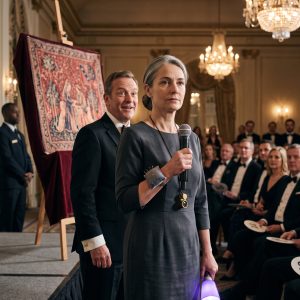
At the library gala, my boss fired me in public for doubting his $380,000 letter. Then I asked for dim lights and took out one small lamp.
I can tell what a sheet of paper is made of by the sound it makes when it bends.
Old rag paper whispers. Modern wood pulp crackles. After eleven years as the conservator at Calder Hill University Library, I rarely need a microscope to be sure.
Three weeks ago, the Fenn Letter landed on my workbench, and it crackled.
It was supposed to be an 1794 letter from our founder, Aldous Fenn. A donor named Harriet Lindqvist had paid $380,000 for it, and tonight it would sit in a glass case at our centennial gala.
I put it under my ultraviolet lamp that same afternoon. Genuine eighteenth-century paper glows a dull, sleepy brown. This sheet glowed bright blue-white, the way paper does when it contains brighteners invented in the 1950s.
I photographed it. I wrote a four-page report. I sent it to my department chair, Dr. Lyle Ransom.
His reply took four minutes.
“Delete this. You are staff, Maren. Not an appraiser.”
So I stayed quiet, and I stayed careful.
Tonight I stood at the back of the grand reading room in my gray work cardigan, the one with the frayed cuff, while two hundred guests in evening wear drifted toward the glass case in the center.
Mrs. Lindqvist reached it first. Silver bob, emerald scarf, a cane she used like punctuation.
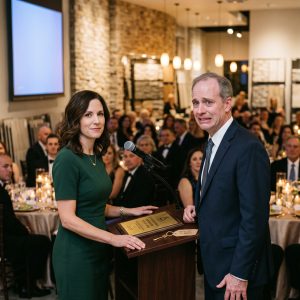
“Lyle,” she said, loud enough to carry, “I’m told a member of your staff has concerns about my letter.”
Ransom’s smile didn’t move. His eyes found me across the room.
He crossed the floor, lifting a microphone from a waiter’s tray on the way.
“Ladies and gentlemen, a small personnel matter,” he said. “Ms. Voss was passed over for promotion this spring. Since then, she has been spreading fantasies about our centerpiece.”
Heads turned. Someone laughed softly.
“Maren is a fine bench worker,” he went on. “But she has mistaken a lab coat for a doctorate.”
He held out his palm.
“Your badge.”
I unclipped it and placed it in his hand. He closed his fist around it like a man pocketing loose change.
“Security will walk you out,” he said. “Don’t make this harder.”
My face stayed still. My eyes stayed dry.
I reached into my cardigan pocket, where a pen-sized lamp had lived for eleven years, and turned to Mrs. Lindqvist.
“Would you open the case and ask someone to dim the lights?”
“This is absurd,” Ransom snapped.
Mrs. Lindqvist held out her hand. “The key, Lyle.”
He hesitated one second too long. Then he gave it to her.
The chandeliers faded. The room hushed.
I held the lamp six inches above Aldous Fenn’s letter and pressed the switch.
The paper blazed bright blue-white, edge to edge, like a window lit from behind. Only the brown ink stayed dark.
A gasp ran through two hundred people. Ransom’s face drained to the color of the page.
He was still gripping my badge.
The blue-white light climbed Mrs. Lindqvist’s face as she bent over the case.
“Is that supposed to happen?” she asked quietly.
“For a stationery sheet from the 1950s,” I said. “Not for 1794.”
Ransom recovered fast. Men like him always do.
He took the microphone again and laughed. “Optical brightener residue. Handling contamination. Ladies and gentlemen, Ms. Voss has just demonstrated her own carelessness with a priceless object.”
“Contamination sits in patches,” I said. “This glow is even from corner to corner, because the brighteners are inside the fibers. Someone made this paper in a factory, Dr. Ransom. Not in a founder’s study.”
“I hold the certificate of authenticity,” he said. “I signed it myself.”
“I know. I read it.”
I turned toward a gray-haired man beside a pillar: Abel Nwosu, the insurance reviewer Mrs. Lindqvist’s policy required for any acquisition over $250,000. He was also the man who had warned her tonight.
“Mr. Nwosu received my report three weeks ago,” I said. “Dr. Ransom told me to delete it. He never told me I couldn’t send it to the one person policy says must receive it.”
Ransom’s smile slipped, then returned, thinner.
“A disgruntled employee and an insurance clerk,” he told the room. “Please. Harriet, you know me.”
“I thought I did,” said Mrs. Lindqvist.
Mr. Nwosu opened a slim leather folder.
“I also asked the dealer for his original invoice,” he said. “Mrs. Lindqvist, he sold this letter three months ago for forty-one thousand dollars. Your foundation paid three hundred and eighty.”
Murmurs rolled through the room. Provost Okafor set down her glass.
Ransom laughed once more, but it came out wrong.
“There are fees,” he said. “Standard fees.”
Nwosu turned a page. “Then the standard fees went to a company I’d like to read aloud.”
The name was Ransom Heritage Advisory, LLC.
For three full seconds, nobody in the grand reading room made a sound.
Then Provost Okafor crossed the marble floor, her heels loud as a gavel.
“Lyle,” she said, “isn’t that the consulting company you told me you’d closed?”
“A technicality, Anita.”
“Is it yours?”
He looked at the microphone in his hand as if someone else had put it there.
Mr. Nwosu read the rest in a flat, patient voice. Ransom’s company had billed Mrs. Lindqvist’s foundation $380,000 for “acquisition services.” It had paid the dealer $41,000. It had kept the remaining $339,000.
Then he held up the dealer’s invoice and read one line from it.
“Item description: ‘Period-style reproduction, circa 1955. Not represented as original.'”
The dealer hadn’t lied to anyone. Ransom had simply bought a copy, signed a certificate calling it real, and sent the difference to himself.
Mrs. Lindqvist straightened, leaning on her cane.
“My husband taught in this building for thirty years,” she said. “I bought that letter in his name.”
“Harriet, please—”
“You stood in front of my friends and called a woman who tried to protect me a fantasist.” Her voice stayed perfectly level, which was worse than shouting. “Do not use my first name again.”
Ransom turned to the provost. “Anita, after everything I’ve given this library—”
“The audit will measure that,” Provost Okafor said. “Effective tonight, you’re suspended pending a full investigation. Your access ends now. Your keys, please.”
He pulled a ring from his pocket. His other hand was still closed around my badge.
The provost held out her palm, exactly the way he had held out his.
He placed the badge in it.
She turned and gave it back to me.
“Ms. Voss,” she said, loud enough for the back row, “I owe you an apology, and I’ll make it in writing. Please keep wearing this.”
I clipped it to my cardigan. My hands were steady. That surprised me more than anything.
Two security officers appeared at Ransom’s elbows. One of them was the guard who had been told to walk me out.
They walked him out instead.
He went the long way, past two hundred donors, past the open case, past the spot where I’d stood when he humiliated me. Nobody spoke. The only sound was his shoes on the marble.
The investigation took five months. The university’s lawyers and the insurer recovered most of the money. Ransom resigned before the board could dismiss him, and every certificate he had ever signed went back under review.
Mrs. Lindqvist didn’t withdraw her gift. She redirected it into a new conservation laboratory, and she refused to put her name on the door.
The provost offered me the job I’d been passed over for in the spring. I accepted on one condition: every condition report in the building goes to an outside reviewer, automatically, with no exceptions.
For years I had believed that staying quiet kept me safe. I was wrong about the reason. Quiet only protects you when it comes with a paper trail, and mine had been building, page by page, the whole time.
That night, after the last guest left, I went down to the basement stacks and opened a flat gray box nobody had touched in decades. Inside was Aldous Fenn’s real household ledger, water-stained and plain, worth maybe three thousand dollars.
I bent one corner of a page and listened.
It whispered.
Paper always tells the truth if you’re patient enough to listen. People do, too. It just takes them longer, and sometimes the lights have to go out first.
This story is a work of fiction. Names, characters, institutions, and events are imaginary.