For twenty years, my world was measured in the rhythm of double shifts, antiseptic spray, and the dull hum of night-shift care facilities. When my husband walked out before our daughter Chloe could even speak in full sentences, I made a silent vow. She would never taste the sour fear of an empty cupboard or know the heavy ache of living paycheck to paycheck.
I scraped together every single penny. I sold my reliable little station wagon, took night rounds turning hospice patients, and stashed folded twenty-dollar bills inside an old coffee tin shoved into the back of a winter coat I hadn’t worn in years. When Chloe’s acceptance letter to the healthcare preparatory academy across the sea arrived, I wept openly on our modest porch.
“You’re going to have choices, Chloe,” I told her, tucking her wild curls behind her ears. “You’re going to build a life where nobody ever tells you what you’re worth.”
For the first four months, she called every single night. The conversations were long, breathless, and full of raw adjustment. She complained about the drizzling rain, the tiny shared kitchen where her flatmates stole milk, and the brutal rigor of anatomy lectures.
“Mom, I don’t think I’m cut out for this,” she would weep into the receiver. “The ward is so heavy. People are so lonely.”
“You have a heart big enough to carry it,” I insisted, pacing our creaky hallway with a mug of black coffee. “Just push through.”
Then, somewhere around the fifth month, the rhythm altered.
Her nightly calls turned into hurried five-minute check-ins. “Mom, sorry, I have clinicals early.” “Mom, I have to run to the pharmacy.” Her voice sounded breathless, taut with a nervous strain I had never heard before.
One evening, unable to bear the growing distance, I asked bluntly, “Chloe, have you met someone?”
She gave a quick, brittle laugh that skipped a beat. “Mom, don’t be silly.”
A mother knows when laughter is a locked door.
Two weeks later, after I spent days pleading for a photograph of her life—a picture of her room, her library desk, her friends—a single notification pinged on my cracked phone screen while I was folding clean washcloths in the laundry room.
My thumb hesitated, then tapped the glass.
The photo showed Chloe standing on a gray stone sidewalk under an overcast sky. She wore her faded blue wool coat, smiling with her eyes slightly shadowed. Standing beside her, his arm draped protectively around her shoulders, was a man. He had silver-streaked hair, deep laugh lines carved into weathered skin, and eyes tired beyond his years.
My breath caught in my throat. I flipped the phone onto the laminate counter, feeling blood pound in my ears.
Before I could form a thought, the phone buzzed violently. Chloe’s contact lit up.
I picked it up with a shaking hand. “What did you do, Chloe?”
Her voice was barely above a whisper. “Mom, please don’t yell. I need you to hear me out.”
“How old is that man?”
A deafening pause stretched across the ocean.
“He’s fifty-six.”
“Chloe, what did you do?” My voice rose into a harsh, ragged register.
“We got married yesterday morning.”
The floor seemed to tilt underneath my sneakers. My knees gave out, and I sank heavily onto the wooden stool by the refrigerator. A terrible sickness clawed at my chest. I had given up twenty years of my youth, broke my back lifting bedridden strangers, scrubbed floors until my knuckles bled—and my brilliant, tender daughter had thrown herself into the arms of a man older than her own father.
In that frantic, wounded hour, I said cruel, desperate words. I asked her if she had priced herself out like property. I asked what kind of money could possibly buy her self-respect.
Chloe didn’t scream back. She didn’t hang up. She just absorbed the blows with a heartbreaking quietness, her breath trembling on the other end.
“I have a flight home next Friday,” she said softly. “Please just wait until I can sit in front of you.”
The seven days that followed passed in a haze of cold misery. In my mind, I constructed every bitter scenario known to women who grow up poor. I imagined her walking off the plane draped in designer luggage, sparkling with ostentatious rings bought with her dignity, an alien in my humble home.
When she finally pushed through the arrivals terminal at the small airport, my heart seized.
There were no designer bags. No expensive jewelry. Her fingers were bare except for a thin, silver band that looked like it had come out of a street vendor’s tray. She wore the same scuffed sneakers she’d left in, dragging her threadbare green canvas backpack across the linoleum. Her face was pale, shadowed by deep, exhausted circles.
We walked to my borrowed truck in silence. I gripped the steering wheel until my knuckles turned white, refusing to let the dam break until we were behind our own front door.
The moment the front door clicked shut behind us, I spun around.
“Tell me the truth,” I choked out, tears finally burning my eyes. “Did you marry him for money? Did you do this to pay off school?”
Chloe dropped her backpack onto the floor with a soft thud. Her shoulders shook, and large, silent tears spilled over her cheeks. She pulled out a wooden kitchen chair and sank into it, looking as though every bone in her body had dissolved into dust.
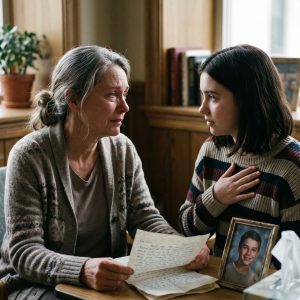
“Mom,” she said, motioning weakly to the opposite seat. “Sit down. Please.”
I pulled out the chair and sat, my chest aching.
Chloe reached into her backpack and pulled out a manila folder, sliding it across the table toward me. Inside were copies of medical transcripts, tenancy leases, and legal guardian authorizations.
“His name is Arthur,” Chloe whispered. “He’s a retired cabinetmaker. He lived in a cold single-room flat two blocks from the clinic where I do my volunteer rounds.”
I flipped open the folder. The medical diagnosis glared back at me in sterile black ink: Non-small cell lung carcinoma, Stage IV. Refractory.
“Arthur doesn’t have money, Mom,” Chloe continued, her voice catching in her throat. “He doesn’t have an estate or savings. He spent thirty years building furniture, and when his wife died eight years ago, he became completely invisible. He has no children, no siblings, no cousins. Nobody.”
“Then why marry him?” I asked, my voice barely a thread.
“Because he was scheduled to be discharged into an unmonitored boarding hostel,” Chloe said, wiping her face with her sleeve. “Under the city’s housing and palliative assistance laws, only a legally recognized next of kin or spouse can authorize full home hospice care, access his pension subsidy, and bring in daily nursing assistance. If he remained a ward of the state, he was going to die alone on a cot in a hallway.”
I stared at her, completely motionless.
“He collapsed in the clinic hallway during my third week there,” she said, looking down at her trembling hands. “I sat with him during his chemo infusions because nobody else ever walked through that door. He told me about his life, his wife, the trees he loved turning into tables. When his prognosis turned terminal, they told him he had to make arrangements. But there was no one to call.”
Chloe looked up at me, her brown eyes bright with an ancient, unbearable sorrow.
“I couldn’t watch him get discarded, Mom. I just couldn’t. I went to the registry with him. We signed the papers so I could become his power of attorney, so I could administer his pain management at home, so he doesn’t have to die terrified in the dark. He’s safe in his bed right now, with a visiting aide watching him until I fly back on Sunday.”
The silence in the kitchen was thick enough to suffocate.
“I didn’t sell myself,” Chloe whispered, her chin trembling. “You asked me why I did it. I did it because every night of my life, I watched you come home smelling of bleach and antiseptic, your back bent, your hands swollen, because you refused to let the old folks at the manor feel unloved. You showed me that caring for people isn’t a career—it’s a duty.”
She reached across the table and covered my calloused, rough fingers with her own.
“I did it because of who you made me, Mom.”
The hot shame that swept through me was heavier than any grief. I reached across the table, grabbed my daughter’s face in both of my hands, and pulled her toward me. We sat there in the late afternoon gloom of our little kitchen, weeping into each other’s shoulders.
I had spent months terrified that the world had broken my daughter’s spirit, that poverty had forced her into compromise. But looking at her, holding her thin, brave frame, I realized she had never been stronger. She hadn’t surrendered her soul; she had offered it as shelter to a dying man who had nothing left to give in return.
And in that quiet kitchen, I knew I had raised the finest nurse this world would ever see.