“You think you’re too good for this family now?”
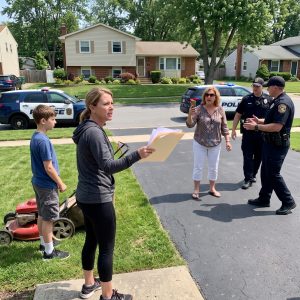
My father’s voice cracked through my phone speaker, filling the entryway of my own home. Two police officers stood on my welcome mat. One had his hands folded politely in front of him. The other kept glancing between me and the phone as if trying to decide which of us was the problem.
The console table still shone from the lemon cleaner I had been using ten minutes earlier. My coffee sat cold on the kitchen counter. My husband, Daniel, stood next to me without saying a word, one hand resting lightly against my back.
“I have belongings in that house,” Dad was saying. “I have a financial stake in that property. She can’t just lock me out.”
The younger officer looked at me. “Ma’am, do you feel safe right now?”
“I do,” I said. “I just want this handled properly.”
Dad kept talking, louder and louder, as if the volume of his voice could stand in for evidence. Then he said the line I had heard in one form or another for my entire life.
“I helped her with that house.”
I looked toward the cabinet in the hallway where I had stored months of bank records and property documents. For the first time, he had brought his arguments somewhere they could be checked against facts.
I should explain how I became the daughter who paid.
I am the older of two girls. My sister Emily is three years younger, and from the moment she could talk, she was the one the house revolved around. I don’t say that with bitterness anymore. It’s just how it was.
When Emily wanted dance lessons, the money had to come from somewhere, so my school trip got canceled. When she needed a laptop for high school, Dad sat me down at the kitchen table. I was seventeen, and I had spent two summers scooping ice cream to save for a used car.
“Family helps family,” he said. “You’ll get your car eventually.”
I handed over the savings. I never got the car.
At nineteen, I enlisted in the Army. I told myself it was for the structure, the education benefits, the chance to build something of my own. Part of it, honestly, was that I wanted to be somewhere I wasn’t constantly being asked for something.
That didn’t work. Even on a private’s salary, the requests followed me. The water heater broke. Emily’s tuition deposit was due. The electric bill was behind. I sent money every month, sometimes leaving myself with less than a hundred dollars until the next paycheck.
Daniel was the first person who ever asked me the question that changed everything. We were dating then, sitting in his car outside a diner.
“When was the last time your family did something for you?” he asked. “Not asked you for something. Did something for you.”
I opened my mouth to answer. Nothing came out. I sat there for almost a full minute trying to think of one example, and I couldn’t.
Still, I kept giving. Old habits are heavy things.
Then came basic training graduation.
I mailed my parents everything: the date, the time, the directions to the base, a list of nearby hotels. I offered to cover their gas and a night’s stay. Dad said they’d “see what they could do.” Mom said Emily had “a lot going on.”
On graduation morning, I stood in formation in my dress uniform, sweat gathering under my collar, and I scanned the bleachers. Row by row. Face by face. Hundreds of families were there, holding signs, crying, waving.
None of them were mine.
After the ceremony, while soldiers around me were being swallowed in hugs, I stood alone near the edge of the parade field. A woman in a yellow cardigan—somebody else’s mother—noticed me. She walked over, wrapped her arms around me without asking, and whispered, “I’m proud of you, honey. Whoever isn’t here, I am.”
I cried on a stranger’s shoulder. I still think about her.
Three weeks later, my phone buzzed. It was Dad. No “How was graduation?” No “Sorry we missed it.” Just one line.
I need $8,000 for your sister’s wedding.
I stared at that text for a long time. Something inside me that had been negotiating with itself for twenty-five years simply went quiet.
I opened my banking app. I typed in eight dollars. In the memo line I wrote: Best wishes.
Then I walked into the living room where Daniel was reading and said, “Can we change the locks this weekend?”
He looked up, studied my face, and nodded. “I’ll go to the hardware store tomorrow.”
Dad called the next morning. I let it ring twice before answering.
“What is this?” he demanded. “Eight dollars? Is this a joke?”
“It’s a gift,” I said. “For the wedding.”
“I asked for eight thousand. Where’s the other seven thousand nine hundred ninety-two?”
“I don’t have it for you.”
What followed was a tour of every tactic I had grown up with. First guilt: “After everything we’ve done for you.” Then insults: “You’ve always been selfish, always thought you were better than us.” Then, when neither worked, the accusation.
“I put money into that house,” he said. “You don’t get to shut me out of something I helped pay for.”
That was the moment I realized the folder was going to matter.
Years earlier, when Daniel and I bought our home, Dad had contributed toward closing costs. It was the only time in my life he had ever given me money, and I had been so stunned that I insisted on paying it back. Every cent, over fourteen months, documented with transfer receipts.
Since then, at Daniel’s gentle suggestion, I had been keeping records. The recorded deed with only our two names on it. The repayment history. Years of transfers I had sent to my parents and Emily, totaling far more than I’d ever want to say out loud. And now, screenshots of the wedding demand and the phone call that followed.
“You’ll regret this,” Dad said before he hung up.
I knew what that meant. Dad had never lost an argument in private that he couldn’t try to win in public.
A few days later, the police arrived.
I put Dad on speaker and handed the officers the folder.
The older officer flipped through it slowly. The deed. The repayment records. The transfer history. He raised his eyebrows once, then closed the folder and looked at the phone.
“Sir,” he said, “the property records show two owners, and neither of them is you. The bank documents show your contribution was repaid. If you believe you’re still owed money, that’s a civil matter. You can file a claim and bring your evidence to court. But we can’t grant you access to someone’s residence because you’re their father.”
Dad started up again. “She’s ungrateful. She’s selfish. She—”
And here’s the strange part. The words were the same ones that had bent me since I was a child. But standing there, in a house I had paid for, beside a man who had asked me the right question, they sounded different. They sounded small.
“Dad,” I said. “Do you know I stood in those bleachers looking for you?”
Silence.
“I sent you the directions. I offered to pay for your hotel. A stranger’s mother hugged me because nobody who shared my last name showed up. And three weeks later, the first thing you said to me was that you needed eight thousand dollars.”
“That’s not—”
“You didn’t want a daughter,” I said quietly. “You wanted an ATM.”
I told him not to come to the house again. I told him that if he genuinely believed he had a financial claim, he could take it to a lawyer and a courtroom, where paperwork matters more than volume. Then I ended the call.
The younger officer nodded at me on his way out. “You did this the right way,” he said.
Emily called two days later. She didn’t ask about the police. She asked whether the deposit for the venue was “still happening.”
“Emily,” I said, “I graduated from basic training last month. Did you know that?”
She sighed. “It was just some ceremony. This is my wedding.”
That sentence ended the last argument I was still having with myself.
“I hope it’s beautiful,” I told her. “I won’t be paying for it, and I won’t be there.”
She hung up on me.
Nearly a year has passed. My father has never apologized. Emily got married without me, and when photos surfaced of Dad beaming beside her in his rented tuxedo, it hurt more than I expected. I won’t pretend it didn’t.
But the quiet in my home slowly turned into something that wasn’t loneliness. It was peace. My paychecks stayed in my account. My phone stopped being a collections line.
Daniel and I have a daughter now. She’s small and loud and utterly certain that she is the center of the universe, which, in this house, she is.
My graduation photo still hangs near our entryway. Not because I enjoy remembering the empty seats. I keep it there because of the promise I made the day I took it down from my old barracks wall.
Whatever our little girl grows up to become, whenever she looks toward the people who are supposed to show up for her, she will never have to search the bleachers twice.