My parents were supposed to be celebrating.
Gene and Carol Hartwell had been married forty-seven years as of that Thursday in October. Forty-seven years of the same kitchen, the same morning routines, the same gentle bickering over which news channel to watch. I had been a terrible daughter lately — too busy, too distracted — and I wanted to make it right.
I made a pot of white bean soup from my mother’s own recipe. I bought peppermint candies from the little old-fashioned candy shop my dad has loved since the 1970s. I wrote a long card, the kind where you run out of space and have to keep writing smaller and smaller near the edges.
I drove to Birchwood Drive feeling almost light.
That feeling lasted until I saw the mailbox.
It was stuffed — catalogs, envelopes, a small package — the kind of overflow that only happens when nobody’s collected mail in three or four days. My parents collected their mail every single morning before eight. My mother called it her “first errand.”
I stood there on the front walk, my bag in one hand and the soup container in the other, and felt something cold move through me that had nothing to do with the October air.
The blinds were closed. At three in the afternoon. My mother, who had opened those blinds every morning since I was born, who believed that “a dark house is a sad house,” had left them shut.
I knocked. Rang the bell. Called out.
Silence.
I fumbled for my spare key. The lock clicked. I pushed the door open.
The smell hit me first — faint, almost sweet, somewhere between almonds and something chemical. I didn’t know what it was. I just knew it was wrong.
“Mom? Dad? It’s Diane!”
I moved through the entry hall into the kitchen. And then I saw them.
My father was face-down on the tile floor, his reading glasses in pieces beside him, his arm stretched out as if he’d been reaching for the counter when he fell. My mother was slumped against the base of the kitchen cabinet, still holding her coffee mug, her head tilted to one side.
Neither of them moved.
“Dad!” I dropped everything. The soup container cracked open on the floor. I grabbed his shoulder and shook it. “Dad, wake up — please —”
Nothing.
I pressed two fingers to his neck, the way I’d seen on television a thousand times, and felt something so faint I wasn’t sure I’d imagined it. A pulse. Barely.
I was screaming before I even realized I was doing it.
I don’t fully remember the 911 call. I remember the operator’s voice, steady and calm, telling me not to move them. I remember saying my parents’ address three times before I got it right. I remember sitting on the kitchen floor between them, holding my mother’s free hand, begging her to open her eyes, while the minutes stretched out like wire pulled too tight.
The paramedics arrived in eight minutes. It felt like eight years.
They worked on my parents right there in the kitchen. I was pushed gently into the hallway, then onto the front porch, where a young police officer stood with me and kept asking if I needed water. I kept saying no. I kept staring at the African violets on the windowsill through the kitchen window.
My husband David arrived twenty minutes after I called him. He held me in the driveway while they loaded my parents into separate ambulances.
“They’re alive,” he kept saying. “They’re both alive.”
But that was all we knew.
At the hospital, a detective named Reyes sat across from me in a beige waiting room and asked me to think carefully. Had my parents mentioned any conflict with a neighbor? Any strange visitors? Had they eaten or drunk anything unusual?
I couldn’t help. I had been forty minutes away and two months absent. That guilt sat on my chest like a stone.
The toxicology results came back on day six: arsenic poisoning. Administered over time, in small doses, in something they consumed regularly. The detective said it was deliberate. Methodical. Whoever did this had wanted it to look like a natural decline.
My parents were stable but weak. The doctors said had I arrived even a few hours later, they might not have survived.
On day seven, David went back to the house with Detective Reyes to help catalog what might have been contaminated. He called me at 4:17 in the afternoon.
“Diane,” he said. “I need you to sit down.”
I was already standing in a hospital corridor. I leaned against the wall.
“I found something behind the loose brick in the garden wall. You know that spot your dad always meant to re-mortar? There was a small bag. Inside it was a receipt, a vial, and a handwritten note.”
I could barely form the word. “Whose handwriting?”
He was quiet for just a moment too long.
“It’s your brother Marcus’s.”
I slid down the wall until I was sitting on the cold floor of that hospital corridor, the phone pressed to my ear, unable to make a sound.
Marcus. My older brother. The one who had power of attorney over my parents’ finances. The one who’d been visiting them every week for months — more than I had, more than our sister Brittany. The one my mother called “her devoted boy.”
Detective Reyes later pieced it together. My parents had recently updated their will, and Marcus had discovered they were planning to leave the Birchwood Drive house — worth considerably more than any of us had realized — to a charitable trust rather than dividing it among the three of us. He had been slowly poisoning their morning coffee for weeks, waiting.
Marcus was arrested three days later at his office. He didn’t fight it. He sat very still when they put the handcuffs on, my mother told me afterward, as if some part of him had known this moment was coming.
My parents came home to Birchwood Drive six weeks after that terrible Thursday. My mother opened the blinds the first morning, right on schedule. My father complained that the garden had gone to ruin in his absence and immediately began making plans to fix it.
I call them every single day now. Not every week. Every day.
I used to think “I’ve been meaning to visit” was a harmless phrase. Now I understand it for what it is: a way of borrowing time you may not actually have.
That forty-minute drive saved two lives. Mine included.
Related Posts

He Kept a Money Jar for Six Days. Then He Told Me Who Took His Sister
The first thing I noticed was the coins. Nickels, mostly. A few crumpled ones. My son Theo had started hiding a mason jar under his bed, and…
The Signal at Gate 14
Officer Renata Ford had worked airport security for six years, long enough to develop an instinct for the wrongness that doesn’t show up on any scanner. It…

She Stopped Wearing Makeup. Hollywood Started Paying Attention Again
She Stopped Wearing Makeup. Hollywood Started Paying Attention Again. Pamela Anderson walked into Paris Fashion Week in September 2023 wearing nothing on her face. No foundation, no…

A toddler was thrown off a bridge into the bay during a 5-car crash.
A toddler was thrown off a bridge into the bay during a 5-car crash. A stranger jumped 30 feet after her. It happened May 2, 2021 on…

When My Widowed Father Kept Taking Women to the Same Restaurant, I Thought I Understood Grief. I Didn’t.
My mother died two years ago. My father, Daniel, was sixty-one, and for the first year he barely left the house except for groceries and the occasional…
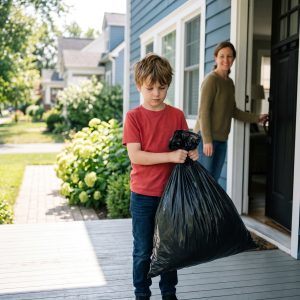
After four long years of home visits, interviews, and endless waiting, our son finally arrived. Ethan was seven, small for his age, with serious brown eyes.
After four long years of home visits, interviews, and endless waiting, our son finally arrived. Ethan was seven, small for his age, with serious brown eyes. It…