In the world of extreme sports, few athletes achieve the level of mastery and innovation that separates legends from the rest. On a cold February morning in 2026, that world lost one of its brightest talents when a catastrophic equipment failure claimed the life of one of freeflying’s most celebrated champions.
A Life Lived at Altitude
For nearly two decades, the French-born athlete had dominated competitive freefall and wingsuit disciplines, earning two world championship titles and establishing himself as a globally recognized figure in aerial acrobatics. At just 37 years old, he represented the pinnacle of what’s possible when human courage meets technical mastery in the sky. Born and raised in the Alps, he seemed destined to push the boundaries of flight. His career trajectory spoke volumes: multiple world-class titles, featured in international extreme sports media, and a social media following that numbered in the thousands, all drawn to witness his defiance of gravity itself.
The Fatal Flight
The accident occurred during what should have been a routine expedition over the Mont Blanc range in southeastern France. Jumping from a helicopter while wearing a specialized wingsuit—equipment designed to allow flyers to glide at speeds exceeding 250 kilometers per hour—he initiated what witnesses and investigators would later determine to be a textbook freefall jump. For those first critical moments, everything appeared normal.
Then something went terribly wrong.
After a brief free-fall period, the backup systems that save lives every day around the world simply failed to deploy. In the seconds that followed, the athlete’s decades of experience and technical knowledge couldn’t overcome a mechanical failure. His body was recovered in the picturesque village of Les Bossons, nestled in the Chamonix Valley, where emergency responders found themselves unable to offer aid to a man who had seemed invincible in his element.
The Aftermath and Legacy
The international skydiving community’s response was immediate and profound. France’s National Parachuting Federation released a statement that honored not just his competitive achievements but his character—his friendly demeanor, his infectious passion for the sport, and his contributions as a filmmaker documenting the heights that human athletes could reach. Federation president Yves-Marie Guillaud noted that “the entire sport parachuting community mourns a talented young man with such a friendly smile.”
Beyond the statistics and medals, what remained most poignant was the enormous body of aerial footage this artist-athlete had created. Through his lens, thousands of viewers around the world had experienced the incredible freedom of human flight, captured at speeds and altitudes most will never experience. His Instagram feed became a memorial—followers from every continent leaving tributes beneath the final images of an athlete soaring through crystalline skies.
The Unanswerable Questions
Investigators launched an inquiry into the specific technical failure that prevented his parachute from opening. While such accidents remain extraordinarily rare in modern skydiving—a testament to decades of safety refinements—they remind us that extreme sports, by definition, carry extreme risks. Every athlete who participates in wingsuit flying understands the mathematics: fly at heights measured in thousands of meters, at speeds that kill on impact, and accept that between you and survival stands only synthetic fabric and physics.
Flying On
The freeflying community will continue their sport, as they must. But they’ll do so with one fewer voice in the conversation, one fewer pair of eyes capturing the transcendent beauty of falling through clouds. The investigation may eventually reveal mechanical specifics—a manufacturing defect, a deployment issue, user error—but no explanation will be satisfactory to those who knew him.
What remains is a body of work: hundreds of aerial videos showcasing human potential at its most extraordinary, a legacy in the competition records of multiple world championships, and the memory of someone who chose to live vertically, who chose to dance with the sky, and who paid the ultimate price for that choice.
The mountains he loved will continue to stand eternal. And somewhere in those heights, the community he left behind will remember not just how he flew, but how he inspired them to reach higher.
Related Posts

He Kept a Money Jar for Six Days. Then He Told Me Who Took His Sister
The first thing I noticed was the coins. Nickels, mostly. A few crumpled ones. My son Theo had started hiding a mason jar under his bed, and…
The Signal at Gate 14
Officer Renata Ford had worked airport security for six years, long enough to develop an instinct for the wrongness that doesn’t show up on any scanner. It…

She Stopped Wearing Makeup. Hollywood Started Paying Attention Again
She Stopped Wearing Makeup. Hollywood Started Paying Attention Again. Pamela Anderson walked into Paris Fashion Week in September 2023 wearing nothing on her face. No foundation, no…
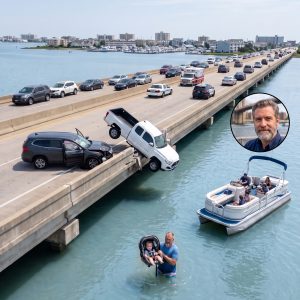
A toddler was thrown off a bridge into the bay during a 5-car crash.
A toddler was thrown off a bridge into the bay during a 5-car crash. A stranger jumped 30 feet after her. It happened May 2, 2021 on…

When My Widowed Father Kept Taking Women to the Same Restaurant, I Thought I Understood Grief. I Didn’t.
My mother died two years ago. My father, Daniel, was sixty-one, and for the first year he barely left the house except for groceries and the occasional…

After four long years of home visits, interviews, and endless waiting, our son finally arrived. Ethan was seven, small for his age, with serious brown eyes.
After four long years of home visits, interviews, and endless waiting, our son finally arrived. Ethan was seven, small for his age, with serious brown eyes. It…