When Dreams Meet the Mountains: The Story of Pierre Wolnik
In the rarefied world of extreme sports, few names command as much respect as Pierre Wolnik. The 37-year-old French wingsuit skydiver had achieved what most athletes only dream of—becoming a two-time world champion in one of the planet’s most dangerous disciplines. Yet on Saturday, February 7, 2026, a moment of catastrophic equipment failure transformed the Mont Blanc massif from a playground of possibility into a site of unimaginable tragedy.
A Passion Written in the Sky
Wolnik wasn’t just another adrenaline junkie chasing thrills. He was a pioneering figure in the wingsuit flying community, an athlete whose technical mastery and grace in the air had earned him the sport’s highest honors. Crowned wingsuit world champion in both 2022 and 2024, Wolnik was already being discussed as the likely three-time champion at the upcoming 2026 FAI World Championships. Beyond his competitive accolades, he served the Fédération Française de Parachutisme (FFP) as a videographer, documenting the beauty and danger of his beloved sport through footage that captivated thousands on social media.
For someone who spent his life choreographing motion through the clouds, Wolnik seemed to exist in perfect harmony with the skies. His Instagram posts regularly featured breathtaking aerial views and reflective captions about freedom and perspective. In one recent post, he wrote: “Flying high, feeling free. Because up there, everything makes sense.” Those words, now haunting in their innocence, capture what drew him to this extreme sport year after year.
The Jump That Changed Everything
February 7 began like countless other days in Wolnik’s extraordinary life. He boarded a helicopter above the French Alps, donning his specialized wingsuit—the webbed garment that transforms skydivers into near-flying creatures, allowing them to glide at speeds approaching 200 miles per hour. The Mont Blanc massif, that iconic mountain range that had beckoned him so many times before, rose majestically below.
After launching from the aircraft, Wolnik entered the freefall phase, that precious window of pure flight where wingsuit pilots experience the closest thing to human-powered aviation. His body moved through the thin Alpine air with practiced precision. Seconds ticked away as he descended through the sky.
Then came the moment that should have been routine—the altitude at which he would deploy his parachute. Wolnik reached for the ripcord. But something went catastrophically wrong.
The parachute failed to open.
For reasons still under investigation, the deployment mechanism that should have arrested his fall remained inert. Wolnik had only seconds to comprehend what was happening—that the equipment that had always carried him safely to earth had betrayed him. According to emergency responders and initial reports, he remained conscious through those final moments, aware that the mountain he had loved was now rushing toward him with fatal inevitability.
The Moment of Impact
The impact came in the village of Les Bossons, nestled in the Chamonix valley. When emergency crews arrived on scene, the injuries were catastrophic. Wolnik, still in his wingsuit, had struck the ground at the full speed of his freefall. Despite the immediate efforts of first responders, there was nothing to be done. At 37 years old, one of the world’s most accomplished skydivers was pronounced dead at the scene.
His body was carefully recovered and airlifted by helicopter from the remote mountain location. An investigation was immediately launched by French authorities, focused on understanding what caused the parachute failure—whether mechanical malfunction, equipment degradation, or operational error played a role.
A Community in Mourning
The news reverberated through the global skydiving community like a shockwave. The Fédération Française de Parachutisme released a statement that spoke to the profound loss: “Today, the entire sport parachuting community mourns the loss of a talented young man with such a warm smile. Pierre Wolnik will be remembered as a teammate whose presence will forever be etched in the memories of those around him.”
FFP President Yves-Marie Guillaud added a more personal tribute: “The entire sport parachuting community mourns a talented young man with such a friendly smile. May the memory of this exceptional parachutist fill our hearts.”
Teammates, fellow athletes, and colleagues took to social media to remember Wolnik not just as an exceptional athlete, but as a warm, humble person whose presence elevated everyone around him. Videos of his daring flights began circulating online again—tributes to a life fully lived, even if it ended too soon.
Understanding the Danger
Wolnik’s death throws into sharp focus just how perilous wingsuit flying truly is. According to extreme sports data, there is approximately one fatality per 500 base jumps in wingsuit flying—a death rate that exceeds most extreme sports. While modern safety protocols and equipment have improved dramatically over the decades, the fundamental danger remains immutable: at speeds exceeding 200 mph and at extreme altitudes, there is virtually no margin for error.
The first recorded wingsuit jump, which took place in Paris in 1912 when Austrian tailor Franz Reichelt jumped from the Eiffel Tower in his self-designed suit, ended in similar fashion—in tragedy. Yet the sport persists, drawing athletes who understand the risks and accept them as the price of achieving something transcendent.
A Legacy That Endures
For the thousands who followed Wolnik’s journey through social media, his death represents more than just a statistic in the annals of extreme sports accidents. It represents the sudden erasure of someone who seemed to embody mastery, grace, and an almost philosophical connection to the sport of flight.
His final social media post, made before this fateful jump, continues to haunt those who knew him: “It seems that too many of us take this great mystery of life for granted to a point that they don’t even question the nature of the experience until the very end of it.”
Pierre Wolnik questioned it every time he jumped. Every flight was a meditation on freedom, risk, and what it means to truly live. Tragically, his very last jump became a meditation on something far more profound—the fragility of even the most exceptional among us, and the thin margin between soaring achievement and devastating loss.
The investigation into his death continues. The skydiving community mourns. And the mountains stand eternal, waiting for the next brave soul willing to dance among their peaks.
Related Posts

He Kept a Money Jar for Six Days. Then He Told Me Who Took His Sister
The first thing I noticed was the coins. Nickels, mostly. A few crumpled ones. My son Theo had started hiding a mason jar under his bed, and…
The Signal at Gate 14
Officer Renata Ford had worked airport security for six years, long enough to develop an instinct for the wrongness that doesn’t show up on any scanner. It…

She Stopped Wearing Makeup. Hollywood Started Paying Attention Again
She Stopped Wearing Makeup. Hollywood Started Paying Attention Again. Pamela Anderson walked into Paris Fashion Week in September 2023 wearing nothing on her face. No foundation, no…
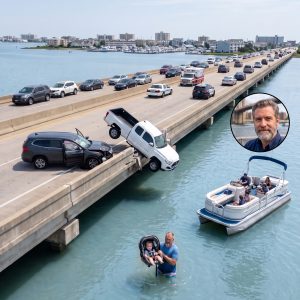
A toddler was thrown off a bridge into the bay during a 5-car crash.
A toddler was thrown off a bridge into the bay during a 5-car crash. A stranger jumped 30 feet after her. It happened May 2, 2021 on…

When My Widowed Father Kept Taking Women to the Same Restaurant, I Thought I Understood Grief. I Didn’t.
My mother died two years ago. My father, Daniel, was sixty-one, and for the first year he barely left the house except for groceries and the occasional…

After four long years of home visits, interviews, and endless waiting, our son finally arrived. Ethan was seven, small for his age, with serious brown eyes.
After four long years of home visits, interviews, and endless waiting, our son finally arrived. Ethan was seven, small for his age, with serious brown eyes. It…