A day of fun in the Australian waters turned into a 10-hour fight for survival that would test the limits of courage, endurance, and a mother’s impossible choice
The water was supposed to be calm that Friday morning. Joanne Appelbee and her three children—Austin, 13, Beau, 12, and Grace, 8—had rented kayaks and paddleboards from their hotel in Quindalup, a picturesque beach town about 250 kilometers south of Perth, Western Australia. It was January 30, 2026, and they were on vacation, enjoying what should have been a perfect day on Geographe Bay.
The children had been swimming since they were young. The water looked inviting, the shoreline reassuringly close. They paddled out into the shallows, laughing and splashing, completely unaware that within hours, they would be fighting for their lives in one of the most harrowing ocean survival stories Australia has witnessed.
When Paradise Turns Predator
Shortly after noon, everything changed. The wind picked up. The waves grew aggressive. Their kayak flipped and began filling with water. The inflatable paddleboards—perfect for calm waters—became precarious lifelines in increasingly violent seas.
The family tried desperately to paddle back toward shore, but the ocean had other plans. With each passing minute, the coastline grew smaller. The current was relentless, dragging them further and further from safety. Within a short time, they found themselves four kilometers offshore with no way to fight back against the powerful forces pulling them into open water.
Joanne realized with growing horror that they were in serious danger. She had three children to protect, and the situation was deteriorating rapidly. The waves were getting bigger. The light would soon fade. They had life jackets, but no food, no water, and no way to signal for help.
A Mother’s Impossible Decision
As the reality of their predicament set in, Joanne faced a decision that would haunt her for the rest of her life. She couldn’t leave her younger children alone in the water. But if someone didn’t get help soon, none of them would survive.
She looked at her oldest son, Austin, just 13 years old. He was strong, a good swimmer, but still a child. Could she really ask him to swim four kilometers through rough, cold ocean waters alone? Could she watch him disappear into the waves, not knowing if she’d ever see him again?
But what choice did she have?
“One of the hardest decisions I ever had to make was to say to Austin: ‘Try and get to shore and get some help. This could get really serious really quickly,'” Joanne would later tell reporters, her voice still thick with emotion at the memory.
Austin understood what his mother was asking. He knew the risk. But he also knew that without help, his family would die.
“Alright,” he said. “Not today, not today, not today. I have to keep on going.”
The Superhuman Swim
Austin climbed onto the family’s inflatable kayak and began paddling toward the distant shoreline. But within minutes, the rough seas were filling the vessel with water. It was sinking. He abandoned it and began swimming with his life jacket on.
For two hours, he fought through massive waves, each one threatening to push him back or drag him under. His muscles burned. His lungs screamed for air. But the life jacket, meant to save him, was actually slowing him down, dragging in the water and making each stroke harder.
In a decision that stunned rescue workers when they later heard about it, the 13-year-old made a calculated choice: he removed his life jacket and continued swimming without it.
“The waves are massive, and I have no life jacket on,” Austin would later recall. “I just kept thinking, ‘Just keep swimming, just keep swimming.'”
To keep himself going through the physical and mental agony, Austin sang the theme song from “Thomas the Tank Engine” in his head. He thought about his friends at school. He thought about his Christian youth group. He thought about his family desperately waiting for him to succeed.
“I was thinking about all the happy things in my head, trying to make it through, like, not the bad things that’ll distract me,” he explained.
For four grueling hours, the teenager swam through cold, choppy waters in fading light. Physical therapists would later tell him that the exertion he endured was equivalent to running two marathons back-to-back.
Finally, at around 6 p.m., Austin’s feet touched the bottom of the beach. He collapsed on the sand. But his ordeal wasn’t over—he still had to run two kilometers to find a phone to call for help.
“Some nice ladies on the beach” gave him food before he “just passed out,” he remembered. He was taken to Busselton Health Campus, where he would wake up with no idea whether his family had survived.
Ten Hours in Hell
Meanwhile, miles out at sea, Joanne was living every parent’s nightmare.
She had used leg braces to tether herself to Beau and Grace, binding them together to the paddleboard so they wouldn’t drift apart. For hours, she kept them calm, singing songs and joking, treating the life-threatening situation “as a bit of a game” to keep fear from overwhelming her young children.
But as the sun began to set and the waves grew even more violent, maintaining that facade became nearly impossible. The water was brutally cold. Beau was losing feeling in his legs. Grace was terrified. And Joanne was consumed by a question that tortured her with every passing minute: “If Austin hasn’t made it, what have I done? Have I made the wrong decision? Is anyone going to come and save my other two?”
The hours dragged on. The family had been in the water for eight, nine, then ten hours. They had drifted 14 kilometers from shore—more than eight miles into open ocean. Just minutes before rescue arrived, a massive wave separated the three of them from the paddleboard.
“I could only hear Grace screaming,” Joanne recalled. “I couldn’t hear Beau, and that scared me.”
“The Best Feeling in the World”
At 8:30 p.m., after nearly three hours of searching, a rescue helicopter finally spotted the family clinging desperately to their paddleboard in the darkness.
A multi-agency rescue operation involving Western Australia water police, Naturaliste Volunteer Marine Rescue, and the state’s rescue helicopter had been mobilized after Austin raised the alarm. His detailed descriptions of the kayaks and paddleboards—including their colors—proved invaluable to the search effort.
When the rescue boat approached, Joanne was still separated from her children in the churning water. “When the boat came and picked me up, I screamed that there were two kids in the water,” she said. “I called out for Grace and I could hear her, and then all of a sudden I heard this other voice… it was Beau. We picked them up and it was the best feeling in the world.”
But even in that moment of relief, Joanne still didn’t know if Austin had survived his impossible swim.
“I Thought They Were Dead”
In the hospital, Austin had awakened disoriented and alone. He had no idea what had happened to his family after he left them in the ocean.
“I realized they were gone, I thought they were dead,” he said. “I had a lot of guilt in my heart. I thought, ‘Oh man, I wasn’t fast enough.'”
But shortly after, he received the news that would lift an unbearable weight from his young shoulders: his mother, brother, and sister had all survived. The same ambulance worker who had picked him up was able to deliver the incredible news.
“I have three babies,” Joanne said, her voice breaking with emotion. “All three made it.”
Heroes in the Water
In the days following the rescue, praise poured in from around the world for the extraordinary courage displayed by both Austin and his mother.
“The actions of the 13-year-old boy cannot be praised highly enough—his determination and courage ultimately saved the lives of his mother and siblings,” declared Police Inspector James Bradley in an official statement.
Paul Bresland, commander of Naturaliste Volunteer Marine Rescue, described Austin’s four-hour swim as “superhuman.”
“He swam, he reckons, the first two hours with a life jacket on,” Bresland told reporters. “And the brave fella thought he’s not going to make it with a life jacket on, so he ditched it, and he swam the next two hours without a life jacket. I thought, mate, that is incredible.”
But Bresland also praised Joanne’s heroism in keeping her younger children alive for ten hours in brutal conditions. “Physically, she just said, ‘I’m struggling, I can’t,’ but she just kept going and kept them together,” he said. “She was an absolute hero.”
The Aftermath
The family was treated for minor injuries—swollen legs, blisters, bruises, and a rash from repeatedly getting on and off the paddleboard. Austin had to use crutches for days because his legs were so damaged from the equivalent of running two marathons.
But remarkably, just days after their ordeal, the children attended an Ed Sheeran concert—tickets that had been a Christmas present. Hospital staff even arranged for them to attend as VIPs.
Joanne’s mother, Doreen Cunningham, speaking from the family’s hometown of Carrickmacross in County Monaghan, Ireland, expressed her overwhelming relief and pride.
“I’m proud of the two boys and the wee girl,” she said. “Austin is a very quiet and good child. He kept telling his mother that he would make it and get them all help.”
Austin himself remains humble about his actions. “I don’t think I am a hero,” he insists, despite what the world keeps telling him. He credits his survival to basic swimming skills and water safety lessons from childhood, calling it “a tough battle.”
His praise is reserved for others: “the lovely ambulance crew” and the “really quick response” from emergency services.
A Reminder and a Warning
The incident serves as a stark reminder of how quickly ocean conditions can change, even in seemingly safe, shallow waters. Inspector Bradley emphasized this in his statement: “This incident is a reminder that ocean conditions can change rapidly. Thankfully, all three people were wearing lifejackets, which contributed to their survival.”
The family had been using equipment appropriate for calm waters but were caught off guard by the sudden change in conditions—a situation that happens far too often in coastal areas around the world.
A Story That Will Live On
For nearly 200 years, Australians have recounted the heroic story of Grace Darling, the lighthouse keeper’s daughter who rowed through a storm to rescue shipwreck survivors in 1838. In the coastal communities of Western Australia, the story of 13-year-old Austin Appelbee and his superhuman swim will now take its place alongside such legends.
It’s a story about the impossible choices parents sometimes have to make. About courage that defies age and circumstance. About the unbreakable bonds of family that give us strength when we have nothing left.
Joanne Appelbee made one of the hardest decisions any mother could face—watching her eldest child swim alone into a dangerous sea. Austin Appelbee, just 13 years old, swam for four hours without a life jacket through massive waves because his family needed him.
Both acts were superhuman. Both were driven by love. And both saved lives that day in the waters off Western Australia.
When Austin collapsed on that beach after his four-hour ordeal, and when Joanne finally held all three of her children safe again, they had survived what most would consider impossible odds.
Sometimes, heroes don’t wear capes. Sometimes, they’re 13-year-old boys thinking about Thomas the Tank Engine while swimming through their worst nightmare. Sometimes, they’re mothers making impossible choices because there is no other option.
And sometimes, against all odds, impossible choices lead to miraculous outcomes.
Related Posts

He Kept a Money Jar for Six Days. Then He Told Me Who Took His Sister
The first thing I noticed was the coins. Nickels, mostly. A few crumpled ones. My son Theo had started hiding a mason jar under his bed, and…
The Signal at Gate 14
Officer Renata Ford had worked airport security for six years, long enough to develop an instinct for the wrongness that doesn’t show up on any scanner. It…

She Stopped Wearing Makeup. Hollywood Started Paying Attention Again
She Stopped Wearing Makeup. Hollywood Started Paying Attention Again. Pamela Anderson walked into Paris Fashion Week in September 2023 wearing nothing on her face. No foundation, no…
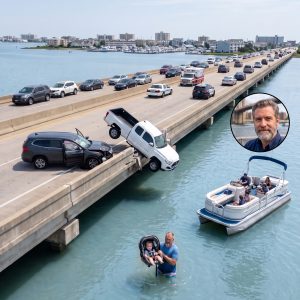
A toddler was thrown off a bridge into the bay during a 5-car crash.
A toddler was thrown off a bridge into the bay during a 5-car crash. A stranger jumped 30 feet after her. It happened May 2, 2021 on…

When My Widowed Father Kept Taking Women to the Same Restaurant, I Thought I Understood Grief. I Didn’t.
My mother died two years ago. My father, Daniel, was sixty-one, and for the first year he barely left the house except for groceries and the occasional…

After four long years of home visits, interviews, and endless waiting, our son finally arrived. Ethan was seven, small for his age, with serious brown eyes.
After four long years of home visits, interviews, and endless waiting, our son finally arrived. Ethan was seven, small for his age, with serious brown eyes. It…