The scheduled vocalist never made it through the snowdrifts that buried Morgantown that Tuesday evening. As the West Virginia University Coliseum filled with die-hard basketball fans who’d abandoned their cars and trekked through blizzard conditions, officials faced an awkward reality: they had no one to sing “The Star-Spangled Banner” before tip-off against top-ranked Kansas.
Then someone remembered Carlton Smith—the campus police officer working security detail that night—could carry a tune.
What happened next became one of those rare sports moments that transcends the game itself. On January 12, 2016, Smith stepped onto the court in full uniform, accepted a water bottle hastily delivered by a cheerleader, and proceeded to deliver an acapella performance that would ultimately rack up over 1.4 million views online and land him on national television.
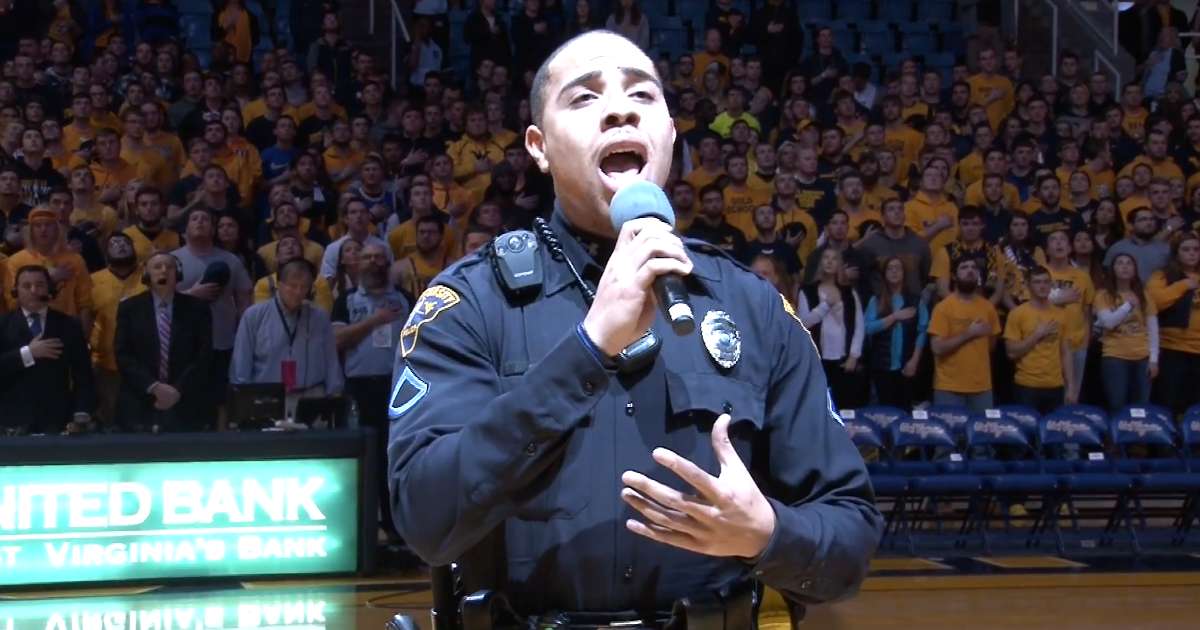
Five Minutes to Showtime
Smith, a 28-year-old WVU graduate who’d joined the campus police force in 2011, was conducting his normal security rounds when organizers approached him with desperation in their voices. The conversation was brief and urgent.
“They came over and asked if I was Carlton and they said, ‘We have a big favor. We don’t have anyone to sing the national anthem. It’s in like five minutes,'” Smith recounted in later interviews. His response was equally direct: “How long do I have?”
The answer wasn’t reassuring. Five minutes barely provided enough time to walk through the concourse and onto the court, let alone warm up vocal cords for one of the most challenging songs in American music. For context, Smith typically gave himself between 60 to 90 minutes of preparation before performances—time to stretch his range, hydrate properly, and mentally prepare for the demanding notes ahead.
“No warming up whatsoever, I wish I did,” Smith admitted afterward, noting that the hastily procured water bottle from a nearby cheerleader constituted his entire pre-performance routine.
A Voice Forged in Church Pews and Competition Stages
Smith’s seemingly spontaneous brilliance wasn’t accidental. Born in Buffalo, New York, and raised singing in church, he’d been developing his vocal abilities since childhood. Music wasn’t just a hobby—it represented a lifelong passion that had taken him down some remarkable paths.
In 2014, during Season 13 of “American Idol,” Smith made the ten-hour drive from West Virginia to Boston for auditions. Facing celebrity judges Jennifer Lopez, Keith Urban, and Harry Connick Jr., he earned that coveted golden ticket to Hollywood. Though he was ultimately eliminated during Hollywood Week—specifically during the group round—the experience validated his talent on a national stage.
His musical journey at WVU included winning Mountaineer Idol in 2005 as a freshman, later serving as a guest judge for the campus competition. He’d also taken first place at WVU’s “Dancing with the Mountaineer Stars” in March 2016, partnering with Marissa Bailey to claim the mirror ball trophy.
Despite these accomplishments, Smith had chosen a stable career path first—following family advice to establish financial security before pursuing music professionally. By day, he worked traffic control and responded to DUI calls. By night, he sang at open mic venues with local bands, keeping his dream alive while serving his community.

The Performance That Stopped a Coliseum
When Smith’s voice cut through the arena that evening, the effect was immediate and electric. Starting quietly with “Oh, say can you see,” he gradually built the anthem’s intensity, navigating its famously difficult vocal range with what observers described as “unadorned conviction” and “sweet soulfulness.”
The crowd, which had been sparse at the game’s start due to the historic snowstorm paralyzing the region, gradually swelled toward capacity. Many fans had literally walked to the venue after abandoning cars on gridlocked, icy roads. They’d come to witness their No. 11-ranked Mountaineers take on the nation’s top team—and they got more than they bargained for.
What they witnessed was an organic moment of excellence under pressure. No stage production. No elaborate sound system support. Just a police officer in uniform, performing acapella before thousands, with virtually no preparation time.
Geoff Coyle, a sportswriter who’d attended WVU with Smith and knew about his vocal talents, had a colleague film the performance. Coyle initially posted it on Facebook for friends and family. Within hours, he recognized it was going viral.
“While I didn’t anticipate it, I completely understand it,” Coyle later reflected. “As West Virginia fans, they have something to be proud of because he’s a graduate. As Americans, I feel that people are very proud to see a member of their law enforcement, with last-minute notice, stepped up to sing the nation’s anthem as well as he did.”
The video exploded across social media platforms, eventually surpassing 1.2 million views. By the following Monday, Smith found himself in New York City, performing the anthem on Fox & Friends—an experience he described as “amazing, kind of surreal in a way.”
The Storm That Created the Moment
The January 2016 blizzard that prevented the original singer from reaching the venue wasn’t a minor weather event. It was part of what would become known as the January 22-24, 2016 snowstorm—a massive weather system that affected approximately 103 million people across the eastern United States, roughly one-third of the entire national population.
Morgantown received approximately 15 inches of snow, while other West Virginia locations saw up to 42 inches. The storm produced treacherous conditions across the state, including a complete shutdown of Interstate 77 after tractor-trailers jackknifed across the highway. The National Guard was deployed to assist stranded motorists.
Yet basketball fans in Morgantown proved remarkably resilient. Despite roads transformed into skating rinks and vehicles abandoned on highways, the coliseum filled with loyal supporters determined to witness history—not just Smith’s impromptu performance, but West Virginia’s eventual 74-63 upset victory over Kansas. It marked the first time the Mountaineers had defeated a No. 1-ranked team in Morgantown since 1983.
Kansas coach Bill Self, when asked if there was something about Morgantown that consistently challenged his team (they’d lost three straight there), responded with characteristic sarcasm: “It’s the buildings and trees and river that caused us to play poorly.”
More Than Just a Viral Moment
Smith’s performance resonated beyond its technical excellence. It captured something fundamental about preparedness meeting opportunity, about hidden talents emerging under pressure, and about the unpredictable nature of memorable moments.
“Any chance I get to do the ‘National Anthem’ is always a big deal to me,” Smith said afterward. His reverence for the anthem itself—not just the performance opportunity—came through in every note.
The story also highlighted an interesting intersection between career and passion. Smith had chosen police work over immediate pursuit of a music career, yet his vocal abilities never disappeared. They simply waited for the right moment to resurface in spectacular fashion.
Following the viral success, Smith and Leslie Dorchester—the original singer who’d been stuck in traffic—eventually performed together. Their duet national anthem was also very well received, demonstrating Smith’s graciousness and collaborative spirit.
The Lingering Impact
Smith’s story illustrates several truths about modern viral fame. First, authentic moments often resonate more powerfully than carefully produced content. There was no auto-tune, no elaborate staging, no multiple takes. Just raw talent and genuine pressure.
Second, social media can amplify worthy performances to audiences that would never have witnessed them otherwise. Without Coyle’s decision to film and share the performance, Smith’s moment of excellence would have remained confined to those physically present in the coliseum.
Third, the convergence of unexpected circumstances—a historic snowstorm, a missing performer, an official who knew about Smith’s background, and Smith’s willingness to step forward on almost no notice—created something memorable from what could have been an embarrassing situation.
“Carlton really is one of the kindest and most talented people I’ve ever met,” Coyle said, reflecting on his friend’s sudden fame.
The performance also offered a humanizing glimpse of law enforcement—a police officer not as authority figure but as community member with extraordinary gifts. In an era of complex police-community relations, Smith’s moment provided a refreshing reminder that officers are multidimensional people with talents, passions, and stories extending far beyond their professional duties.
Where Preparation Meets Providence
Perhaps the most instructive element of Smith’s story involves preparation. His seemingly impromptu brilliance wasn’t actually impromptu at all. Decades of church singing, years of open mic performances, American Idol training, campus competition victories—all of these experiences accumulated into a reservoir of skill that could be accessed when needed.
When officials approached him with five minutes’ notice, Smith didn’t need to build competency from scratch. He already possessed it. The tight timeframe simply demanded he trust his preparation and execute under pressure.
This principle extends beyond singing. Excellence in any field rarely emerges spontaneously. It develops through consistent practice, repeated exposure to pressure situations, and gradual refinement of craft. When opportunity presents itself—often unexpectedly and with inadequate preparation time—those who’ve invested in their abilities can respond.
Smith continued balancing his law enforcement career with musical pursuits following his viral moment. He learned piano after recognizing that many American Idol competitors incorporated instruments into their performances. He performed at various venues and events. He maintained his commitment to serving the WVU community while keeping his musical dream alive.
“Music is an escape and a way for your situation to be different,” Smith once explained. “There’s always a way that music can change your life and have an impact on you.”
On that snowy January evening in Morgantown, his music certainly changed the experience for thousands of fans who’d braved a blizzard for basketball. They received an unexpected bonus—a reminder that remarkable talent often lives in unexpected places, waiting for the right moment to emerge.
And sometimes, that moment comes with only five minutes’ notice and a water bottle hastily delivered by a cheerleader.
Related Posts

Homeowner Spots Terrifying Human-Like Growth Sprouting From Log Furniture
A homeowner looking across their patio received the shock of a lifetime after noticing a dead wooden log seemingly staring back at them. What began as an…

The Boiling Paradox: Why You’ve Been Peeling Half Your Eggs Away
There are few kitchen moments more quietly frustrating than peeling a hard-boiled egg only to watch the shell tear away half the white, leaving you with an…
My Thirteen-Year-Old Hid His Dishwashing Job From Me, but One Call From His Boss Changed Everything
My thirteen-year-old son, Evan, spent nearly six months staring at the exact same bicycle in the downtown sporting-goods window. It was a sleek, matte black mountain bike…
An 8-Year-Old Waited in the Rain to Return My Wallet—Her Words Shook Me
The marble lobby of my commercial headquarters was warm, spotless, and filled with people who spoke in hurried, calculated tones. At sixty-one years old, I had spent…
My Fiancé Vanished Leaving Me With Ten Children, Then Thirty Years Later His Lawyer Arrived
“I’m sorry. I can’t do this anymore.” Those seven cold words, scribbled haphazardly across a scrap of yellow legal pad on our kitchen island, were all Julian…

My Granddaughter Refused to Swim at Our Pool Party, Then Whispered a Secret Behind Closed Doors
The backyard was supposed to be filled with nothing but easy summer joy. The heat hummed through the afternoon air, carrying the rich scent of grilling burgers,…