The house felt different the moment I pulled into the driveway.
I’d just buried Sarah that morning—my wife of thirty-two years, my best friend, the woman who made coffee exactly the way I liked it even when we were fighting. The funeral was small, quiet, everything she would’ve wanted. I was still wearing the black suit that felt too tight around my chest, still carrying the weight of condolence handshakes that meant well but couldn’t reach the hollow place inside me.
Then I saw them.
Fifteen motorcycles parked along my property like some kind of strange barricade. My back door—the one that stuck every winter—was hanging open. Lights were on inside. My neighbor, Carol, was standing in her yard with her phone, eyes wide.
“Robert! I called the police! Someone broke in!”
I didn’t run. I didn’t panic. Honestly? Part of me didn’t care anymore. What else could the universe possibly take from me today?
I walked through that broken doorway expecting the worst.
Instead, I found something I’ll never fully understand.
The Kitchen Was Full of Strangers—Fixing Everything I’d Let Fall Apart
There were bikers in my kitchen. Not the kind you see in movies—these were real people. Worn leather jackets, calloused hands, faces that had seen weather and trouble and probably everything in between.
One guy was under my sink, replacing pipes I’d been promising Sarah I’d fix “next weekend” for the past two years. Another had my ancient toaster oven apart on the counter, carefully reconnecting wires. Someone else was actually mopping the floor—the same floor Sarah used to complain I tracked mud across.
A big man with gray in his beard looked up from rehinging a cabinet door.
“You must be Robert,” he said, like this was perfectly normal. “Sorry about the door. We’ll replace it before we go.”
I just stood there. “Who are you? What is this?”
He wiped his hands on a rag and extended one toward me. “Name’s Pike. I run the Dust Devils MC. Your wife… she used to serve us breakfast at the Rusty Spoon diner.”
“You broke into my house,” I said slowly, “to do repairs?”
Pike smiled—not mockingly, but with something that looked like respect. “She told us you’d never ask for help. Said if she wasn’t around anymore, we should kick the door in if we had to. Her words, not mine.”
Sarah Had Been Planting Seeds I Never Saw
I sat down hard in Sarah’s chair—the squeaky one by the window she refused to let me replace. Around me, the house was transforming. Fresh paint on walls I’d stopped seeing. Fixed outlets that had sparked for months. The bathroom door that had hung crooked since last spring was suddenly straight.
“Why would you do this?” I asked. “You don’t even know me.”
Pike pulled up a chair. “We knew her. And she asked us to take care of you.”
Over the next hour, the stories came out. Sarah had worked at that diner for twenty years. I knew she was kind to customers—that was just who she was. What I didn’t know was the depth of it.
Pike told me about losing custody of his son five years ago, how he’d stopped by the diner at 3 AM, crying into his coffee. Sarah sat with him for an hour. Told him, “Everyone’s got chapters they don’t read out loud, honey. That doesn’t mean the book’s over.”
Another biker, Danny, said Sarah once paid his electric bill when he was between jobs. Wouldn’t take no for an answer. Just did it.
Miguel said she helped his daughter with college applications, stayed after her shift to proofread essays.
My wife had been changing lives while I thought she was just pouring coffee.
They Stayed for Dinner—And Kept Coming Back
That night, those fifteen bikers cooked chili in my kitchen. They used Sarah’s recipe—the one she made every October when the weather turned cold. Somehow they knew about it.
We ate together. Talked. Laughed, even. The house felt full again, warm in a way I’d forgotten was possible. When they finally left, Pike gripped my shoulder.
“We’ll be back Saturday. Got a fence to fix.”
I wanted to say they didn’t have to. But the words wouldn’t come. Because the truth was, I needed them to.
Then I Found Her Letter
Five days after the funeral, I was sorting through Sarah’s things when I found an envelope with my name on it. Her handwriting—the looping letters I’d seen on grocery lists and birthday cards for three decades.
“Rob,
If you’re reading this, I’m gone. And knowing you, you’re probably sitting alone in that house pretending you’re fine.
I asked the boys from the club to check on you. Let them in. Let them help. I know you think you have to handle everything yourself, but you don’t.
Love doesn’t end, sweetheart. It just changes shape.
Let it in.
Always yours,
Sarah”
I sat on our bedroom floor and cried like I hadn’t at the funeral. Because she’d known. Even at the end, fighting through pain and exhaustion, she’d been thinking about me.
What Started as Repairs Became Something Bigger
They kept their word. Every weekend, someone showed up. The fence. The garage. The gutters I’d been ignoring. Tasks Sarah used to remind me about that I’d always said I’d “get to eventually.”
The neighborhood started noticing. Carol brought lemon bars for “the workers.” My buddy Tom lent his pressure washer. People I barely knew stopped by with tools, supplies, questions about whether I needed anything.
One evening, a man I’d never met arrived holding a wooden box.
“I’m Jim. Used to ride with a different club, back when I was drinking heavy. Your wife… she used to give me free pie. Every Monday for six months. Said I looked like someone who could use a win.” His voice cracked. “She saved my life, man. I wanted you to have this.”
Inside was a journal—Sarah’s journal. Recipes. Photos. Letters she’d written to our kids for milestones she knew she’d miss. Instructions for her memorial service. Random memories.
And on the last page:
“If Rob looks lost, remind him he’s not. Tell him to look around. Love is everywhere. He just has to see it.”
The Day They Gave Me Back Part of Myself
A month later, Pike showed up with a motorcycle.
“Sarah said you used to ride. Before kids, before the house, before life got complicated. Thought maybe you’d like to remember what freedom feels like.”
I hadn’t been on a bike in thirty years.
But I got on anyway.
They taught me again—patient, careful, like I was their brother. We rode through back roads I’d driven past a thousand times but never really seen. The wind. The rumble. The feeling of moving forward.
For the first time since Sarah died, I felt something other than sadness.
I felt like myself again.
Sarah’s Table
Eventually, we turned the Rusty Spoon into something new. Raised money, renovated, reopened it with a new name: Sarah’s Table.
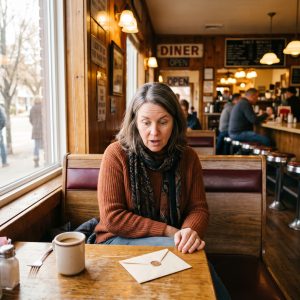
Her old apron hangs framed behind the counter. People still sit in what used to be her booth. The place serves free coffee to anyone who needs it, no questions asked.
It’s become what she always was—a place where broken people find kindness.
What I Learned From Fifteen Motorcycles in My Driveway
The thing nobody tells you about grief is that it splits you open. Makes you vulnerable in ways you’ve never been. You feel raw, exposed, like your skin’s been peeled back.
But that’s also how the light gets in.
Sarah didn’t leave me alone. She left me surrounded—by people whose lives she’d touched, by kindness she’d planted years before, by love that didn’t end when her heart stopped beating.
Those bikers didn’t just fix my house. They fixed me. Reminded me that asking for help isn’t weakness. That community isn’t something you earn—it’s something you allow.
If you’re grieving right now, I hope you hear this: Love doesn’t disappear. It transforms. It shows up in unexpected ways, through unexpected people, exactly when you need it most.
Sometimes it arrives quietly.
And sometimes it roars into your driveway on fifteen motorcycles, kicks in your back door, and refuses to let you face the darkness alone.
Final Reflection:
Grief can make us feel completely isolated, like we’re the only ones who truly understand our pain. But this story reminds us that love planted during a lifetime continues to grow even after someone is gone. The people we touch, the kindness we offer, the connections we make—they all become part of a safety net we might not even know exists until we need it most.
Disclaimer:
This article shares a personal story inspired by real-life experiences. Names and specific details have been adapted to protect privacy while honoring the universal truth of how communities come together in times of loss.